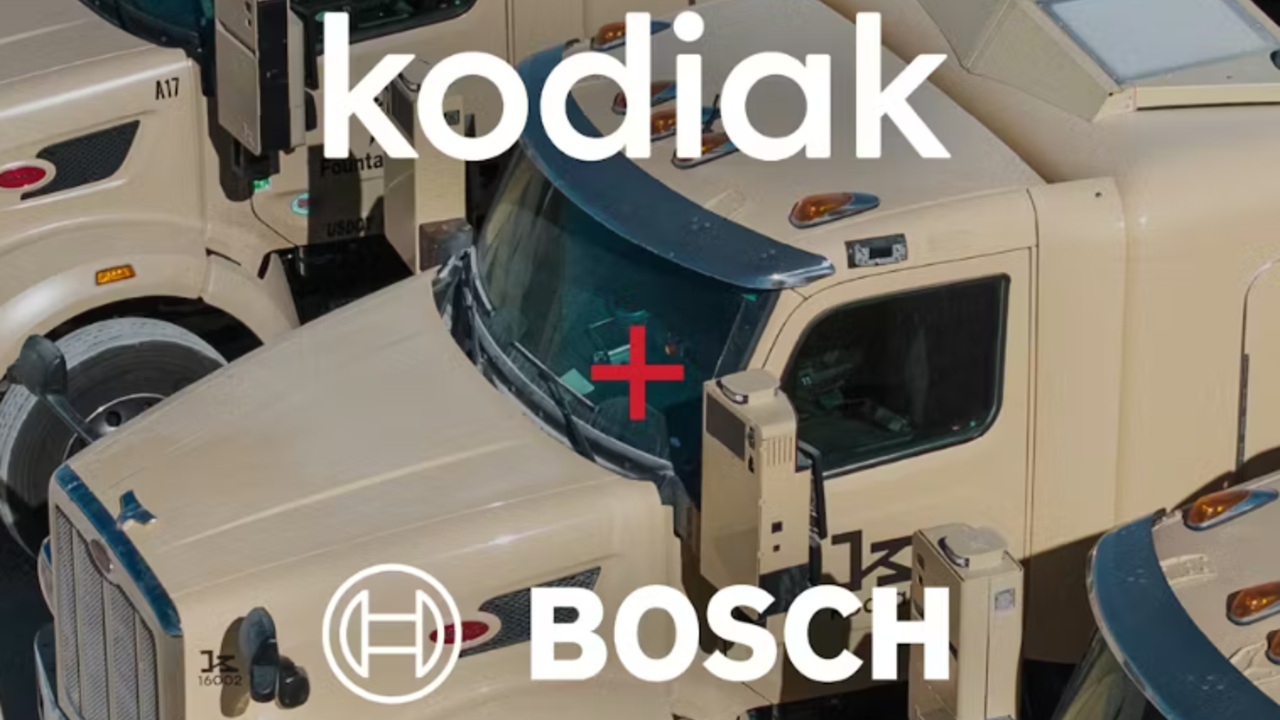
Kodiak AI is turning to one of the world’s most established automotive suppliers to push its self-driving trucks from pilot projects into large scale deployment. By partnering with Bosch, the autonomous freight specialist is betting that industrial strength hardware, sensor integration, and global manufacturing muscle are now just as important as cutting edge software.
I see this deal as a signal that the race in autonomous trucking is shifting from pure research to execution. The focus is moving from proving that self driving works to proving that it can be built, serviced, and supported across thousands of trucks that haul real freight every day.
Kodiak’s pivot from prototype to product
Kodiak AI has spent the past several years developing the Kodiak Driver, its AI powered autonomous solution for long haul trucks, and is now clearly orienting around scale. The company describes the Kodiak Driver as a modular system that can be integrated into standard commercial tractors, rather than a bespoke vehicle platform, which is a crucial distinction for fleets that want to retrofit existing assets instead of buying entirely new trucks. That product mindset is visible on the company’s own materials, which emphasize a safety case built around redundancy, remote monitoring, and a clear path to commercial deployment.
To move from a handful of test vehicles to a network of revenue generating routes, Kodiak AI needs a repeatable way to equip trucks with its hardware stack, from compute units to sensor pods. Earlier activity around manufacturing, including the selection of Roush as a partner to upfit Kodiak Driver equipped trucks, shows that the company has been laying the groundwork for industrialization rather than treating each truck as a one off engineering project. The Bosch agreement builds directly on that foundation, turning what had been a specialized upfitting process into something that can be replicated at automotive scale.
Inside the Bosch partnership
The new strategic agreement with Bosch is designed to scale production of Kodiak’s autonomous truck hardware and sensor suite across commercial fleets. Under the arrangement, Bosch will support the design, industrialization, and manufacturing of key components that sit at the heart of the Kodiak Driver, including the sensor integration that allows the system to perceive the road and surrounding traffic. Reporting on the deal notes that Bosch will help standardize hardware, firmware, and software interfaces so that the autonomous platform can be deployed consistently across different truck models rather than customized for each individual build.
Kodiak AI has framed the collaboration as a way to achieve modularity, serviceability, and reliability that match the expectations of freight operators who already rely on Bosch components in conventional vehicles. Bosch, for its part, is positioning the work with Kodiak as an example of how its expertise in Software and hardware symbiosis can bridge the gap between prototype technology and mass market mobility products. By embedding autonomous specific hardware into Bosch’s existing manufacturing and quality systems, the partners aim to deliver self driving kits that can be produced in volume and supported through established service channels, not just specialized engineering teams.
Why Bosch’s manufacturing and sensor expertise matters
In autonomous trucking, the sensor stack is not just a collection of cameras and lidar units bolted to the cab, it is a tightly integrated system that must withstand vibration, temperature swings, and constant exposure to the elements while feeding clean data to the AI. Bosch brings decades of experience in sensor research and production, from radar modules to inertial measurement units, and that background is central to the Kodiak deal. The agreement calls for Bosch to help refine and industrialize the sensor architecture that sits on Kodiak equipped trucks so that it can be produced reliably at scale and maintained by technicians who are already familiar with Bosch hardware.
That kind of robustness is especially important in freight, where trucks can log more than 100,000 miles per year and downtime directly erodes margins. Bosch has been highlighting its role in shaping the future of mobility, with board member Tanja Rueckert stressing that Our expertise enables the company to connect advanced software with proven automotive grade components. By aligning with that philosophy, Kodiak AI is effectively outsourcing a large portion of the hardware risk to a supplier whose business is built on meeting strict durability and safety standards for global automakers.
Freight first: why long haul is leading autonomy
Autonomous technology developers are increasingly prioritizing freight over passenger transport because the economics and operating patterns are more favorable. Long haul trucking typically runs on predictable highway routes between distribution hubs, which simplifies the problem compared with dense urban driving that involves pedestrians, cyclists, and complex intersections. Reporting on the Kodiak AI and Bosch partnership notes that Many industry players are turning to freight precisely because it offers clearer paths to profitability and a more straightforward regulatory environment than robotaxis in crowded city centers.
Kodiak AI’s focus on highway freight aligns with this broader shift. By concentrating on linehaul corridors where trucks can operate at steady speeds and interact mostly with other large vehicles, the company can design its hardware and sensor layout around a narrower set of scenarios. That in turn makes it easier for Bosch to standardize components and production processes, since the use cases are more consistent than those of a robotaxi that might need to handle everything from school zones to downtown nightlife districts. The freight first strategy is not just a business choice, it is a hardware and manufacturing choice that makes the Bosch collaboration more tractable.
Building an ecosystem around the Kodiak Driver
The Bosch partnership does not exist in isolation, it is part of a broader ecosystem that Kodiak AI is assembling around the Kodiak Driver platform. The earlier decision to work with Roush as a manufacturing partner to upfit trucks showed that Kodiak was willing to lean on established players in mobility, aerospace, and defense to handle complex physical integration. Now, by adding Bosch to handle large scale production of autonomous specific hardware and sensor systems, Kodiak is effectively creating a supply chain that mirrors that of traditional truck manufacturers, but with autonomy at its core.
This ecosystem approach is also reflected in how Kodiak AI presents itself to fleets and shippers. The company’s materials emphasize that it is not trying to become a truck OEM, but rather a provider of an AI powered autonomous solution that can be integrated into existing commercial platforms. That positioning makes partnerships with companies like Bosch and Roush essential, because it allows Kodiak to plug into the existing industrial base instead of recreating it from scratch. For fleets, the promise is that a Kodiak Driver equipped truck will be supported by familiar names, from NASDAQ listed Kodiak AI (ticker KDK) on the software side to Bosch and Roush on the hardware and upfitting side, which could lower perceived risk as they consider large orders.
More from Fast Lane Only: