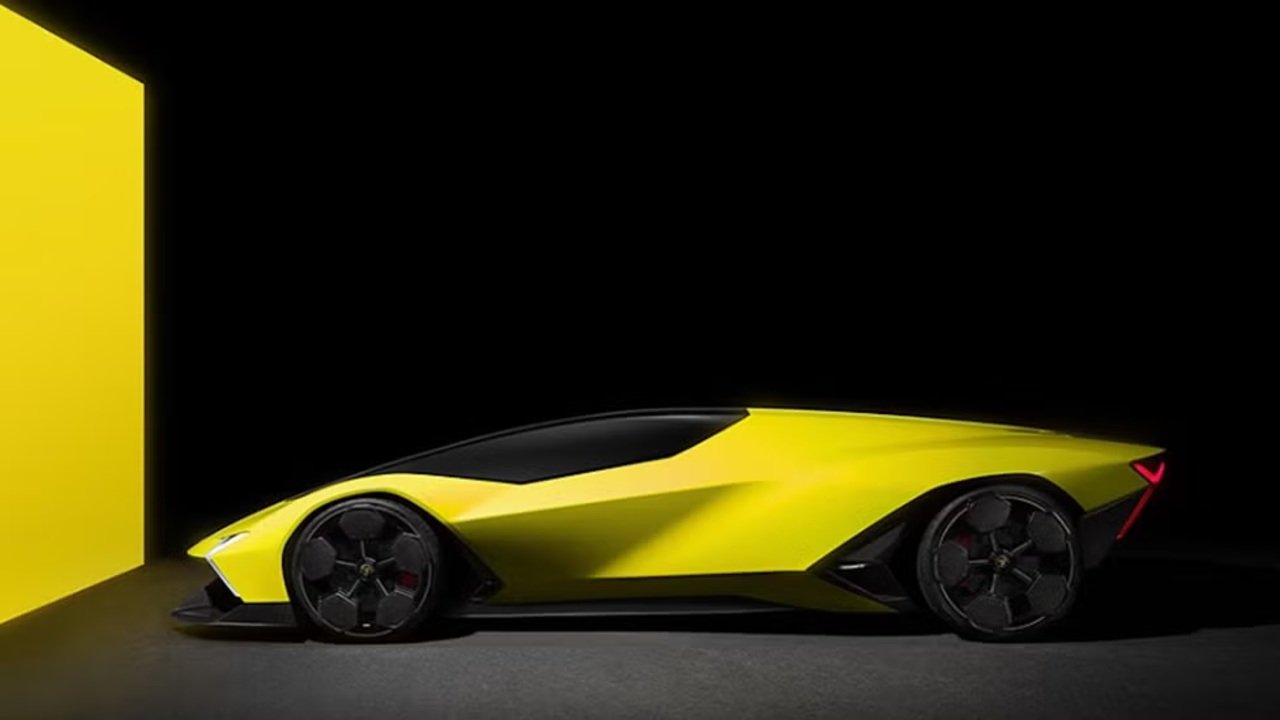
Lamborghini has chosen a strikingly pure shape to signal its next chapter, and the Manifesto concept is the clearest expression yet of that intent. The low, razor-edged show car previews a future design language that strips the brand’s familiar wedge down to its essentials while still hinting at the drama of a V‑12 supercar. It is less a traditional concept car and more a rolling thesis on how Sant’Agata wants its machines to look, feel, and, quite possibly, sound in the years ahead.
A minimalist sculpture with unmistakable Lamborghini DNA
The Manifesto is presented first as an object, a minimalist sculpture that reduces the classic Lamborghini silhouette to a few decisive lines. Designers at Centro Stile describe it as a study in purity of form and proportion, with the body carved into a low wedge that appears to hug the ground so closely it might ride on rails rather than public roads. The panoramic windshield flows into the roof and rear bodywork in a single sweep, while the flanks widen rearward into a planted stance that visually locks the car to the asphalt, a look that recalls the brand’s most iconic wedges even as it pares away ornamentation.
Despite that restraint, the Manifesto is instantly recognizable as a Lamborghini. At the front, the familiar Y‑shaped light signature is integrated into slim headlights, a motif that has defined recent Lamborghinis and is carried here in a more graphic, almost architectural way. The overall profile remains a sharp wedge, with a nose that sits low and clean, and a tail that rises into a broad, tapering volume, reinforcing the impression of a mid‑engined layout and serious performance intent. The cabin appears to seat two occupants, consistent with the car’s compact, driver‑focused proportions, and the entire composition reads as a distilled statement of what the brand considers non‑negotiable in its visual identity.
Centro Stile’s design philosophy, distilled into one car
The Manifesto is also a showcase for the philosophy that guides Centro Stile Lamborghini. The design team describes its approach with three key ideas: curiosity, recognisability, and surprise. Curiosity pushes the studio to question established solutions and explore new forms, recognisability ensures that even radical experiments still look like a Lamborghini at a glance, and surprise keeps each project from feeling predictable. The Manifesto is framed as the clearest expression of this mindset, a car that is not about a single production model but about a way of thinking that will inform multiple future projects.
Mitja Borkert, who leads the design group, emphasizes that the goal is not to chase short‑lived trends but to shape a long‑term visual language that can evolve with new technologies. In that context, the Manifesto’s clean surfaces and bold graphics are less a styling exercise and more a structural framework for integrating aerodynamics, lighting, and cooling in a coherent way. The concept is intended to preview how shape and airflow will be treated as a unified whole, with every crease and opening serving both aesthetic and functional roles, and how that approach will help Lamborghini uphold its reputation for audacity even as regulations and powertrains change.
Wild surfaces, functional aero, and a cabin for two
Look closely at the Manifesto’s bodywork and the interplay between sculpture and function becomes clearer. The nose is kept visually simple, yet the openings and channels around it suggest careful management of airflow over and under the car. As the surfaces sweep rearward, they widen into a wedge that appears to sit low enough to skim the ground, reinforcing the impression of speed even at a standstill. The panoramic glass canopy not only dramatizes the profile but also hints at a cockpit that immerses driver and passenger in their surroundings, a theme that has become more prominent in high‑end supercars.
The rear treatment is even more theatrical. The body flares outward, then appears to taper around a central spine, creating a sense of tension between mass and lightness. This layout leaves visual room for a substantial power unit behind the occupants, and the sculpted forms around the back suggest integrated aerodynamic elements rather than add‑on wings. The two‑seat configuration, visible through the glass, underlines the car’s focus on an intimate, driver‑centric experience, while the extreme stance and low roofline make clear that practicality has been sacrificed in favor of drama and performance signaling.
V‑12 hints and the shadow of the Fenomeno
While Lamborghini has not detailed the Manifesto’s mechanical package, the design is laced with cues that point toward a V‑12 heart. The long rear deck, the mid‑engined proportions, and the muscular haunches all echo the brand’s traditional twelve‑cylinder flagships. Reporting on the concept notes that certain elements around the rear and engine cover subtly hint at a V‑12 engine, suggesting that the car is meant to keep that configuration in the conversation even as electrification reshapes the lineup. The Manifesto is therefore less a technical prototype and more a visual promise that the visceral character associated with a V‑12 will not be abandoned lightly.
That promise is reinforced by the company’s current range‑topping hybrid, The Fenomeno. Official information on the limited‑series model highlights a Powertrain & Performance package built around a 6.5-liter V12 aspirated engine paired with three electric motors, a layout that delivers a combined output of 1,080 CV and positions the car as the most powerful Lamborghini ever. Additional reporting describes the Lamborghini Fenomeno as The Ultimate V12 ‘Design Manifesto’ for the Ages, explicitly linking its powertrain and styling to the idea of a manifesto in physical form. In that light, the Manifesto concept can be read as the next step in this narrative, a design‑first exploration that keeps the V‑12 aura alive while acknowledging that hybrid systems and advanced aerodynamics will define how that power is delivered.
From design manifesto to future showroom reality
The Manifesto is not expected to reach production in its current form, yet its influence is likely to be felt across upcoming Lamborghinis. The concept is described as the clearest expression of the brand’s new vision, unveiled during celebrations in Sant’Agata Bolognese to mark a milestone for the design center. That context matters, because it positions the car as a reference point for future styling decisions rather than a one‑off showpiece. Elements such as the sharpened Y‑shaped lighting, the cleaner wedge profile, and the integration of aerodynamic structures into the bodywork are all candidates to migrate into next‑generation supercars and limited‑series models.
At the same time, the Manifesto underscores how Lamborghini intends to balance heritage with innovation. The company stresses that the exercise goes beyond surface aesthetics, previewing how shape, airflow, and emotional appeal will be woven together to uphold its legacy of boldness even as hybrids and, eventually, other advanced powertrains become the norm. The recent emphasis on V‑12 hybrids like the Fenomeno, combined with the Manifesto’s sculptural minimalism and clear nods to a mid‑mounted twelve‑cylinder, suggests that the brand sees no contradiction between electrified performance and traditional drama. Instead, it is using concepts like this to chart a path where wild styling, cutting‑edge engineering, and the possibility of V‑12 fury remain tightly intertwined.
More from Fast Lane Only