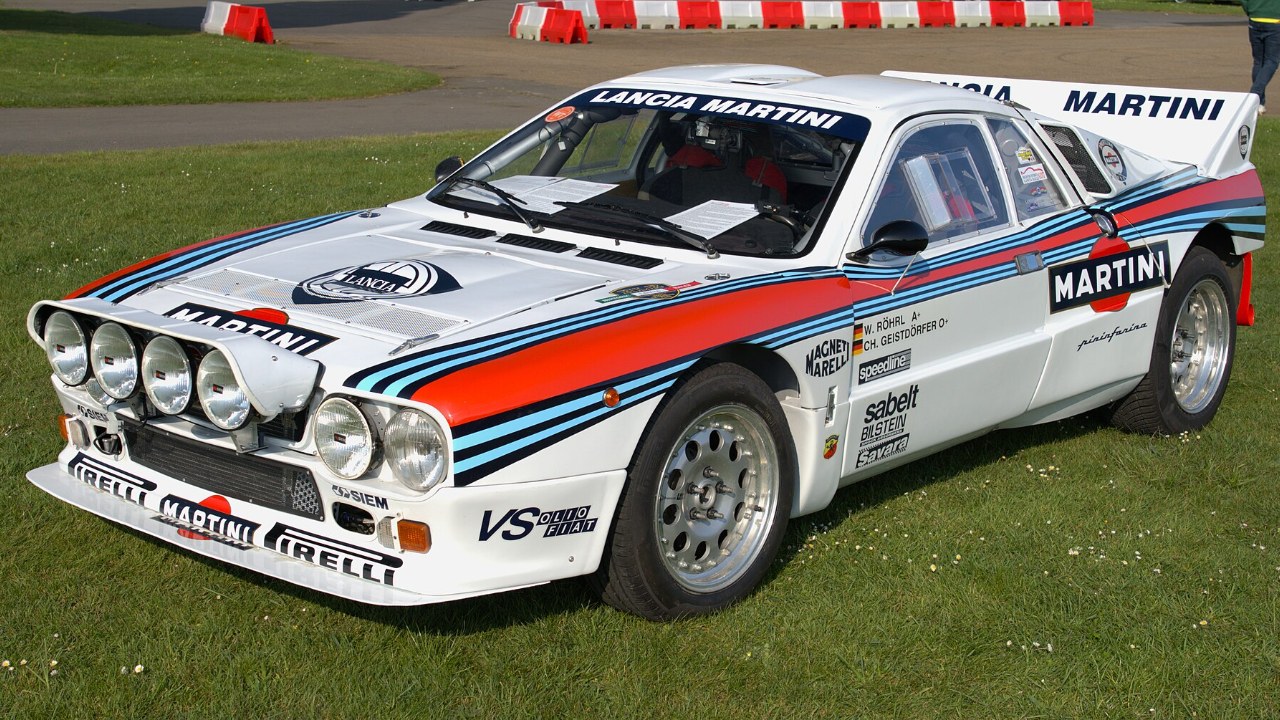
In 1983, the Lancia 037 won the World Rally Championship for manufacturers by two points over Audi. It did it with a supercharged four-cylinder engine and only the rear wheels driven. Audi’s Quattro, by contrast, sent power to all four.
That small margin carries a big footnote. No two-wheel-drive car has taken the makes’ crown since. Every manufacturers’ title after 1983 went to a car driving all four wheels.
So the Lancia 037 sits at a turning point in rallying. It was the last champion of an old idea, built by a team that knew exactly what it was up against.
How Lancia built the 037
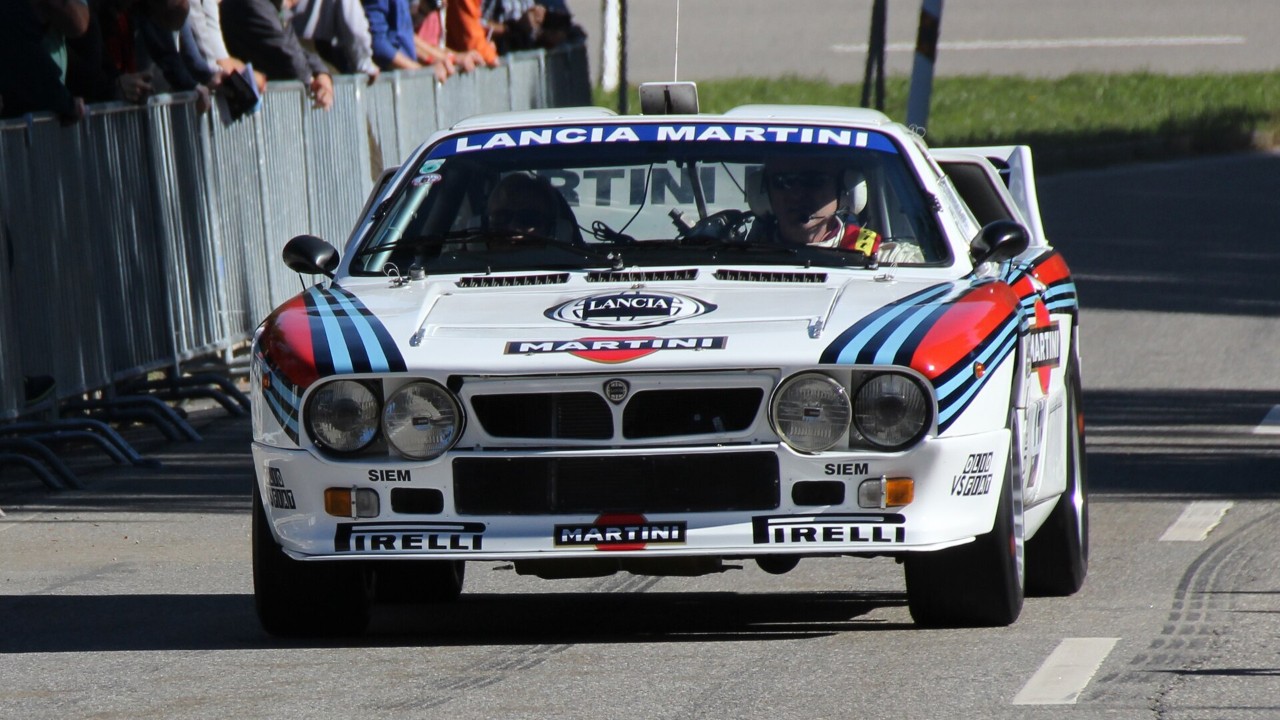
The project began in 1980, Hagerty writes in its profile of the car. Pininfarina, Dallara and Abarth engineer Sergio Limone all worked on it. Their brief was a new car built for rallying’s Group B rules.
To save time, the team started from the Lancia Beta Montecarlo, a compact mid-engined coupe. According to Lancia’s heritage history, two tubular steel subframes were added to the Montecarlo’s center section. The engine sat in the middle, with a ZF gearbox and drive to the rear wheels.
At its heart, the engine came from Fiat’s twin-cam four, a design by Aurelio Lampredi. Abarth then added a Roots-type supercharger it called the Volumex. Hagerty says the team chose it to avoid the lag of a turbocharger.
Over three evolutions, displacement grew from 1,995 cc to 2,111 cc. Lancia’s heritage records put output at 260 to 305 hp across the racing cars. Meanwhile, Pininfarina shaped a body that, in the company’s words, generated “an effective down force” at speed.
Two hundred road cars for homologation
Group B rules required a production run before a car could compete. Lancia’s heritage history says the company built 200 units between 1982 and 1983 to meet that rule. The road version first appeared at the 1982 Turin Motor Show.
However, that street car was milder than the rally car. It made 205 hp and used a dual-barrel carburetor, yet it kept the volumetric supercharger. As a result, buyers got a road car with the same supercharger idea as the works rally cars.
Monte Carlo and the tire-change trick
The 1983 season opened in the snow and ice of Monte Carlo. On paper, it suited Audi’s four-wheel drive. Even team boss Cesare Fiorio admitted as much. “Normally it was a rally that we should have lost as there was snow,” he recalled in Autosport.
Instead, Lancia found a loophole. Autosport’s history of the rally describes in-stage pit stops to fit studded snow tires for the icy sections. Each stop took about 45 seconds and gained roughly two minutes. No rule banned changing all four wheels during a live stage at the time, though the FIA outlawed it in 1986.
Walter Röhrl won the rally, with Markku Alén second in another 037. Altogether, Lancia won 20 of the 31 stages. Röhrl did not enjoy every minute of the plan, however. “I was first and it was horrible just sitting there in the middle of the stage for a minute,” he recalled.
How the 037 beat Audi by two points
Monte Carlo was only the start. Alén then led a Lancia one-two in Corsica, and Röhrl won the Acropolis in Greece. There, Motor Sport notes, Hannu Mikkola’s Quattro retired after a broken boot pin damaged its oil lines.
After that, Röhrl added New Zealand. Finally, a one-two-three at Sanremo clinched the title with two rounds to spare, according to Autosport. Lancia’s heritage history adds that Röhrl finished second in the drivers’ standings.
Engineering chief Giorgio Pianta explained the car’s edge to Motor Sport. Its output was “just over 300,” he said, but torque was the real weapon. “We could be going from nothing to 165kph in just 350 metres,” Pianta said.
Still, the 037 was always a little short on traction. Writing in Motor Sport, David Evans called it “two driven wheels short of the full package” against the Quattro. Yet it was fast enough to land Lancia what he called an “unlikely” manufacturers’ championship.
The last two-wheel-drive champion
Autosport describes the 037 as “the last two-wheel-drive car to win the manufacturers’ crown.” Lancia itself drew the lesson. Its heritage history says the company held off on four-wheel drive until better technology was ready, and that technology later went into the Delta S4.
The switch paid off in a big way. Hagerty notes that by 1991, Lancia’s four-wheel-drive Delta had scored 46 victories and six consecutive WRC championships. In other words, the company that beat Audi with rear drive went on to dominate with all-wheel drive.
The Lancia 037 remains the answer to a rally trivia question that has not changed in more than four decades. Lancia built 200 road cars to homologate it, and in 1983 it beat Audi to the makes’ title by two points.
More from Fast Lane Only