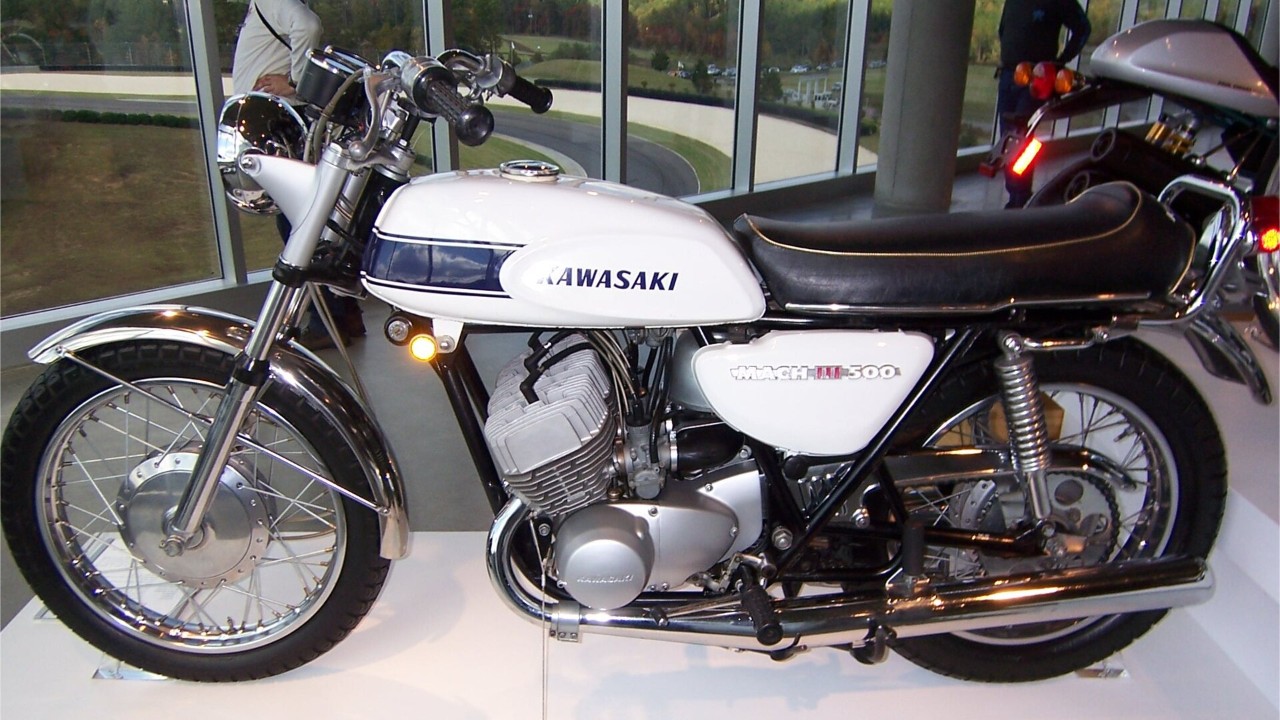
Cycle World tested Kawasaki’s 500 Mach III in 1969 and ran the quarter mile in 13.20 seconds at 119.14 mph. That is a startling number for a three-cylinder two-stroke of about 500 cc, and it explains why the Mach III still pulls a crowd. Two-strokes were loud, smoky and light, and they made big power for their size.
Emissions rules pushed most of them off the road decades ago. As a result, a clean two-stroke at a show now feels like a visitor from another era. The smell of oil smoke and the ring-a-ding exhaust note turn heads in a way a modern bike rarely does.
These are our picks for 11 two-stroke motorcycles that continue to impress at every car show. The verdict is our opinion. However, the engines, figures and dates behind each bike come from maker records, motorcycle magazines and reference sources.
1. Kawasaki 500 Mach III H1A
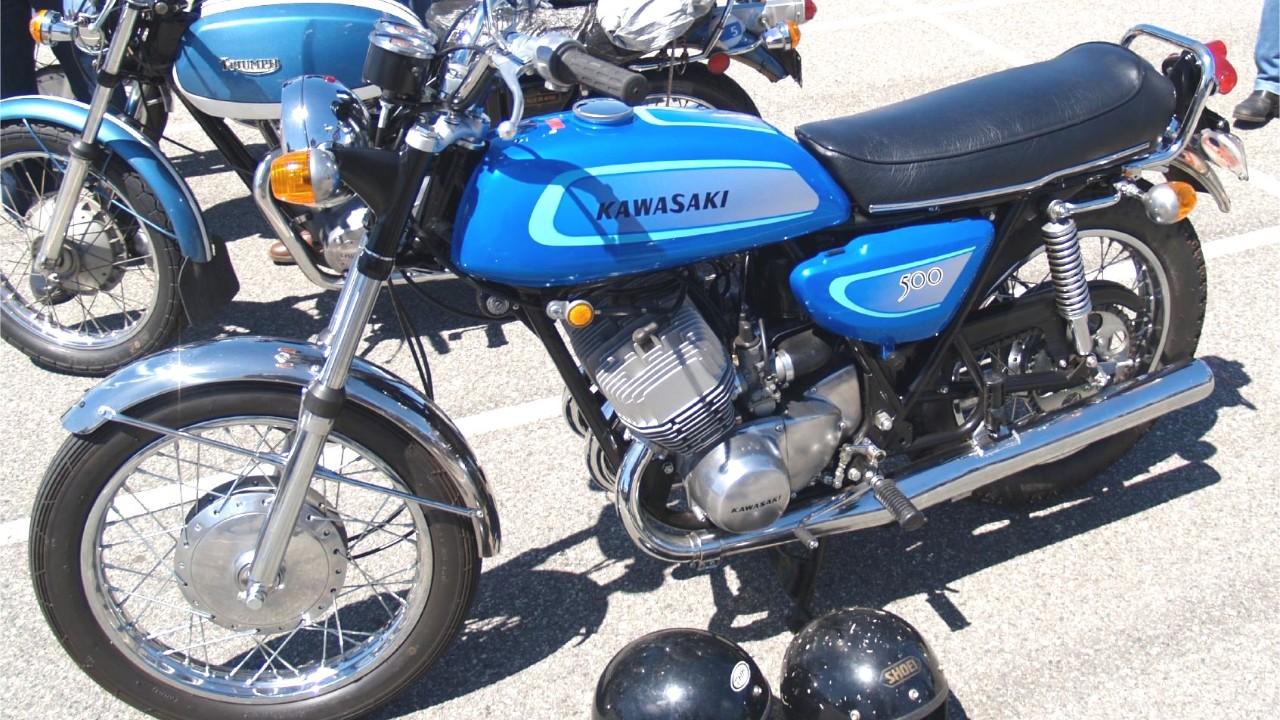
Kawasaki set its engineers a simple goal for the Mach III. It wanted a 500 cc motorcycle that could make 60 hp. The result was a three-cylinder two-stroke of 499 cc, sold in the US from 1969. Its capacitor discharge ignition fired at 25,000 to 30,000 volts, which was unusual on a street bike then.
The Mach III earned its fame on the drag strip. Cycle World’s 1969 test of the first bike delivered that 13.20-second quarter mile. Other testers recorded slightly slower runs. For example, Reads of London timed 13.5 seconds at 109 mph, which is still very quick for the late 1960s.
The H1A followed for the 1971 model year. Its most visible change was a new fuel tank without knee recesses. The original Mach III look, with a white tank and a blue stripe along its lower edge, set the style for the whole line. Our take: the H1A is the purest early form of Kawasaki’s wild triple. At a show, its three exhausts tell people what it is before they read the badge.
2. 1971 Suzuki GT750
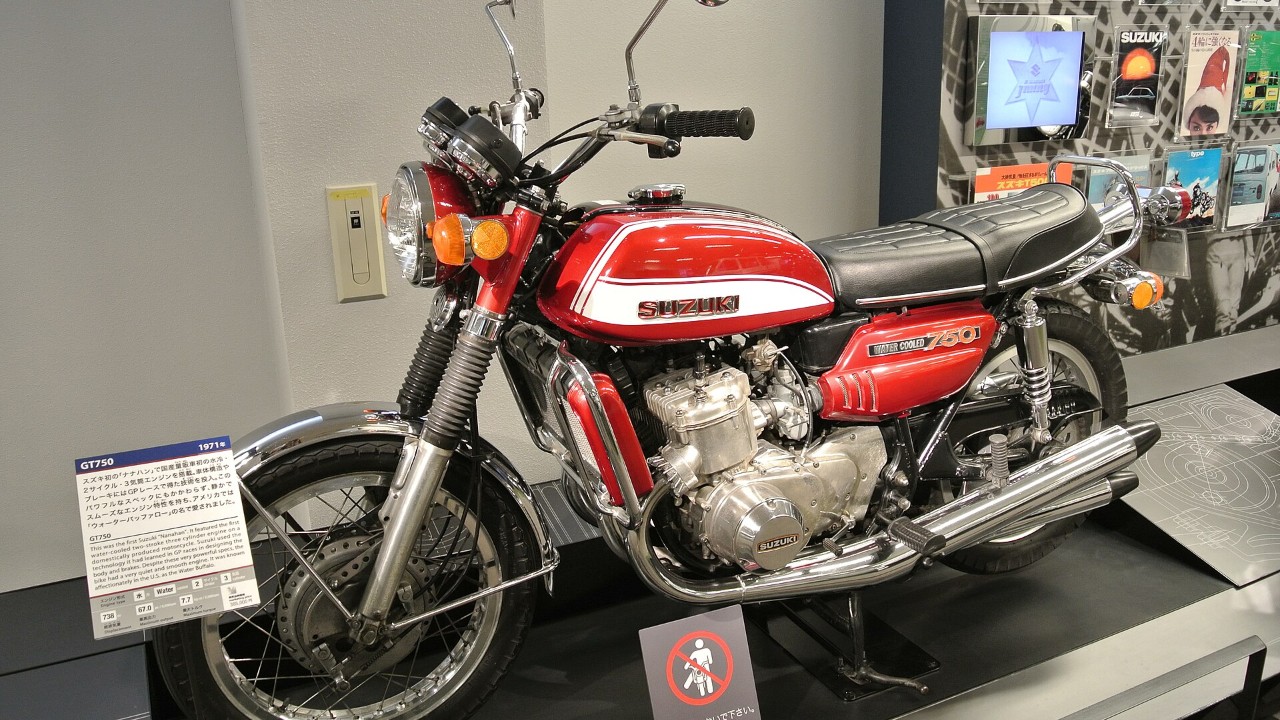
Suzuki showed a prototype of the GT750 at the 17th Tokyo Motor Show in October 1970. Sales began in Japan in September 1971. The bike was a 739 cc three-cylinder two-stroke rated at 67 bhp at 6,500 rpm. More important, it was the first Japanese motorcycle with a liquid-cooled engine.
That radiator gave the bike its nicknames. British riders called it the “Kettle,” while Americans called it the “Water Buffalo.” Neither name was meant as an insult. Instead, both pointed at the radiator, which no Japanese bike had carried before.
Early bikes stopped with drums. The 1972 GT750J used a 200 mm two-leading-shoe drum up front. Then, in 1973, the GT750K swapped it for twin 295 mm discs. Our take: an early drum-braked GT750 is the more interesting version to see at a show. It shows where Suzuki started before it fixed the brakes. Fans of the triple love the big radiator shroud, because nothing else from the period looks like it.
3. 1976 Suzuki GT550
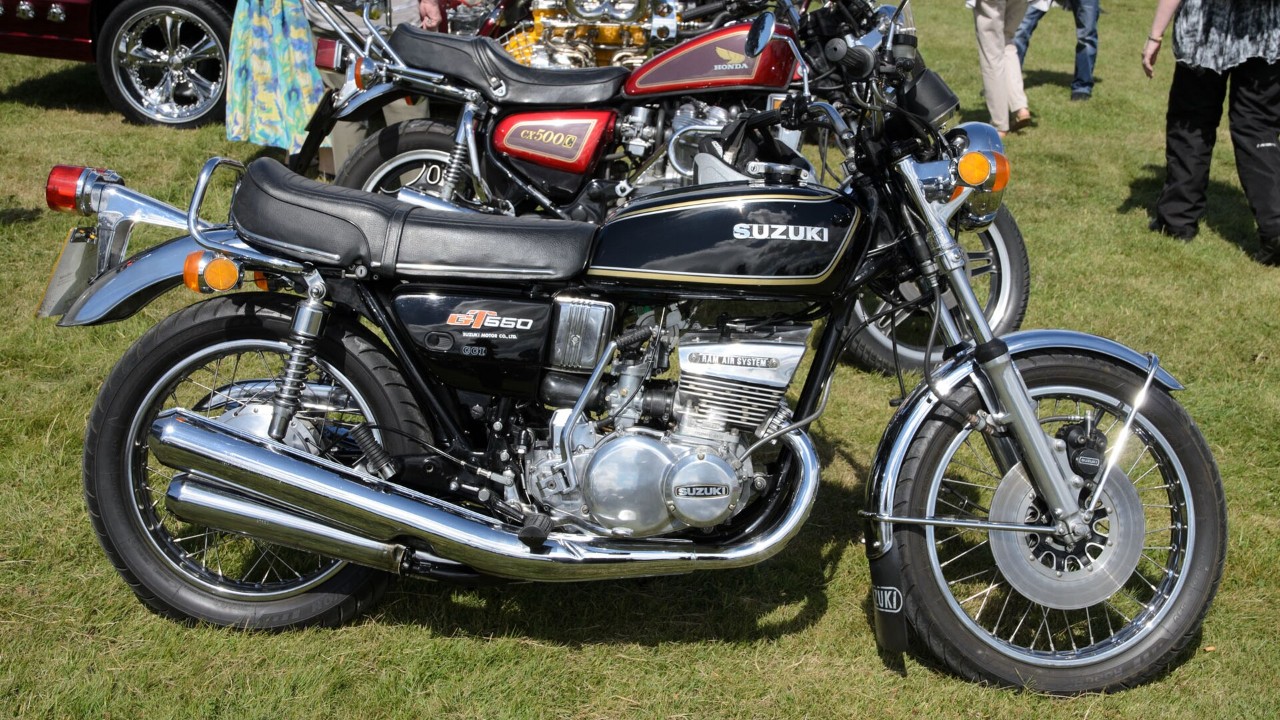
The GT550 sat in the middle of Suzuki’s two-stroke triple family. It used a 543 cc engine with Suzuki’s “Ram Air” system. A two-piece aluminum shroud ducted air over the head fins, so the cylinder head ran cooler without a radiator. North American dealers sold it as the “Indy.”
Output was a claimed 50 bhp. In 1975, Suzuki retuned the engine to 53 hp, although North American bikes kept the 50 hp tune. The 1976 model brought a long list of small changes. For example, it got new tank graphics that swept up at the front, LED gear indicator segments and brown gauge faces instead of blue.
Suzuki sold more than 9,000 GT550s for 1976, then built its last for the 1977 model year. In contrast, the busiest years topped 14,000. Our take: the 1976 bike is a good one to show because its details mark the end of an era. It even borrowed rear lights and side panels from Suzuki’s four-stroke GS models that year, a hint of what came next.
4. Suzuki GT250
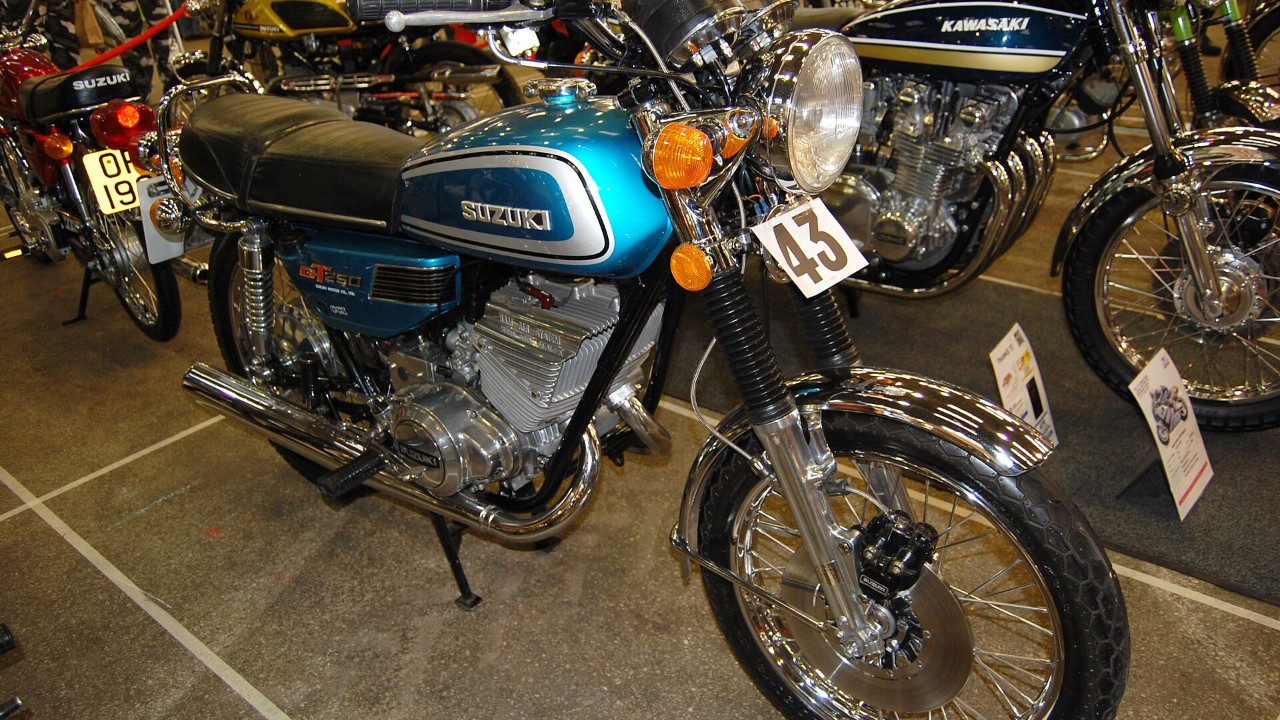
The GT250 was a small bike with a big following. It debuted in Japan in 1971 and reached export markets in 1973. In the US, riders knew it as the Hustler. Its 247 cc air-cooled twin made a claimed 31 bhp at first, then 32 bhp at 7,500 rpm after a 1976 revision.
For a while, it was the bike to have in its class. At the time, it became the top-selling 250 cc bike among learner riders. Suzuki also fitted a Ram Air cooling duct to the cylinder head for several years, then removed it in 1976. Even now, people debate whether it made much difference.
The line later led to the 1978 X7, which could reach 100 mph in favorable conditions. That redesign then formed the basis of the RG250 Gamma. Our take: the GT250 belongs at a show because so many riders learned on one. Show a clean example, and someone will always walk over to tell you about theirs. That kind of connection matters more than rarity.
5. 1972 Kawasaki KH350 S2 Mach II
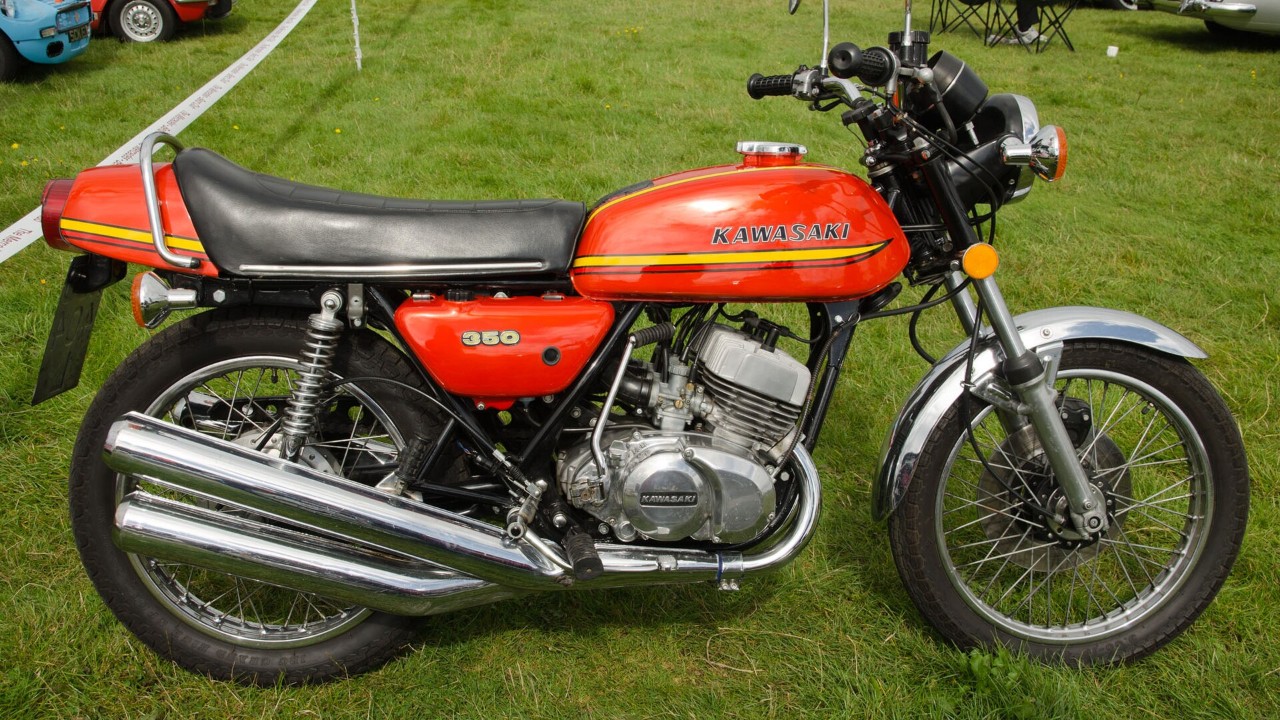
The S2 had the shortest run of all of Kawasaki’s triples. According to Rider magazine’s retrospective, it lasted only two years, 1972 and 1973. Kawasaki claimed about 45 hp at 8,000 rpm from its 350 cc piston-port triple. The bike weighed 330 pounds dry, more than 50 pounds less than the 500.
It was quick and cheap. In the US, the S2 cost just under $900, compared with about $1,200 for the 500. However, Kawasaki’s claimed 112 mph top speed was optimistic, because no magazine tester reached 100 mph. Hard riding could also empty its 3.7-gallon tank in under 100 miles.
The S2 used battery-and-coil ignition instead of the 500’s CDI. A front disc arrived late in 1972. Then, in 1974, Kawasaki enlarged the engine to 400 cc and detuned it to 42 hp. Our take: the S2 is the sharpest of the small triples. Because its run was so short, a tidy one is a rarer sight at a show than a Mach III.
6. Kawasaki KH400
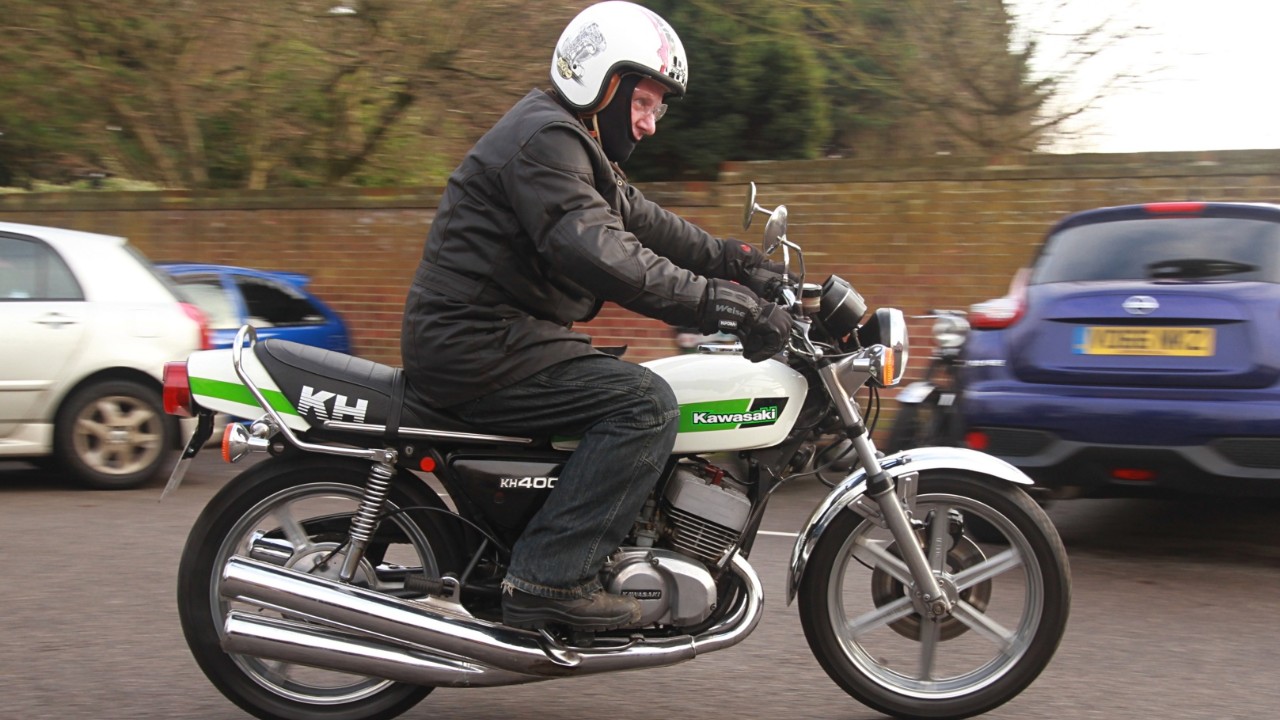
The KH400 arrived in 1976 to replace the S3, and it stayed in the range until 1981. Its 400 cc, piston-ported triple made 38 bhp at 7,000 rpm. That was 4 bhp less than the S3, because new intake baffles and quieter silencers cut noise and power.
Writing for Hagerty UK in 2026, Roland Brown noted that Cycle World recorded 98 mph and Bike magazine 100.33 mph. Electronic ignition replaced points, while the front disc was uprated to match the one on Kawasaki’s Z1. The asymmetrical exhaust, with two pipes on the right and one on the left, carried over.
The KH400 was thirsty. Bike averaged 31 mpg, while its tank held just over three gallons, so the range was under 70 miles. Even so, rubber engine mounts made it smooth. Our take: the KH400 is the friendliest triple to own and ride to a show. Its softer tune is the reason it works as a weekend bike.
7. 1966 Bultaco Metralla MK2 250
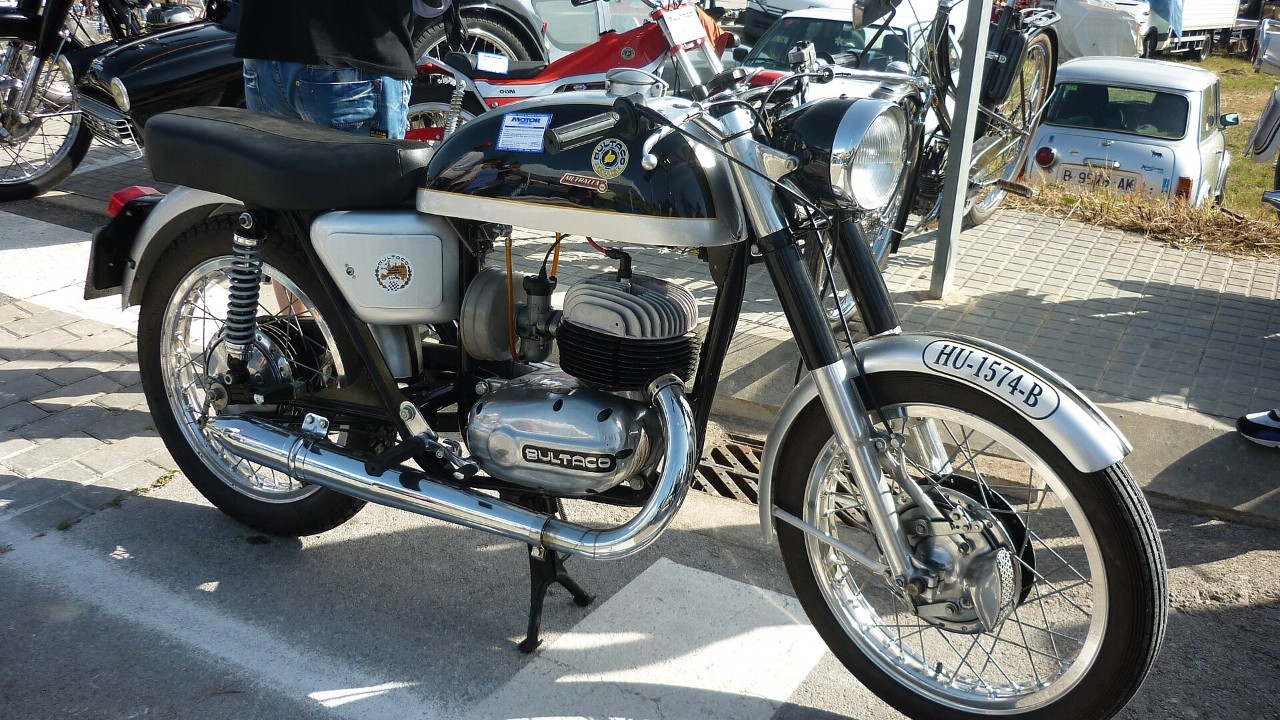
Bultaco was formed in Spain in 1958. Its name joins the first letters of founder Francisco Xavier Bultó’s surname with the end of his nickname, “Paco.” The Metralla Mk2 of 1966 was its road-going sports bike. In its spec table, Old Bike Australasia lists a 244.29 cc single and 27.5 hp at 7,500 rpm.
The magazine rates the Mk2 as good for a genuine 100 mph, and the bike proved it on the race track. In 1967, a three-bike factory team won the Isle of Man Production 250 TT. Bill Smith took the win at an average of 88.63 mph, while Tommy Robb finished second. A five-speed gearbox helped keep the small single on the boil.
That result gave a small Spanish maker a win on the Isle of Man course. Our take: a Metralla is the bike at a show that most visitors cannot place. Once they hear about the TT win, though, they stop and look harder. That is exactly the reaction a good show bike should get.
8. 1995 Aprilia RS250 Reggiani replica
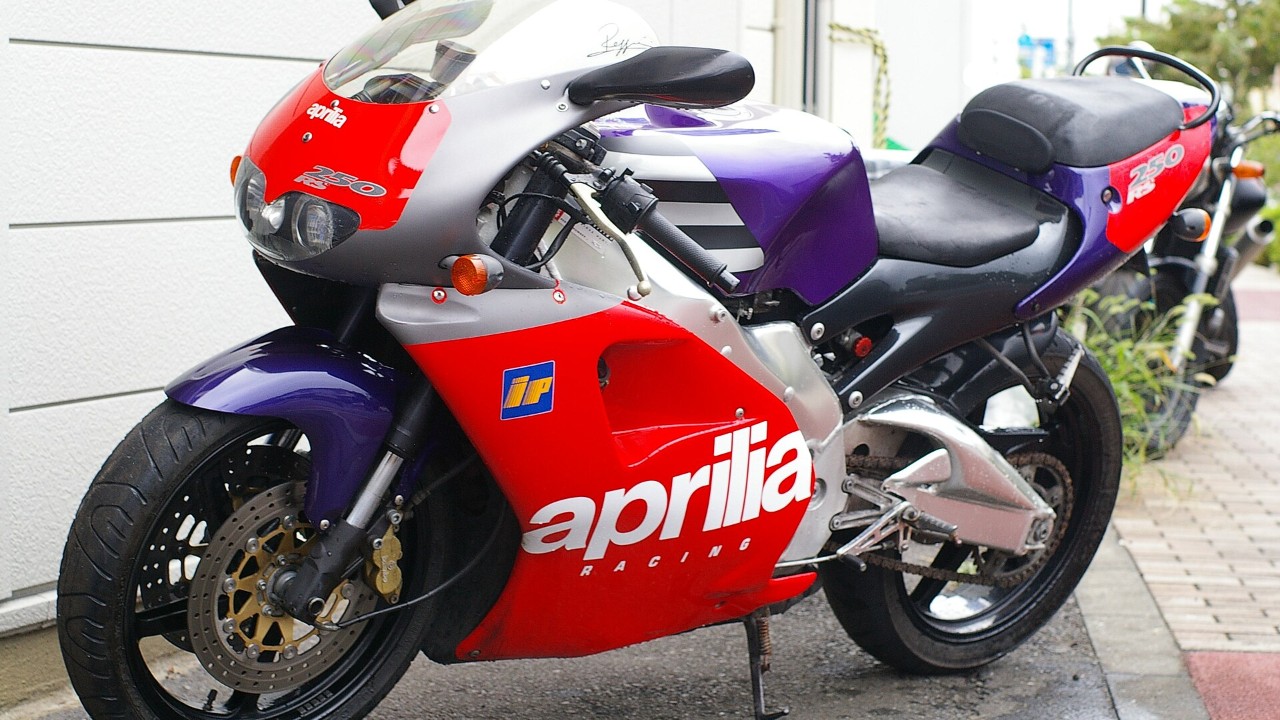
The Aprilia RS250 paired an Italian chassis with a Japanese engine. It used a modified Suzuki RGV250 V-twin of 249 cc. Aprilia then added its own electronics, exhausts, airbox and barrels. Production ran from 1995 to 2002.
The 1995 Reggiani replica honored Loris Reggiani, the first racer to win a Grand Prix for Aprilia. According to a Bike-urious feature on one of these bikes, Aprilia made just 500 of them. That example quotes about 55 hp, along with Brembo brakes, Showa forks and a Sachs shock. The swingarm is the curved “banana” type.
It is also the newest bike on this list. Our take: a Reggiani replica in its race colors is a 1990s Grand Prix bike you could register for the road. With only 500 built, it also draws real attention from people who know the period.
9. Yamaha RD400
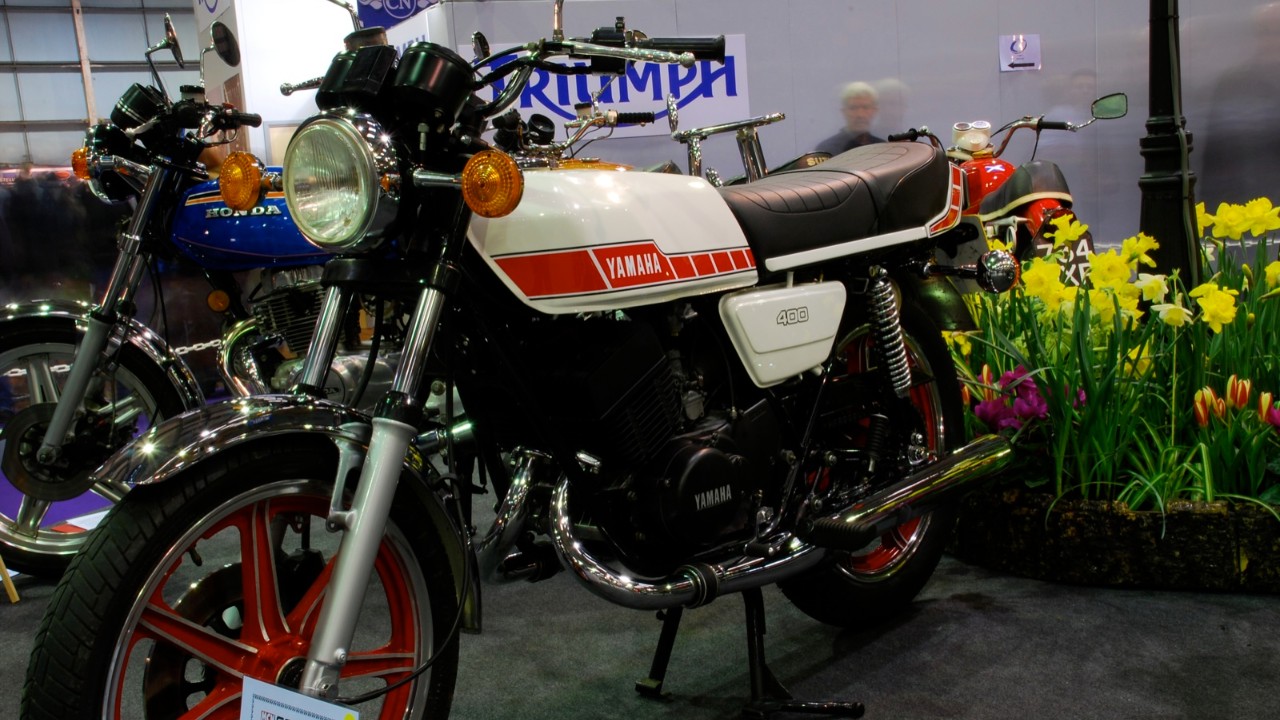
The RD400 was Yamaha’s two-stroke road bike for the late 1970s. Its 399 cc air-cooled twin made 44 bhp at 7,000 rpm. Production dates vary by source, but the main run sits between 1976 and 1979.
One version made history. The RD400C was the first motorcycle from a major maker fitted with cast wheels. Disc brakes were optional on the C, and choosing cast wheels also brought a rear disc. Later, Yamaha offered an RD400 Daytona, sold in the US as the “F.”
New emissions rules ended the RD series in the US in the early 1980s, although it carried on elsewhere into the late 1980s. In our view, the RD400 is the sensible two-stroke of its day. Bike magazine figures quoted by Hagerty put it at 45 mpg, against 31 mpg for the KH400. Our take: a clean, unmodified example is the one to show, because it lets people see the bike Yamaha actually sold.
10. 1959 Yamaha YDS-1
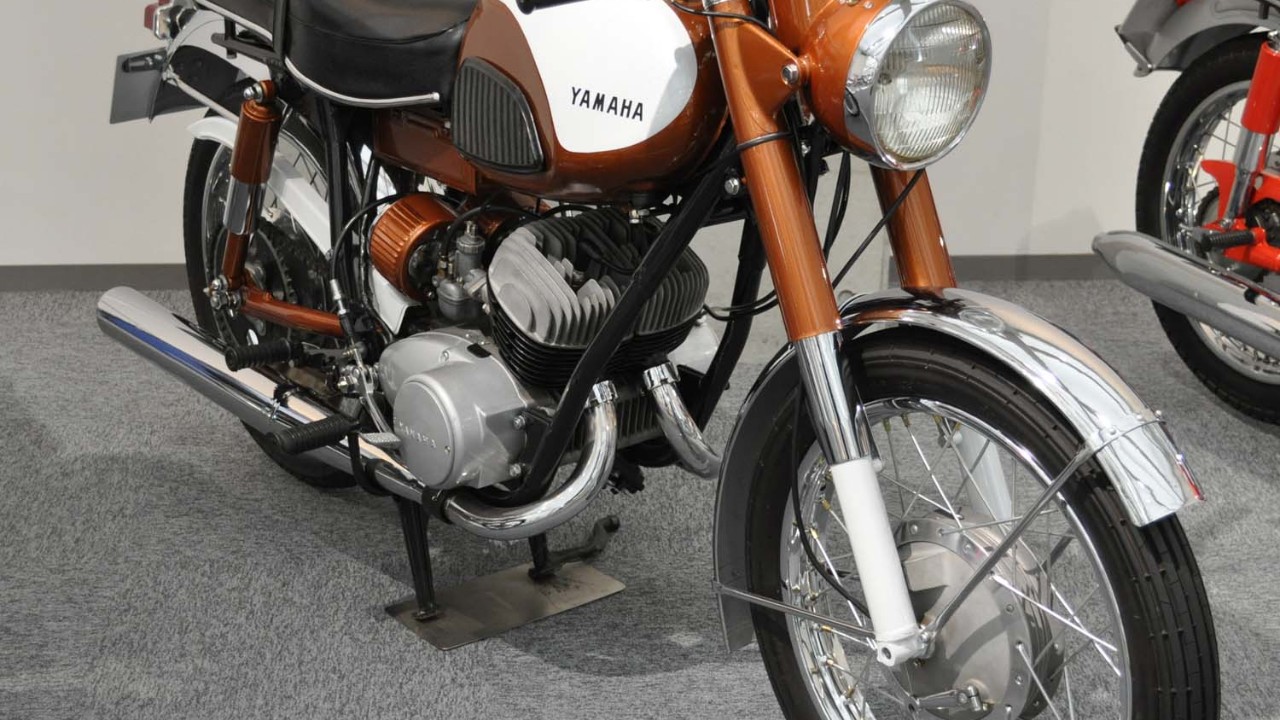
The YDS-1 was the bike that put Yamaha on the sporting map. According to Yamaha’s own heritage collection, it used a 246 cc air-cooled two-stroke twin rated at 20 PS at 7,500 rpm. It also had the first Japanese-made five-speed transmission.
The bike grew out of racing. Yamaha developed it from the YD-1 and the YD Racer, which competed in the second Asama Highlands Race. Buyers could also fit a range of race kit parts. As a result, the YDS-1 became a leading performer in on- and off-road competition.
It came with a steel tube cradle frame and a tachometer in a combination instrument panel. It weighed 138 kg and sold for ¥185,000 in Japan. Our take: the YDS-1 is the grandfather of every sporty Yamaha two-stroke twin, including the RD400 above. Putting the two side by side at a show tells a 20-year story in one glance.
11. 1988 Honda NSR250R
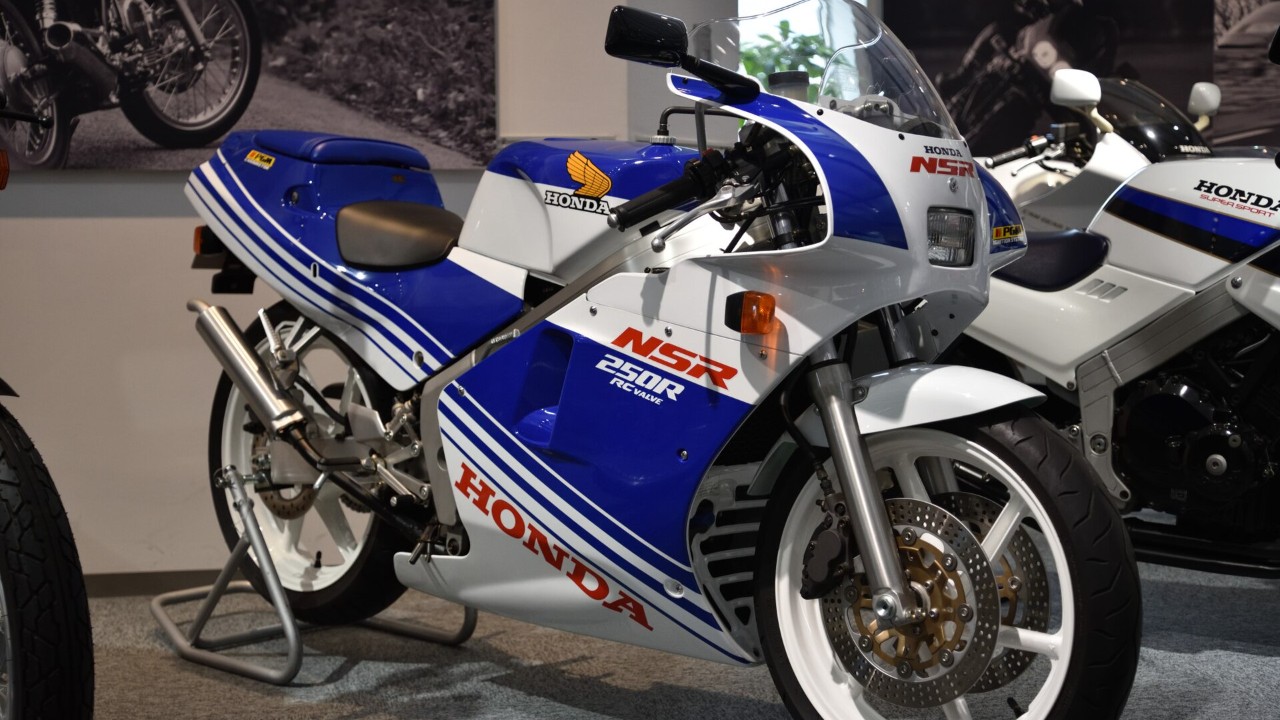
Honda’s NSR250R was a race replica in every sense. It used a 249 cc, 90-degree V-twin two-stroke with liquid cooling and reed-valve induction. The bore and stroke measured 54 mm by 54.5 mm. Unrestricted, the engine is listed at 57 hp.
The 1988 model year brought the MC18 generation in two forms. One was the standard NSR250R, while the other was the SP in Rothmans colors. The bike also used Honda’s PGM ignition system. The NSR line ran from 1987 to 1999.
Our take: the NSR250R is the bike that makes younger visitors stop at a classic show. It looks like a Grand Prix machine, yet it wears a number plate. For more Japanese and European classics with a following, see 11 vintage motorcycles collectors are quietly hoarding, or go further back with 11 American motorcycles that continue to impress at every car show. A 1988 MC18 comes from the second year of a line that Honda kept building until 1999.
More from Fast Lane Only