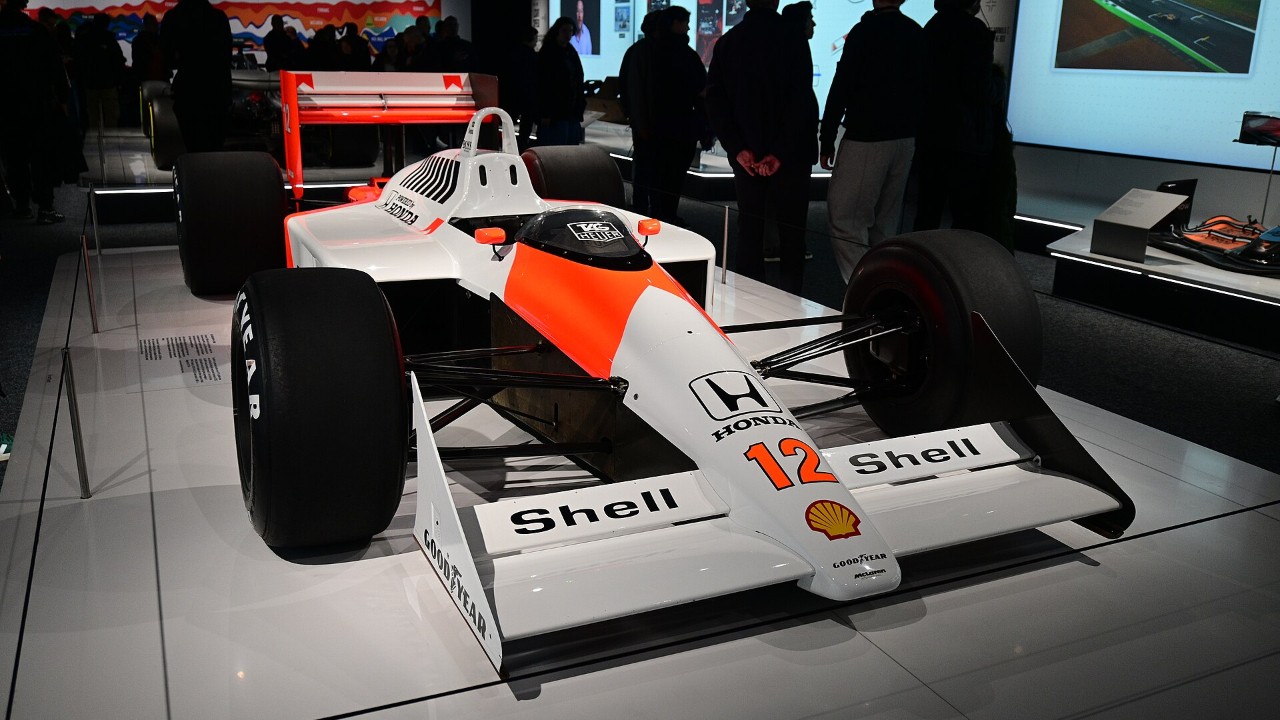
The McLaren MP4/4 won 15 of the 16 Formula 1 Grands Prix in 1988. It did that with a 1.5-liter Honda V6 turbo in the final year before turbos left the sport, and under a rule that cut every turbo car’s race fuel to 150 liters.
That fuel limit is the key to the car. More boost means more power, but it also means more fuel. Honda had to build an engine that made both ends meet.
Ayrton Senna won the title in it, while Alain Prost finished three points behind him. Meanwhile, the only race the team lost came down to one collision with a backmarker.
The rules that shaped the McLaren MP4/4
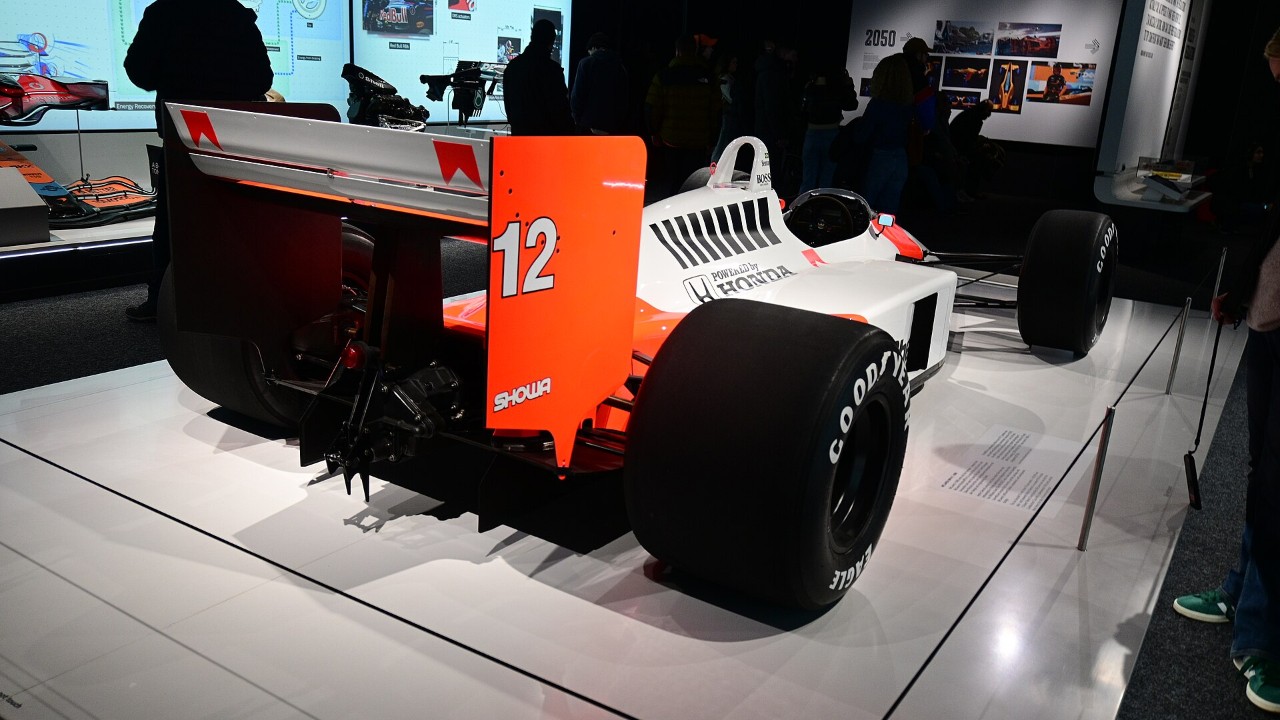
For 1988, the sport squeezed the turbo cars hard. According to Honda’s history of the RA168E engine, the maximum boost pressure dropped from 4 bar to 2.5 bar. At the same time, the fuel allowance for a race fell from 195 liters to 150 liters.
McLaren’s own heritage page confirms the 150-liter limit, although it quotes a 2.8-bar boost cap. This story uses Honda’s figure, since Honda built the engine.
Still, the fuel cut was the bigger problem. A turbo engine running high boost burns fuel quickly. As a result, any car that ran out before the flag lost the race no matter how fast it was. Honda says it designed the RA168E “aiming for both improved power output and fuel economy.”
Honda’s RA168E engine
Honda lists the RA168E as a 1,494cc water-cooled V6 with twin turbochargers. The company says the engine weighed 146 kg fully equipped and ran a compression ratio of 9.4.
However, power figures vary by source. Honda cites a published technical report giving a maximum of 685 hp. Meanwhile, McLaren’s heritage page says the engine was “at times putting out in excess of 700bhp” in its final development year.
The fuel itself was special, too. Honda says the engine ran on a blend of 84% toluene and 16% n-heptane. In other words, this was not pump gas.
The car around the engine
McLaren describes the MP4/4 as a highly effective development of the carbon composite chassis concept the team had introduced in 1981. Its heritage page credits the car’s light weight, strong downforce and efficient brakes and suspension.
The car also sat much lower than its predecessor, the MP4/3. The Wikipedia entry on the MP4/4 notes that this low line forced the drivers into a reclined position. It also lists the design team: Gordon Murray as technical director, Steve Nichols as chief designer and Bob Bell on aerodynamics. On the Honda side, Osamu Goto led the engine program.
McLaren built six MP4/4 chassis in total, according to its heritage page. That small fleet then covered the entire 16-race season.
Fifteen wins from sixteen races
From the start, the results were lopsided. Senna started from pole 13 times and won eight races, McLaren says, and he took the title despite a disqualification in the opening race in Brazil. Prost, by comparison, won seven rounds and finished three points short of his teammate.
Together, the two drivers took 15 pole positions, according to Wikipedia, with two of them going to Prost. The team also scored 199 points in the constructors’ championship. McLaren describes that as almost three times the score of runner-up Ferrari.
Honda puts the winning rate at 93.75%. Prost, McLaren says, told team principal Ron Dennis after only a few laps in the car that it would win the championship.
The one race the MP4/4 lost
In fact, the single defeat came at Monza, in the Italian Grand Prix. McLaren’s account says Senna “tripped over” the Williams of backmarker Jean-Louis Schlesser in the first chicane. Many people, the team adds, saw the loss as self-inflicted.
Even so, that one race kept the record at 15 of 16 rather than a clean sweep. It is the only blemish in the McLaren MP4/4’s season.
What came next
Formula 1 banned turbo engines for 1989. Consequently, the MP4/4 had no second season. Its successor, the MP4/5, used a Honda V10, according to Wikipedia.
After that, the 1988 car stood as the turbo era’s last word. McLaren built six of them, and on Honda’s count they won 15 of 16 races on 150 liters of fuel per Grand Prix.
More from Fast Lane Only
- Unboxing the WWII Jeep in a Crate
- 15 rare Chevys collectors are quietly buying
- 10 underrated V8s still worth hunting down
- Police notice this before you even roll window down
This article was created with the help of AI and was reviewed and edited by Fast Lane Only editors before publication.