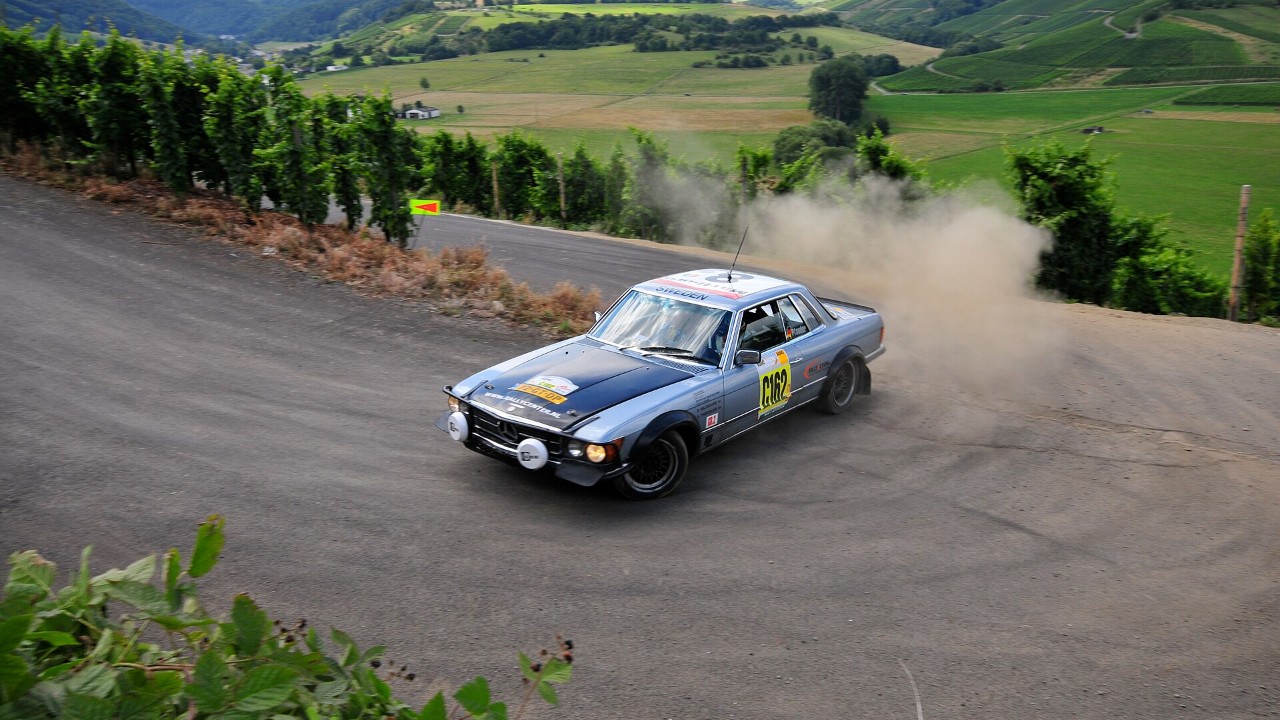
Hannu Mikkola won the 1979 Rallye Bandama in Ivory Coast driving a Mercedes 450 SLC 5.0. Then three more of the big coupes followed him home. That gave Mercedes-Benz the top four places. The winning car was a luxury coupe with a V8 and an automatic gearbox. Yet it left the rest of the field far behind.
Goodwood calls it the last world championship event of the decade. It also settled the inaugural drivers’ world championship, because the man in second place needed exactly that position.
Here is how a Stuttgart coupe ended up on a world championship podium. After that comes what made the rally car different and how the story ended.
How the 1979 Rallye Bandama finished
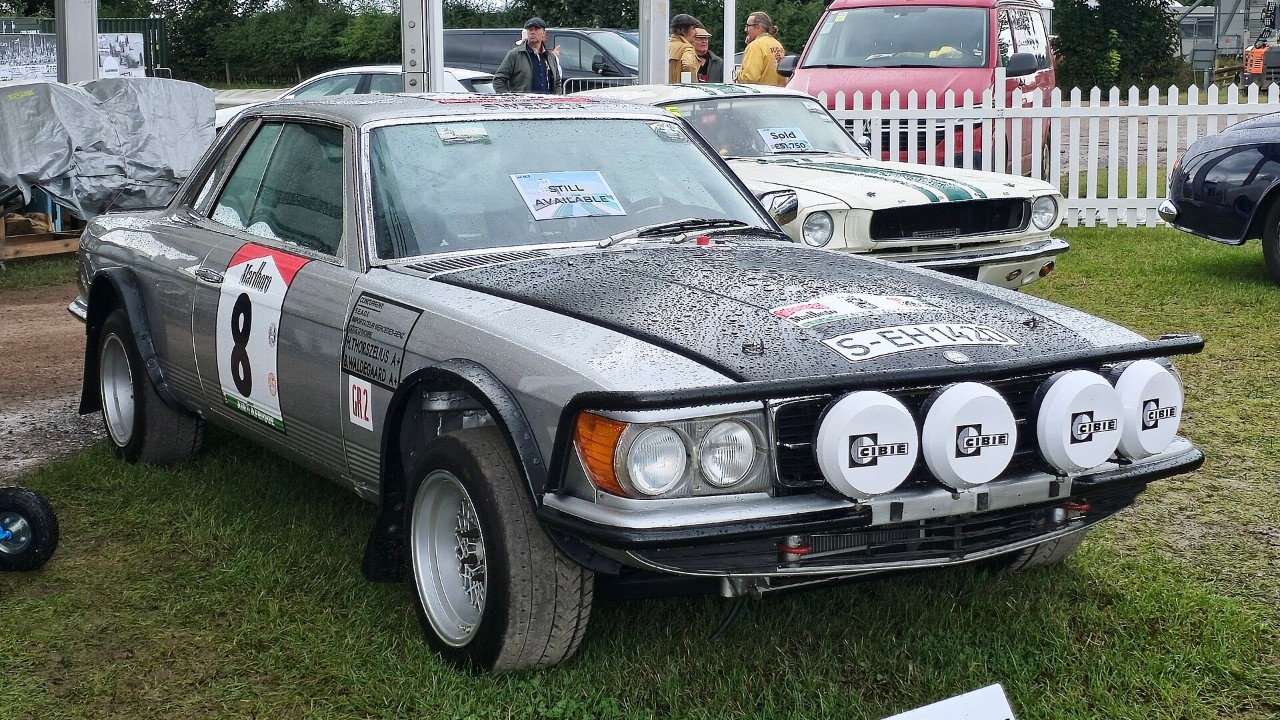
Mikkola and co-driver Arne Hertz took the win, according to Goodwood’s account of the event, which dates it to December 14, 1979. Björn Waldegård and Hans Thorszelius finished second, 35 minutes back. Andrew Cowan and Klaus Kaiser came third, 47 minutes behind. Finally, Vic Preston Jr and Mike Doughty took fourth, 54 minutes off the lead.
The gap to the rest was enormous. Goodwood lists Ove Andersson’s Toyota in fifth, 2 hours and 45 minutes behind the winner. Meanwhile, a Peugeot 504 V6 Coupé finished sixth, more than five hours back.
Second place mattered most of all. Waldegård needed it to win the drivers’ title by one point, Goodwood says. As a result, he took the 1979 World Rally Championship.
Why Mercedes built the 450 SLC 5.0
Mercedes-Benz surprised the rally world in 1977 when it announced the 450 SLC, according to the RM Sotheby’s catalog for one of the works cars. The auction house says the road version was built to homologate the car for the 1978 World Rally Championship. In other words, Mercedes had to sell a lighter, more powerful road car before it could rally one.
The road car ran from September 1977 to March 1980, according to Classic & Sports Car. Its 5.0-litre V8 made 240 bhp at 5,000 rpm. That was 20 bhp more than the iron-block 450, the magazine says. The doors, bonnet and bootlid were aluminum, and the car wore discreet bib and boot spoilers.
Production numbers need care. Classic & Sports Car puts the 5-litre SLCs at 2,769 cars, but that total includes the later 500 SLC. Split by model, it gives 1,636 for the 450 SLC 5.0 and 1,133 for the 500 SLC.
What made the rally car different
The competition cars used an all-aluminum V8 that weighed 40 kilograms less than the iron version, RM Sotheby’s says. Each works car also used a specially developed automatic transmission. Hagerty UK identifies it as a three-speed automatic.
That choice ran against rally tradition. Even so, it worked. Classic & Sports Car calls the 450 SLC 5.0 the first V8-engined car to win a World Rally Championship event, and the first automatic. RM Sotheby’s makes the same claim for Mercedes as a maker.
The works fleet was small. Mercedes-Benz built 19 SLCs for international rallying, RM Sotheby’s and Hagerty UK report. Only seven of them carried 450 SLC 5.0 badges.
The long road to Ivory Coast
Bandama was not the first success for the coupe. The SLCs made their debut on the 1978 Vuelta a la América del Sud. There, Classic & Sports Car says, they took the top five places. At that stage, the magazine adds, they were still standard 450s rather than 5.0 cars.
Still, the pressure to win was intense. Classic & Sports Car says Daimler’s view was that “anything less than total victory was bad publicity.”
What came after Bandama
Mercedes kept developing the car. The 500 SLC came next. For that car, Hagerty UK says, the M117 5-litre V8 rose from 240 bhp to 329 bhp. The rally car also gained a four-speed automatic.
The team went back to Ivory Coast in 1980 and finished one-two, according to Hagerty UK. Later that year, Mercedes-Benz finished fourth out of 16 manufacturers in the championship.
A two-seat 500 SL was meant to take over for 1981. In fact, Classic & Sports Car says Mercedes even hired Walter Röhrl on a $10,000-per-drive contract. After testing it, though, Röhrl judged the car likely only good for fourth or fifth on the Rallye Monte-Carlo. In the end, Hagerty UK says, the plan came to nothing.
The works cars survive as collector pieces. For example, RM Sotheby’s offered the second-place Waldegård car, chassis 836, at its Monaco sale in 2024. Its estimate was €800,000 to €1,000,000, and the lot is marked not sold.
More from Fast Lane Only