Every microcar on this list was built to answer one question: how little car can a person get by with? In postwar Europe and Japan, plenty of buyers needed cheap transport, and small factories rushed to meet them with tiny engines and clever bodies.
Some of those cars later became famous. The BMW Isetta and the Messerschmitt bubble car draw crowds wherever they go. However, dozens of other tiny machines came and went with far less fanfare. Some had three wheels, some had doors at both ends, and one carried passengers facing backward.
These ten are our picks for the microcar world’s hidden gems, the ones a true fan will spot from across a car show. The years, engines and production numbers come from museum records, maker histories and published references. The verdicts are our own opinion, and we’ll admit to a soft spot for every one of them.
1. 1957 Heinkel Kabine microcar

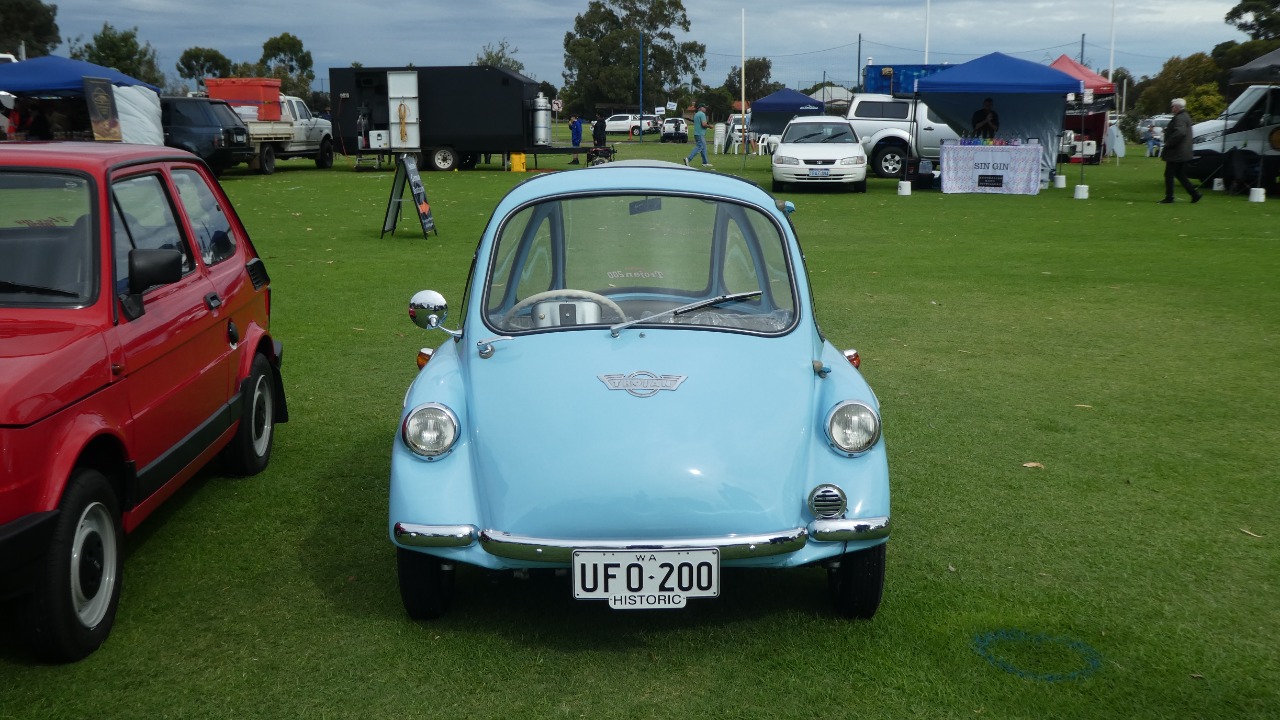
Heinkel built the Kabine in Germany from 1956 to 1958. Like several bubble cars of the era, it had a single door that opened at the front.
At first, the car used a 174cc engine shared with the Heinkel Tourist scooter, rated at 9.2 horsepower. Later versions grew to 204cc, and Heinkel then cut that to 198cc for insurance reasons. Buyers could choose three wheels or four. Either way, the layout stayed simple and light. After Heinkel stopped, the design moved abroad. An Irish licence in Dundalk ended quickly over quality problems, while Trojan in Britain built the car as the Trojan 200 from 1960 to 1966. In addition, Los Cedros assembled it under licence in Argentina.
Our take: the Kabine is the thinking person’s bubble car. Its long life under other badges, in other countries, tells you the basic design worked. If you want the wider story of why these cars caught on, see why bubble cars became popular in postwar Europe. In our view, the Kabine is the best way to enjoy a front-door microcar without the crowds that follow an Isetta.
2. 1957 Zündapp Janus

The Janus takes its name from the two-faced Roman god, and the car earns it. It had one door at the front and another at the back. Its two rows of seats faced opposite directions, so rear passengers watched the road disappear behind them.
According to the Lane Motor Museum, aircraft builder Claudius Dornier designed it. The museum also lists a 248cc air-cooled single-cylinder two-stroke rated at 14 horsepower, a top speed of 50 mph and seating for four. It also counts 6,902 built. That small total makes sense, because the Janus was the only car Zündapp ever made, and the run lasted only into 1958.
Our take: the Janus is the most charming oddball on this list. It solved the space problem with pure lateral thinking, and the result makes people laugh in the best way. If you ever get to ride in one, take the backward-facing seat at least once. It’s the only way to understand what Dornier had in mind. In our view, the Janus also shows how aircraft thinking crept into postwar car design, with every inch put to work.
3. 1957 Fuldamobil S-7

Few people outside Germany know the Fuldamobil, yet builders in a remarkable number of countries made it under licence. Elektromaschinenbau Fulda built the S-7 from 1957 with a fibreglass body over a plywood floor. Adolf Sander designed it.
Still, the specs were modest. A Fichtel & Sachs 191cc single-cylinder two-stroke drove the car through a four-speed gearbox, and an electric switch selected reverse. The S-7 offered 2+2 seating, weighed about 320 kilograms and reached about 80 km/h. In Germany, it sold for 3,100 marks, and the factory built roughly 440 of the first S-7s. Meanwhile, licensed versions appeared under names such as Nobel, Bambi and Bambino, on four continents. Later S-7s switched to a 198cc Heinkel engine from 1965, and about 260 of those followed.
Our take: the Fuldamobil is the microcar that went global without anyone noticing. Its story is about a small design that other countries kept adopting, from Chile to Sweden to Greece. In our view, that makes it far more important than its tiny build numbers suggest. If you spot one, check the badge, because it could be from almost anywhere.
4. 1965 Peel Trident

Peel Engineering, founded by Cyril Cannell in the late 1940s, built the Trident as a two-seat bubble-top. According to the Audrain Automobile Museum, it made its debut at the 1964 Earls Court Motorcycle Show, and production ran until 1966.
In fact, the museum’s figures are wonderfully small. A 49cc Zweirad Union two-stroke made 4.5 horsepower and drove through a three-speed gearbox with no reverse. Peel advertised a 38-mph top speed and around 100 mpg. The car weighed 330 pounds, and a clear plastic dome tilted forward so you could climb in. Only about 80 found owners, and the museum estimates that around 30 still exist. The fibreglass came in blue or red, with the color mixed into the gel coat instead of painted on.
Our take: the Trident looks like a cartoon spaceship, and that’s exactly why we adore it. It promised two seats, yet the museum notes that it worked best as a single-seater. In our view, it is the purest example of microcar optimism ever put on sale. If you see one at a show, you’re looking at one of only a few dozen left.
5. 1957 Goggomobil TS

Hans Glas built the Goggomobil in Dingolfing, Bavaria, and it was far more successful than most microcars. Production ran from 1955 until June 1969, with BMW taking over the company in 1966. The range included a sedan, a van and the TS, a pretty 2+2 coupe that arrived in 1957.
Under the skin, the TS used the same air-cooled two-stroke twins as its siblings. Buyers could choose a 245cc engine with 13.6 horsepower, a 293cc unit or a 392cc version with 18.5 horsepower. Top speed for the smallest TS was about 47 mph. Glas built 66,511 TS coupes in all. That’s a big number for such a small car. Yet in our view, the coupe gets far less attention today than that number deserves.
Our take: the TS proves a microcar could be stylish as well as frugal. It looks like a scaled-down sports coupe, and the larger engines gave it a little more pep. If the Australian roadster version interests you, our piece on the 1959 Goggomobil Dart tells that story. In our view, the TS is the prettiest Goggomobil of them all.
6. 1958 Vespa 400

Piaggio made its name with the Vespa scooter, so a Vespa car was a natural next step. The company designed the Vespa 400 in Italy, but ACMA built it in Fourchambault, France, from 1957 to 1961. It made its public debut on September 26, 1957, at a press event in Monaco.
That launch had star power. Racing drivers Juan Manuel Fangio, Jean Behra and Louis Chiron all attended. Meanwhile, the car itself used a 393cc air-cooled two-cylinder two-stroke, rated at 13 horsepower and later 14. Top speed ran between 50 and 55 mph, depending on the road. ACMA built 12,130 cars in 1958 and 8,717 in 1959, which made it one of the busier microcar lines of the period. We also love that a scooter maker took the leap at all.
Our take: the Vespa 400 feels like a real small car rather than a scooter with a roof. It brought Italian design to a French factory, and it gave buyers four wheels and a proper cabin. In our view, it’s the microcar to choose if you want something cute with room to breathe.
7. 1960 Mazda R360

Mazda’s car business started small, very small. The R360 arrived in May 1960 as the company’s first passenger car. It fit Japan’s kei-car class, built for tight streets and low running costs.
According to Mazda’s own history, the R360 was a four-seat micro car with a four-stroke engine and extensive use of light alloy to save weight. Mazda priced it at 300,000 yen. The engine was a 356cc air-cooled V-twin rated at 16 PS, and the car weighed 380 kilograms. Buyers took 23,417 in the first year, and production eventually reached 65,737. That first-year total shows how ready Japanese buyers were for a small family car. Mazda even offered a two-speed automatic, later kept as a special order for disabled drivers.
Our take: the R360 is a microcar with a family tree. Every Mazda since traces back to this little coupe. We love that a company now known for sports cars began with a four-seater the size of a large toy. If you see one in the United States, stop and look, because it’s a rare piece of Japanese car history.
8. 1970 Bond Bug

The Bond Bug is the youngest car on this list, and the brightest. Tom Karen of Ogle Design drew it as a sharp wedge, and Reliant built it under the Bond name from 1970 to 1974. It’s best remembered in a bright tangerine orange.
There were no conventional doors. Instead, you climbed in under a lift-up canopy. Power came from Reliant’s 700cc light-alloy four, rated at 29 horsepower in the 700 and 700E. As a result, top speed reached 76 mph. At launch, the Bug cost £629, just above the £620 asked for a basic 850cc Mini. In the end, only 2,270 found buyers, including fewer than 200 of the later 750 model. Along the way, the 700ES gained a revised cylinder head and 31 horsepower.
Our take: the Bug is a 1970s concept car that somehow made it to the showroom. It has three wheels, a lift-up canopy and the loudest color of the decade. In our view, it’s the most fun microcar ever sold in Britain. If you want one, budget for the canopy seals and trim, because those parts give the car its whole character.
9. 1958 Scootacar

The Scootacar came from an unlikely source: a locomotive company. Scootacars Ltd was a division of the Hunslet Engine Company, and it built the car in Leeds from 1957 to 1964. The often-told story says it began because a director’s wife wanted something easier to park than her Jaguar.
The result was a tiny tandem-seat machine. A rear-mounted 197cc Villiers single-cylinder two-stroke drove the single rear wheel by chain through a four-speed gearbox. The passenger sat behind the driver, and the original car reached about 50 mph. In 1960, a Mk 2 De Luxe added room for a third person and cost £275. In all, Hunslet built only about 970 Scootacars. Only about 20 cars got the rare Mk 3 Twin with a larger Villiers twin engine.
Our take: the Scootacar looks like a phone booth on wheels, and we mean that fondly. It’s the sort of car that makes people smile before they even know what it is. In our view, few microcars show more British eccentricity. If you get the chance to sit in one, do it, because pictures never quite explain the shape.
10. 1959 Berkeley T60

Berkeley Coachworks made caravans in Biggleswade, England. At the time, it ranked among Europe’s largest caravan makers, and it used fibreglass widely. With designer Lawrie Bond, it turned that skill into small cars from 1956. The T60, a three-wheeler, arrived in September 1959.
For power, it used a 328cc Excelsior Talisman engine and a fibreglass body. About 1,800 found buyers, a big share of the roughly 4,100 cars Berkeley built in all. Then the caravan market collapsed in late 1960. As a result, Berkeley went into liquidation on December 12, 1960, and car production ended with it.
Our take: the T60 is the sporty end of the microcar story. It’s a tiny open car built for fun rather than pure economy, and it shows what a small firm could do with fibreglass and a motorcycle-sized engine. In our view, it’s the microcar a sports car fan should own. If you find one, check the fibreglass and chassis mounts carefully. The company’s short life means a solid original is worth the extra search. For us, it’s a fitting finale, because it ends the list with pure fun.
More from Fast Lane Only