Triumph named its Bonneville after the Utah salt flats where riders chased speed records, and the Triumph Bonneville T120 arrived in 1959. Within a few years, British twins and singles filled showrooms on both sides of the Atlantic. By the late 1970s, though, many of the factories behind them had closed.
That collapse is part of the appeal today. Many of these machines came from factories that no longer exist, built by companies that ran out of time. However, not every British bike makes a rewarding collector piece. Some are hard to keep running, while others give back far more than they ask.
These eight are our picks, and “worth collecting” is our opinion, not investment advice. The years, engines and production counts come from museum records, period-focused magazines and marque references. If you want a classic British motorcycle you’ll actually ride, start here.
1. 1971 Triumph Bonneville T120R
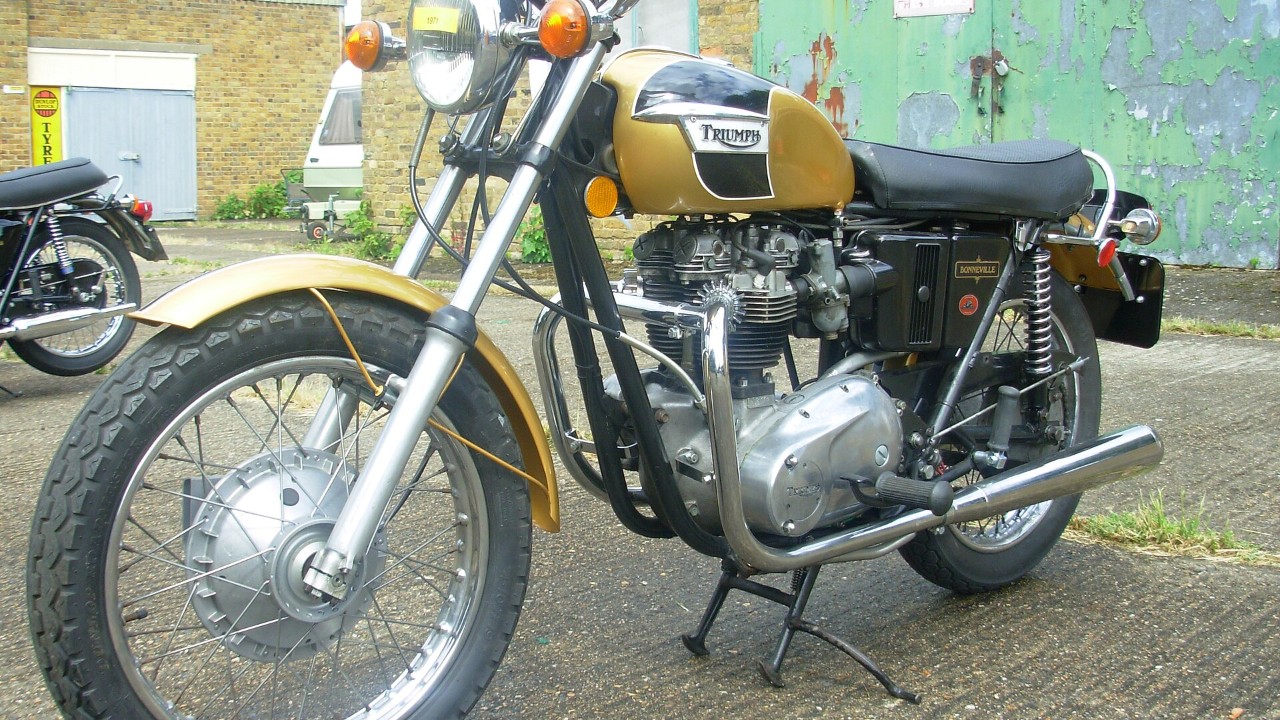
The T120R was the American export version of the Triumph Bonneville. For 1971, Triumph gave it the biggest redesign since it had combined the engine and gearbox. The new frame carried the engine oil inside its tubes, and that change defines the 1971 bike.
The launch went badly. According to Bike-urious, a new computer system caused parts shortages, and the engine wouldn’t fit in the frame without first removing the rocker boxes. As a result, the bike was scarce in America before July. The seat sat 32 inches high, and some frames cracked at the center-stand mount, which doubled as the oil sump. On the plus side, the frame was stiffer, and a five-speed gearbox was optional. Bike-urious also points to four inspection ports on the rocker covers for checking valve clearances.
Our take: the 1971 Triumph Bonneville is the underdog of the family, and that’s why we’d collect it. Its troubles gave it a rough reputation, yet it carries the same 650 twin character and a better frame. Before you buy, check the center-stand area for cracks or repairs. Then fit the five-speed if you can find one, and ride it.
2. 1973 Triumph X-75 Hurricane
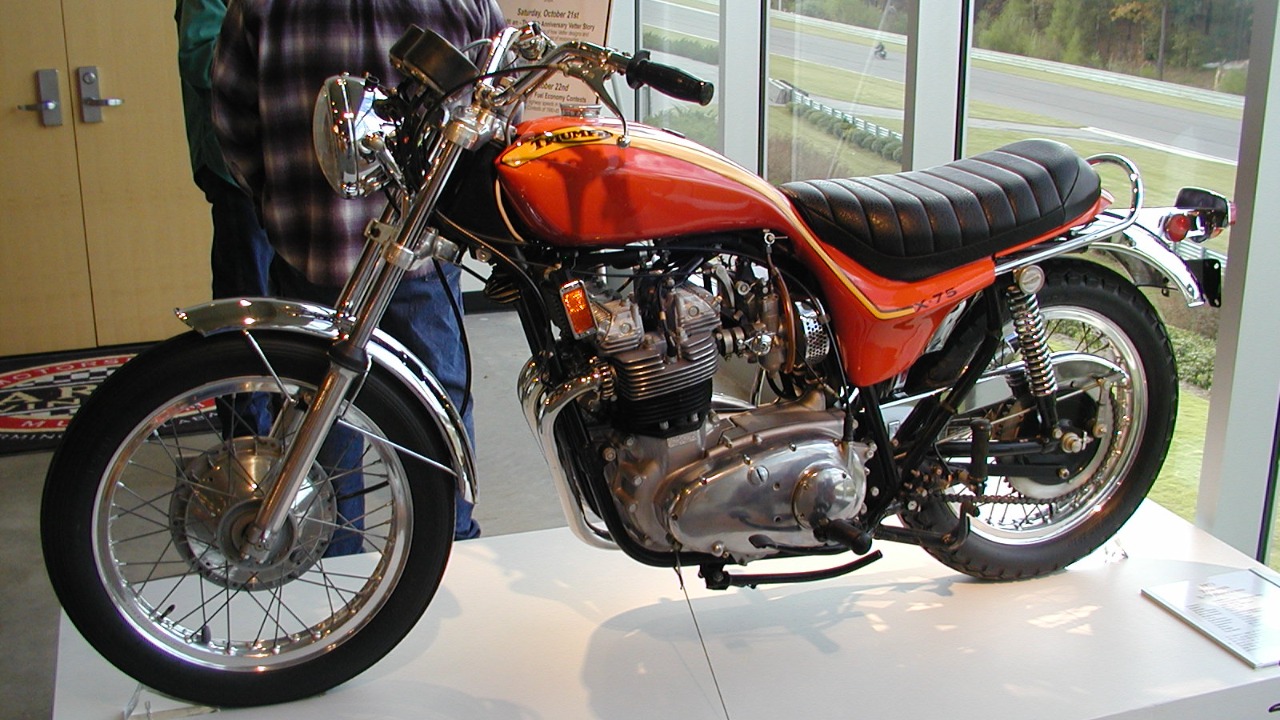
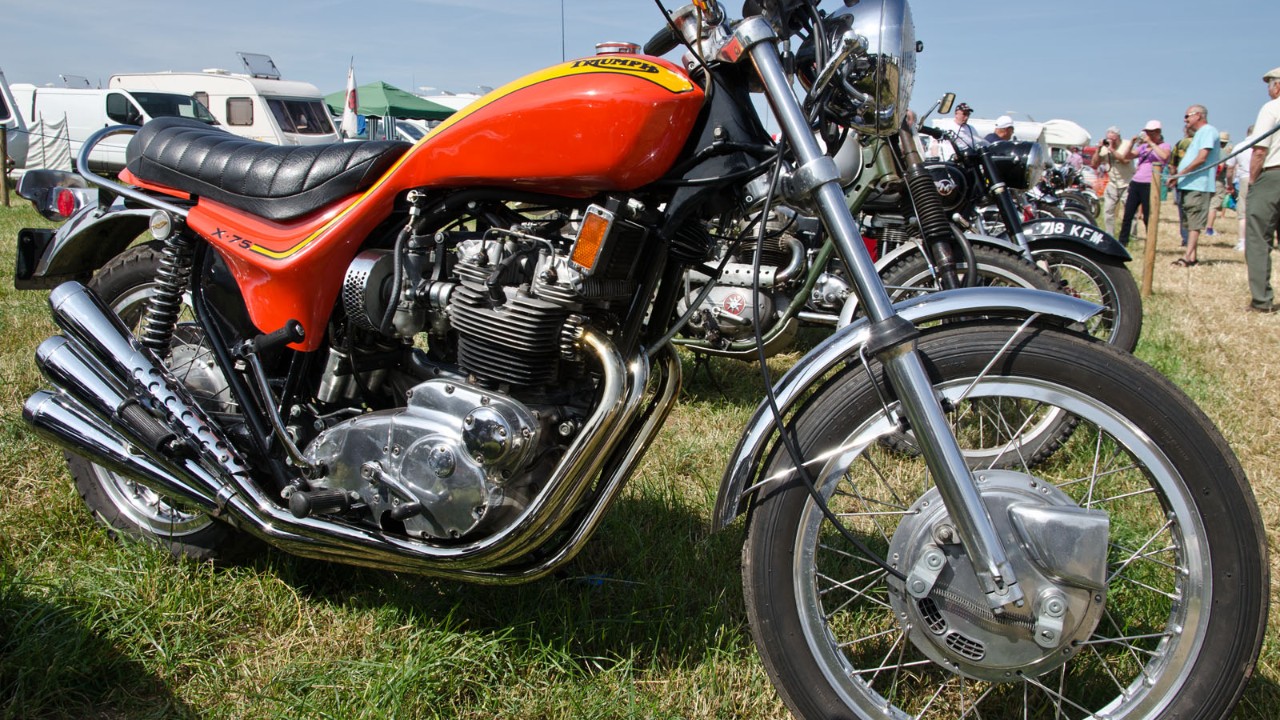
The Hurricane started as a secret styling job. Don Brown, vice-chairman of BSA’s American company, wanted a fresh look for the slow-selling Rocket 3 triple. So young designer Craig Vetter restyled one, with a slim fiberglass body and three slanted exhaust pipes on one side.
Hagerty UK says Triumph’s Meriden factory built fewer than 1,200, all between June 1972 and January 1973. Because BSA collapsed, the bike reached buyers in 1973 as a Triumph. Vetter, Hagerty adds, got his $12,000 fee only after Brown made a personal appeal. Its 740 cc triple made 60 brake horsepower at 7,250 rpm, and the tank held only 10 liters. Hagerty also puts top speed at about 115 mph and quotes values from £20,000 for a project to £30,000 for a show bike. Meanwhile, the National Motorcycle Museum displays one in its Best of the Best gallery.
Our take: the X-75 is the most striking British bike of its decade, and the low build count backs up its status. We’d ride it on short, sunny runs, because that small tank limits the range. If you’re shopping, verify the bodywork and frame numbers.
3. 1974 Norton Commando 850 Interstate
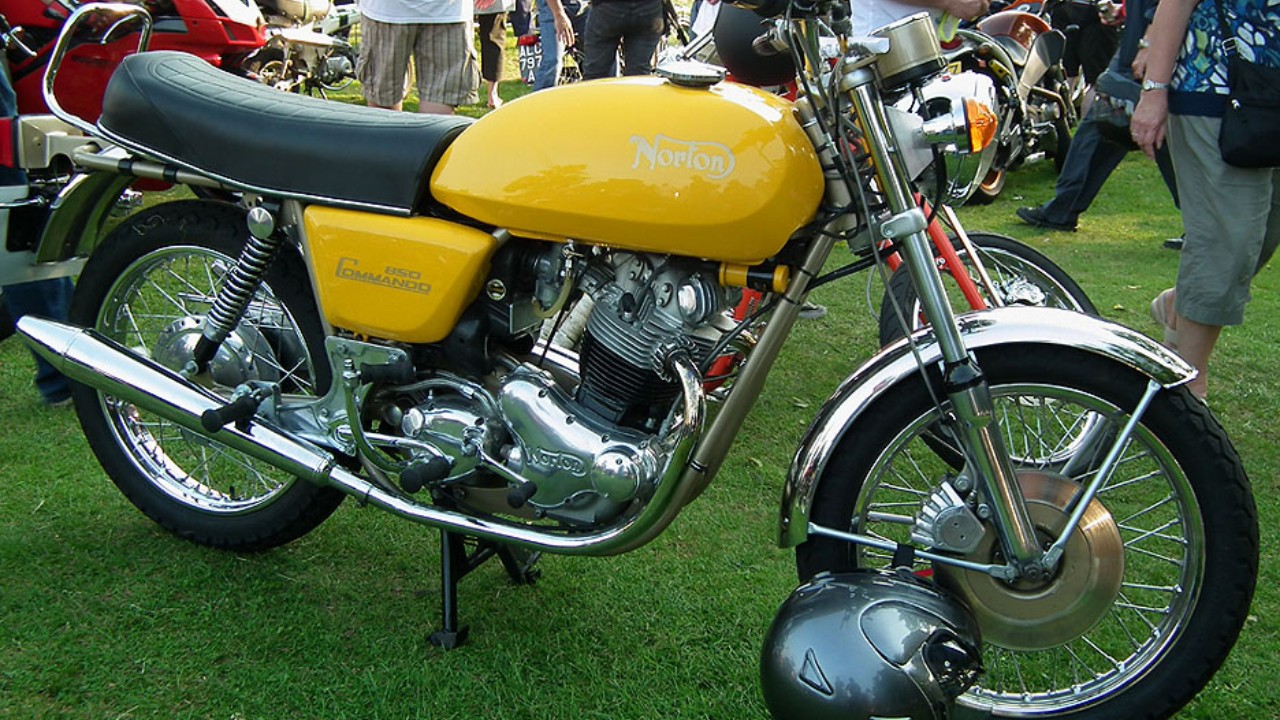
Norton launched the Commando at the 1967 Earls Court show. Its Isolastic frame used rubber mounts to keep the twin’s vibration away from the rider. Motor Cycle News named the Commando its Machine of the Year for five straight years, from 1968 to 1972.
The Interstate arrived in January 1972 with a big touring tank, first 5.25 imperial gallons and later 5.5. For 1973, Norton bored the twin from 73 to 77 millimeters, which gave 828 cc. By late 1973, the 850 was the only engine. RealClassic profiled a 1974 Interstate whose owner bought it in 1982 and once rode 1,600 miles in four days. He fitted a non-return valve to stop wet sumping, and he calls the front brake the bike’s worst feature.
Our take: the 850 Interstate is the British twin we’d pick for long days in the saddle. The big tank and the torque suit open roads, and Norton built around 60,000 Commandos, so you’ll have plenty of bikes to choose from. Check for wet sumping and plan on a brake upgrade. We rounded up more of its peers in Nortons you forgot existed.
4. 1955 Vincent Black Shadow Series D
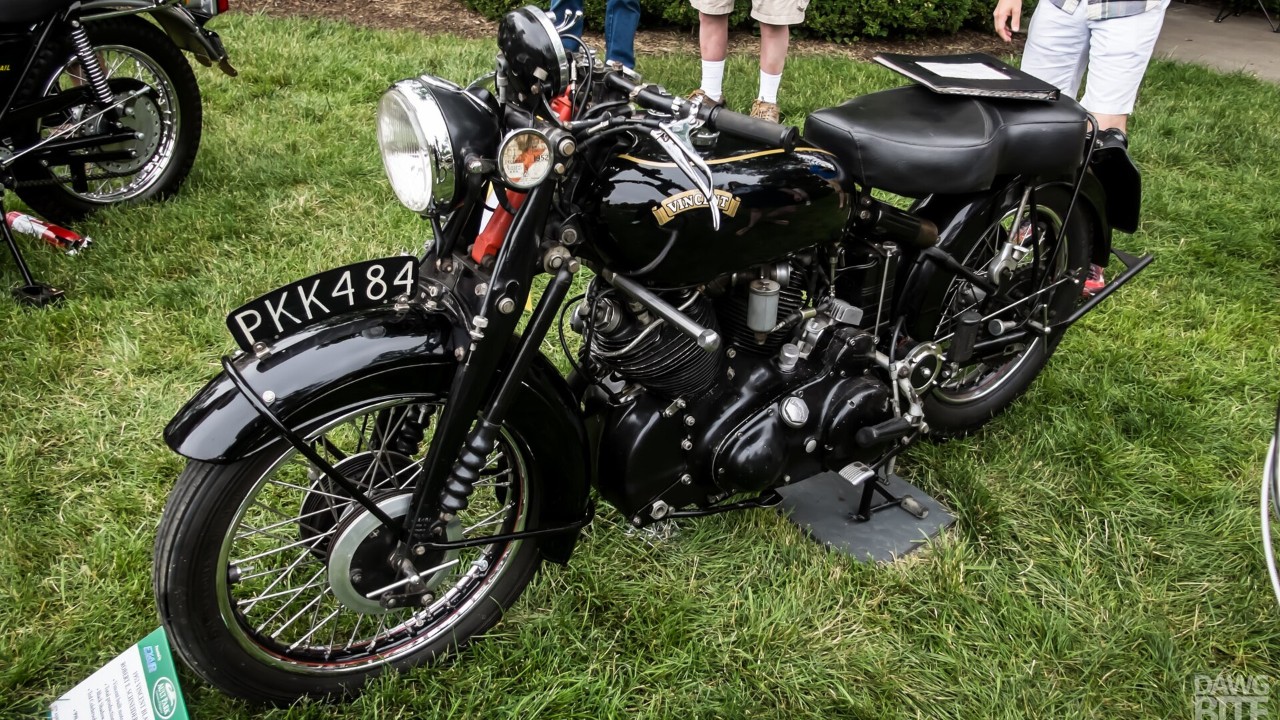
The Black Shadow was Vincent’s fast road bike, with a 998 cc, 50-degree V-twin making 55 brake horsepower. When it was new in 1948, Vincent claimed 125 mph. In a May 1948 road test, Motor Cycling reached 122 mph, a huge figure for the era.
The Series D brought real changes. Vincent replaced the frame’s upper member with a tube and fitted a separate oil tank. It also switched to coil ignition and moved both spark plugs to the right side. At the rear, a single Armstrong spring and damper gave about 30% more travel. The 150-mph speedometer carried over in a smaller three-inch size. Official records count 1,774 Black Shadows in all, plus 15 White Shadows with polished rather than black engines. Vincent stopped making motorcycles in 1955.
Our take: a Series D Black Shadow is the final chapter of a famous British twin, and we’d treasure that. It isn’t cheap or simple, but it rewards you every time you ride. Buy only with documented numbers and a known history, because originality matters on a bike like this.
5. 1958 BSA A10 Super Rocket

BSA hired Bert Hopwood in 1948 to design a 650 cc twin that could take on Triumph’s Thunderbird. The result was the A10 family, built at Small Heath, Birmingham, from 1950 to 1963. Its 646 cc twin used a 70-millimeter bore and an 84-millimeter stroke.
The Road Rocket arrived in 1954 as the first A10 with an alloy cylinder head. Then, in 1958, the Super Rocket replaced it as BSA’s top twin. It made 43 brake horsepower at first and 46 after a Monobloc carburetor arrived in 1962. That same year, BSA combined a tuned Super Rocket engine with a Gold Star frame to create the Rocket Gold Star. The A10 family then ended in 1963, and the A65 took over.
Our take: the Super Rocket is the sweet spot of the A10 range, in our view. It gives you much of the Rocket Gold Star’s character, since that bike used a tuned Super Rocket engine. Look for a swinging-arm frame and matching numbers. For more of BSA’s story, see our list of British motorcycles that were ahead of their time.
6. 1956 Ariel Square Four Mk II
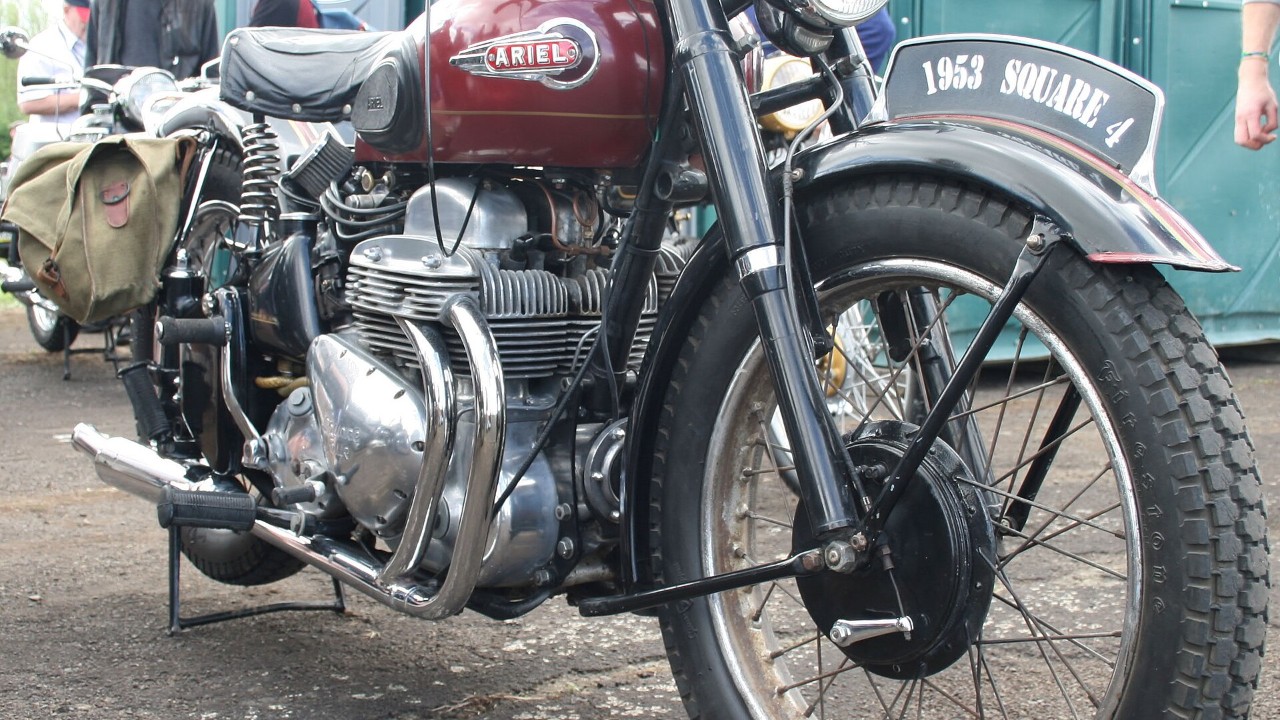
Edward Turner sketched the Square Four’s engine in 1928, and Ariel showed the bike at the 1930 Olympia show. The layout was unusual. Two transverse crankshafts sat one behind the other, joined by geared central flywheels, under a single four-cylinder block and head.
The Mark I of 1949 swapped cast-iron cylinders and head for alloy and saved about 30 pounds. It made 35 brake horsepower and could pass 90 mph. Then the Mark II arrived in 1953 with a redesigned head and four separate exhaust pipes from two cast-aluminum manifolds. It displaced 997 cc, made 40 brake horsepower and could reach 100 mph. Ariel ended Square Four production in 1959, along with all its other four-strokes.
Our take: the Mk II is the Square Four to own, because the four exhaust pipes make it unmistakable. It’s smooth and relaxed rather than fast, which is exactly how we’d ride it. We also love that a 1950s British bike offered four cylinders in such a compact package. Choose a bike with a documented engine rebuild, since the geared crankshafts deserve expert care.
7. 1969 Royal Enfield Interceptor Series II
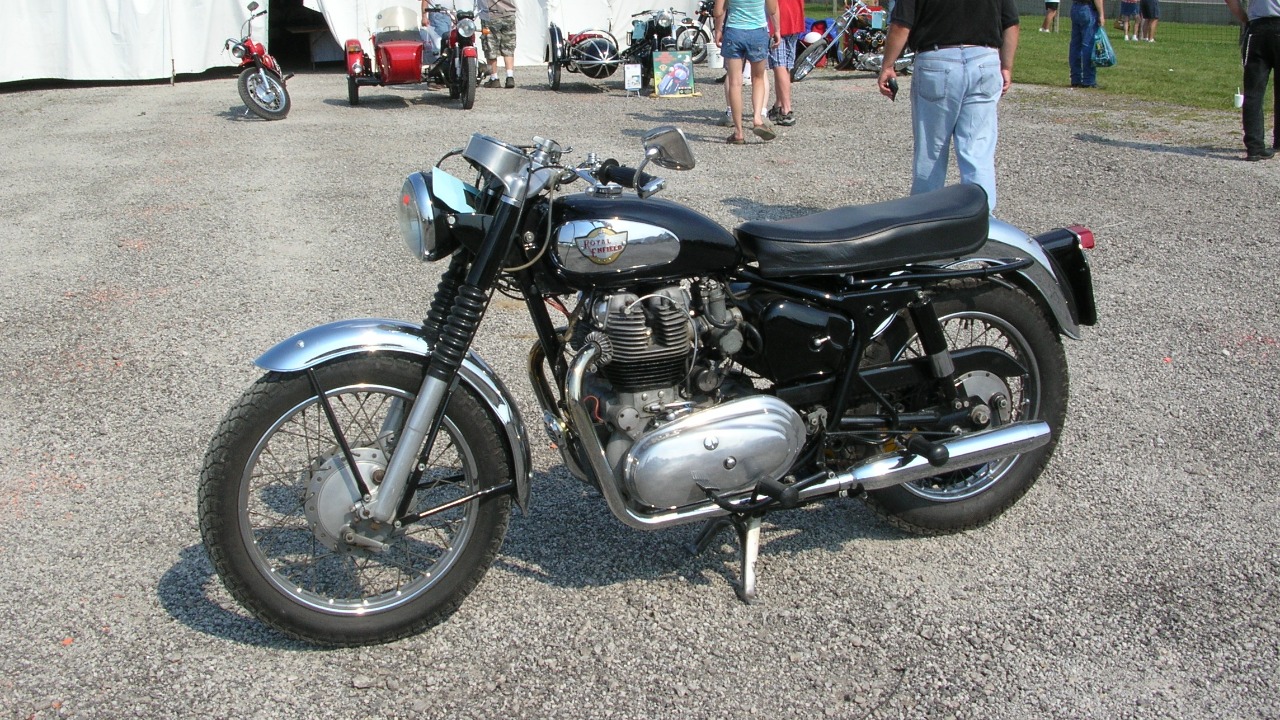
Royal Enfield’s 750 Interceptor used an all-new 736 cc twin from 1962. After the Redditch factory closed in 1967, production moved to Bradford-on-Avon in Wiltshire. The Series 2 brought a major engine redesign with a wet sump for better oil flow to the crankshaft.
The bike’s ending is pure drama. Floyd Clymer bought a batch of Series 2 engines to sell under the Indian name, but he died in January 1970. Rickman then bought the lot and sold them in its own frames as the Rickman Interceptor. After the Bradford-on-Avon factory closed, a prototype 778 cc Series 3 never reached production. Meanwhile, RoyalEnfields.com notes that many Interceptors went to the United States. A West Virginia dealer sold the 750s in 1969, it adds.
Our take: the Series II was the last model the English factory mass-produced, and that history alone earns it a place here. Its wet-sump engine is the most developed version. Confirm the engine series carefully before you pay any money, and look for the twin-leading-shoe front brake. We’d keep one for spirited weekend rides on quiet country roads.
8. 1964 Matchless G12 CSR

Associated Motor Cycles built the Matchless G12 at its Plumstead factory in London from 1958 to 1966. It used a 646 cc twin, and AJS sold a near twin of its own as the Model 31, renamed the Hurricane in 1963. In 1959, the crankshaft moved to stronger nodular iron.
The CSR version is the one to want. The letters stood for “Competition Sprung Roadster,” the same naming Matchless used on its G80 and G50 singles. However, rivals gave it a cheekier name: “Coffee Shop Racer.” The G12 CSR made 35 brake horsepower at 6,500 rpm. Production ended in 1966, when AMC ran into serious financial trouble, so the run lasted only nine years.
Our take: the G12 CSR is the forgotten café bike of the 1960s, and that’s exactly why we’d collect one. It offers period style and a strong 646 cc twin in one tidy package. Check that the frame and engine match a genuine CSR, because standard G12s can wear the parts. If the original handlebars come with the bike, keep them, since period details matter on a café-style machine.
More from Fast Lane Only