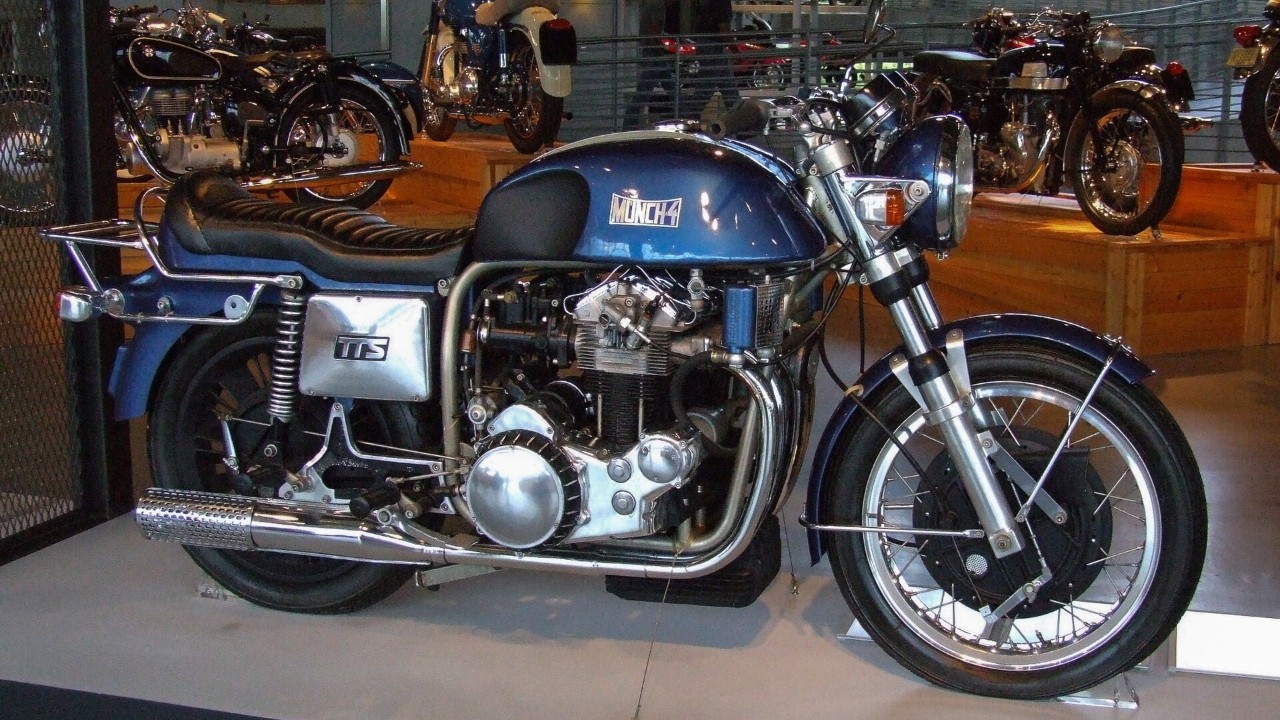
The Münch Mammut motorcycle carried a four-cylinder engine lifted from an NSU car. Friedl Münch built each one by hand in Germany. Fewer than 500 left his workshop, and every one of them weighed about as much as its name suggests.
The Mammut motorcycle took its name from the German word for mammoth. Even so, the name was not only a joke about size. It described a machine built to run fast for hours. As Silodrome points out, a one-liter engine was still relatively rare on a mid-1960s motorcycle.
The story runs through a Horex mechanic, a French sidecar racer and an American publisher. Here is how a small-car engine ended up powering a 650-pound motorcycle.
A tuner who started with Horex
Münch began in the late 1940s as an independent tuner, and his first notable work was a Horex in 1948, according to The Vintagent’s history and road test. Horex later offered him a job in its competition department. At first he refused, but he took it when money got tight.
After Horex folded, Münch bought its tooling and made spares and Horex specials, The Vintagent reports. He then built a light racer around the NSU overhead-cam four. That bike, like his later chassis, used a frame based on the Norton Featherbed.
The order that started the Mammut motorcycle
The first Mammut motorcycle came from a customer’s request. Münch began hand-building the Mammoth in 1966 after a special order from Jean Murit, a former sidecar racer from France, Silodrome reports. Murit wanted a motorcycle that could “cheerfully reach 140 mph and hold it for hours on end.”
Münch first sketched the design around a Horex 500 cc twin, according to Jalopnik. Then he switched to the NSU engine. Silodrome describes it as the overhead-cam inline-four from the NSU Prinz car. Jalopnik names the donor more exactly as the air-cooled four from the NSU Prinz 1000TT.
That first engine displaced 996 cc and made 55 hp, The Vintagent says. In that form, the bike could reach about 115 mph. Silodrome adds that the prototype weighed 480 lbs (218 kg), thanks to magnesium and other light parts.
Magnesium, aluminum and a car engine
The chassis borrowed from the Norton Featherbed, which many riders of the mid-1960s rated as the best frame of its kind, according to Silodrome. Power reached the rear wheel through a four-speed gearbox. A gear-driven primary and an enclosed final chain completed the drivetrain.
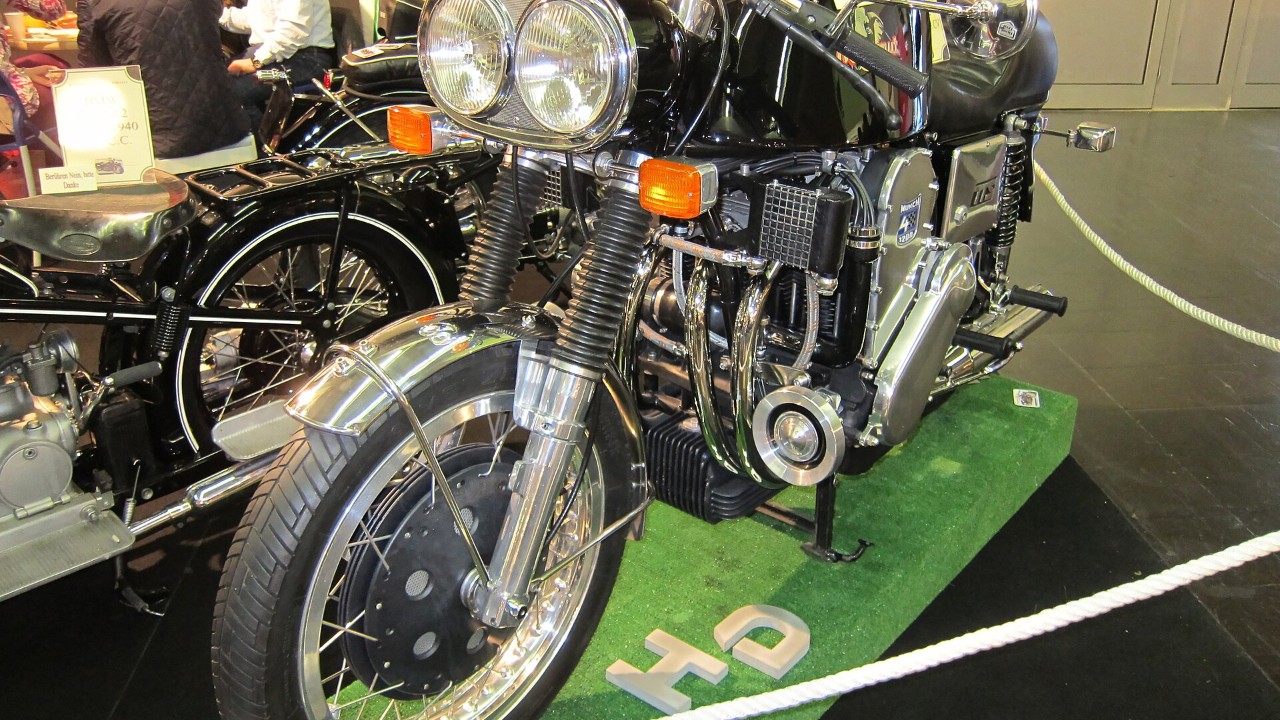
Stopping such a heavy bike was a real job. For that reason, Münch fitted a 250 mm magnesium front drum that he had first developed for racing Nortons, The Vintagent reports. Meanwhile, Jalopnik notes that early bikes ran a 12-volt system with two batteries.
The 1200 TTS grows to 88 hp
Capacity soon climbed. Jalopnik says the engine grew to 1,085 cc and 70 hp in September 1966. Then, in 1968, the 1200 TTS arrived with 1,177 cc and 88 hp, matching the NSU car of the same name, according to The Vintagent.
Münch did not simply bolt the car engine in. In fact, Jalopnik reports the stock unit made 65 hp. Münch raised compression from 9.5:1 to 10.5:1, ported the intakes and fitted new cams to reach 88 hp. Early TTS models breathed through twin Weber DCOE carburetors, The Vintagent adds.
The TTS also brought the details collectors now look for. Münch cast the rear wheel in magnesium with flat spokes, and it became his trademark. The seat and mudguard unit, headlamp bucket and chainguard were cast magnesium as well. By contrast, the fuel tank and side panels were hand-hammered aluminum. The Vintagent lists the weight at 295 kg (650 lbs), while Silodrome gives 656 lbs (298 kg) for production bikes.
Also, buyers could choose a Sport version with one headlamp or a Touring version with two. When The Vintagent rode a 1970 Sport model, it found little power below 2,000 rpm. Instead, the engine’s sweet spot was 4,000 to 4,500 rpm, good for about 80 mph in top gear.
Floyd Clymer and the American market
An American backer nearly turned the Mammut into a production bike. Publisher Floyd Clymer invested in Münch to pursue large-scale production for the U.S. market, The Vintagent says. However, he died before the plan was fully underway.
Clymer began importing the bikes in 1967 as the Clymer Münch Mammoth IV, Jalopnik reports. It started at $4,000, and Clymer died in 1970. Later in the 1970s, Jalopnik puts the Mammut at $5,135, at a time when a BMW motorcycle cost under $2,000.
Fuel injection and 100 hp
The engine reached its final big step in 1973. That year, the TTS-E added fuel injection and 1,278 cc for “a full 100hp,” according to The Vintagent. Jalopnik says Münch built only 130 of the TTS-E.
Meanwhile, ownership of the name changed hands. Münch sold the rights to his name to businessman Heinz Henke, The Vintagent reports. Jalopnik describes Henke as a customer who became a partner from 1973 and dates Mammut production from 1966 to 1980. After the split, Münch kept the Mammut name and made limited numbers for collectors, each built by hand to the buyer’s order.
How many Mammut motorcycles survive
Nobody has a firm survivor count. The Vintagent puts the final count at fewer than 500, while Silodrome and Jalopnik both put the total at about 500. Silodrome adds that it is not known how many still exist.
Friedl Münch died in 2014 at age 87, according to Jalopnik. When Bonhams offered a later 1,177 cc Mammut on 18 October 2015, Silodrome reports, the auction house estimated it at £28,000 to £35,000.
More from Fast Lane Only