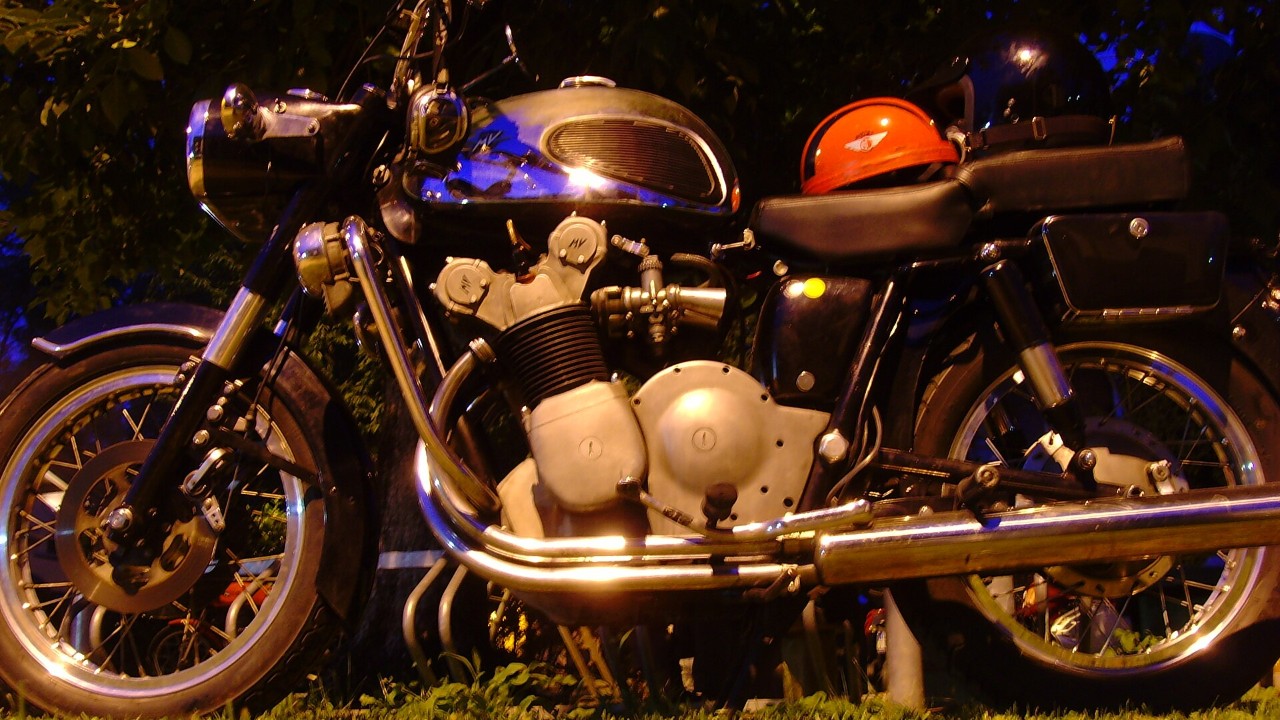
MV Agusta raced four-cylinder machines for well over a decade before it sold one to the public. When the road bike finally came, the MV Agusta 600 was a heavy, shaft-driven tourer with twin front disc brakes. Only about 127 were built.
The tame character was deliberate. According to one history, the company’s owner wanted a road bike that racers could not easily turn into a competition machine. The result was a touring bike, not a race replica.
Here is what the 600 Four was, what made it different, and what period testers thought when one reached America. Every figure comes from published histories and a 1968 road test.
A racing four turned into a tourer
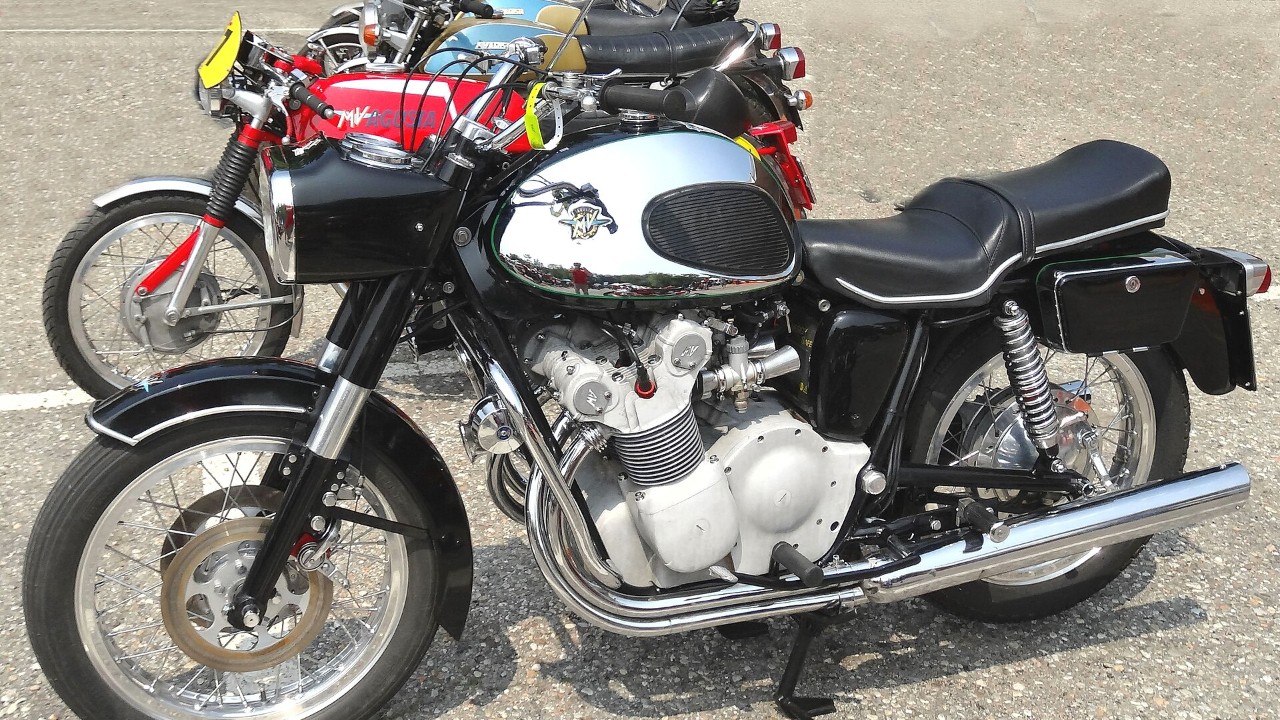
MV had raced four-cylinder machines since 1950, according to a history of the model on MCNews. It even showed a 500cc four-cylinder road prototype, the R 19, that same year. Yet no production four followed for years.
A prototype of the new road bike appeared at the 1965 Milan Show, MCNews says. Cybermotorcycle’s model file also places the debut at that show. Then, in 1967, MV finally put a four-cylinder road bike into production, MCNews reports.
The bike was a sedate tourer by design. MCNews calls that “a deliberate move on Count Agusta’s part to make it as hard as possible for privateer racers to convert the road bike into a race machine.” In other words, the factory protected its racing name by keeping the street bike tame.
The MV Agusta 600 engine
The engine was an air-cooled, inline four with two overhead camshafts driven by gears. Cybermotorcycle lists a 58mm bore and a 56mm stroke, for 592cc. MV marketed it as a 600.
A 1968 Cycle World road test adds that a gear tower between cylinders two and three drove the cams. It also reports a 9.3:1 compression ratio. Fuel came through two 24mm Dell’Orto carburetors, each feeding a pair of cylinders through a U-shaped manifold.
Power figures differ by source. MCNews gives 50 hp at 8,200 rpm. Cybermotorcycle, however, lists “60 HP SAE at 8.000 r.p.m.” MCNews also says four carburetors became an option on later bikes.
Power reached a five-speed gearbox through a multiple-disc clutch, according to both Cybermotorcycle and Cycle World. Cycle World called the engine “turbine smooth.” Still, the testers noted a lack of flywheel effect, which meant a high idle at traffic lights.
Shaft drive and twin front discs
Instead of a chain, the 600 used shaft drive. Cybermotorcycle describes the final drive as running “from engine to wheel by propeller shaft and cardan.” Cycle World explains the clever part: the drive shaft housing doubled as the right-hand swinging arm.
The testers found no slack in the shaft. In fact, they credited it as a major reason the bike felt so smooth.
Up front, the 600 carried two disc brakes, with a drum at the rear, according to Cybermotorcycle and Cycle World. MCNews adds that the discs were mechanically operated rather than hydraulic. Even so, Cycle World said the front discs “tend to fade slightly” during repeated hard stops from high speed.
Size, weight and speed
The MV Agusta 600 was not a light bike. MCNews puts its wet weight at 221 kg, or about 487 pounds. Cycle World described a large rectangular headlight, a broad humped fuel tank and a hat-shaped final-drive housing. Its writers argued that the bulk had a purpose: “What needs to be big is big.”
Top speed depends on whom you ask. MCNews gives 175 km/h, while Cybermotorcycle lists about 185 km/h. Both figures put the tourer well above 100 mph.
The electrics were less impressive. Cycle World reports that a 12-volt generator doubled as the starter. Its 18-amp-hour battery could not handle starting, though, so the testers had to bump-start the bike.
What it cost and how many were built
In Italy, the bike sold for about 1,160,000 lira, or “$2000 U.S.,” Cycle World reported in 1968. The magazine estimated the price in America at “$3000 or more” after duty, shipping, taxes and dealer markup. At the time, only one had reached the United States, imported by Gilberto Cornacchia of Rome.
Both MCNews and Cybermotorcycle give production as 127. Cybermotorcycle notes that at least one source says 135, which is why “about 127” is the safer figure. Cybermotorcycle also says all but two were black.
The two exceptions had famous owners. According to Cybermotorcycle, one mustard-yellow bike went to Kim Bonython. A blue one went to Vittorio Emanuele, son of the last King of Italy.
Where the 600 Fours went
Cycle World’s testers loved the bike anyway. They called it “the most exciting of the world’s touring motorcycles” and said it would likely stay a limited-production model.
Many owners later changed their bikes. MCNews says many 600 Fours were “fairly easily converted into the much more desirable 750 Sport.” As a result, MCNews reports, “Not many of the 127 produced have survived.”
More from Fast Lane Only
- Unboxing the WWII Jeep in a Crate
- 15 rare Chevys collectors are quietly buying
- 10 underrated V8s still worth hunting down
- Police notice this before you even roll window down
This article was created with the help of AI and was reviewed and edited by Fast Lane Only editors before publication.