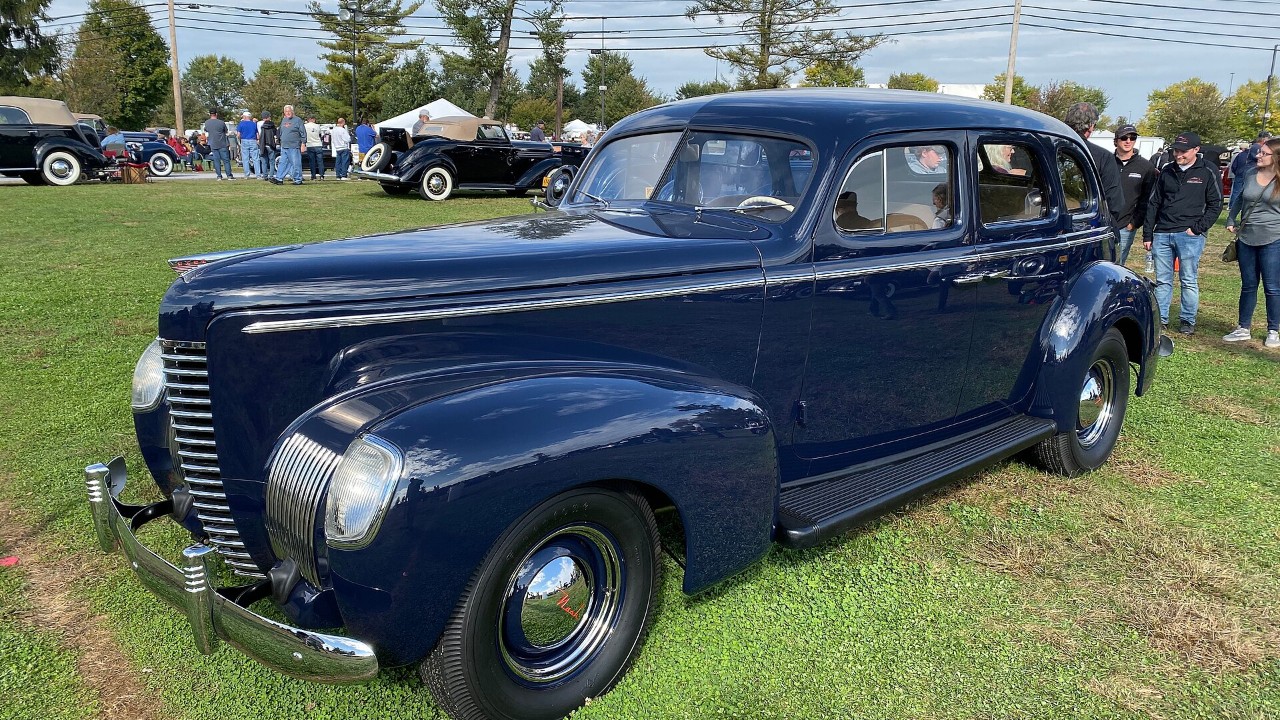
The Nash Weather Eye began as a 1938 heater that did something new. It pulled fresh air in from outside the car, warmed it over a core filled with hot engine coolant, and sent it into the cabin. A year later, Nash added a thermostat and gave the system the name that stuck.
Today, every car works this way, so the idea sounds obvious. In the 1930s, it wasn’t. Heaters were often crude, and some of them borrowed their heat straight from the exhaust.
Nash, a mid-sized independent from Kenosha, Wisconsin, turned that small comfort item into an engineering lead it held for years. As a result, the same thinking later produced one of the first compact air-conditioning systems in an American car.
How cars kept warm before Nash
Early drivers made do with crude fixes. Hagerty’s history of the early days of car heaters describes hot bricks and soapstones warmed in the home oven, then coal-burning foot warmers. By at least 1907, accessory makers were also selling heaters that used exhaust gas.
Those exhaust heaters had a dark side. According to Hagerty, they were hard to fit, and some leaked exhaust into the cabin, which caused carbon monoxide deaths. Ford’s 1933 V8 offered an in-dash heater that passed fresh air around two dozen exhaust flues, while GM’s Delco division tried a steam system charged with about an ounce of water.
Hot-water heaters were the safer path. Hagerty explains that reliable water pumps and thermostats made them practical by the mid-1920s. For example, A.B. Arnold built a prototype for Modine in 1927 and 1928 with a honeycomb core under the dash.
What Nash’s 1938 heater did differently
Nash combined the two jobs. In a 2016 piece marking the company’s centennial, Jalopnik describes the 1938 heater as one that “took in fresh air and passed it over a heater core full of hot radiator water.” It credits Nash engineer Nils Eric Wahlberg with the flow-through ventilation idea behind it.
Printers Devil, which reproduces a period Nash advertisement, calls the 1938 setup a “conditioned air” heating and ventilating system. It also describes it as “the first hot-water car heater to draw fresh air from outside the car.” In other words, the cabin got warm, clean air rather than the same air warmed again and again.
That difference is what put Nash ahead. Before that, Hagerty adds, Nash had already worked on cabin pressurization for 1937, forcing filtered air through the heater so cold drafts couldn’t seep in. The 1938 design went a step further by drawing that air from outside and heating it with engine coolant.
The 1939 Nash Ambassador Eight and the Weather Eye name
For 1939, Nash added the piece that made the system feel modern. Jalopnik says a thermostat arrived that year, and it calls the result the first Weather Eye. Printers Devil adds that the upgrade brought a dashboard dial, so drivers could set the temperature and let the system manage it.
Nash’s own advertising leaned hard on comfort. The 1939 ad reproduced by Printers Devil promised that the “Weather Eye” gave “fresh air, free of dust…rain….insects…chilling drafts!” The same ad also pitched a rear seat that converted into a bed for two adults.
Packaging was another win. Jalopnik notes that the Weather Eye “was all under the front cowl,” instead of eating trunk space. That layout became the template for later heating and cooling systems.
From heater to the 1954 All-Weather Eye
Nash kept building on the same hardware. In 1954, it added air conditioning to the system and called it the All-Weather Eye. Mac’s Motor City Garage describes it as the first modern, fully integrated automotive air-conditioning system, with heating, cooling and defrosting run from a single control.
Earlier systems from rivals had put the evaporator and blower in the trunk. By contrast, Nash tucked them into the cowl, behind the dash. Mac’s adds that Nash patented the basic layout in 1942, with Wahlberg and Joseph F. Sladky leading the work.
Price was the other selling point. According to Mac’s, the option added $395 to a Statesman or Ambassador. The Henry Ford museum holds a June 24, 1954, Time magazine ad in which Nash billed the system as “Another ‘World First’ from Nash!”
Why the Nash Weather Eye still matters
The industry took decades to catch up on the basics. Curbside Classic notes that heaters stayed an extra-cost option on most American cars well into the 1950s. GM made them standard across its cars only in 1962, and Studebaker still charged $80 for one in 1966.
Meanwhile, Nash had made its Weather Eye heater standard on the 1950 Rambler in its first, top-trim Custom form, according to Curbside Classic. The Weather Eye name also outlived Nash itself. Nash-Kelvinator merged with Hudson in April 1954 to form American Motors, and Mac’s notes that the new company started with combined assets of $355 million.
More from Fast Lane Only