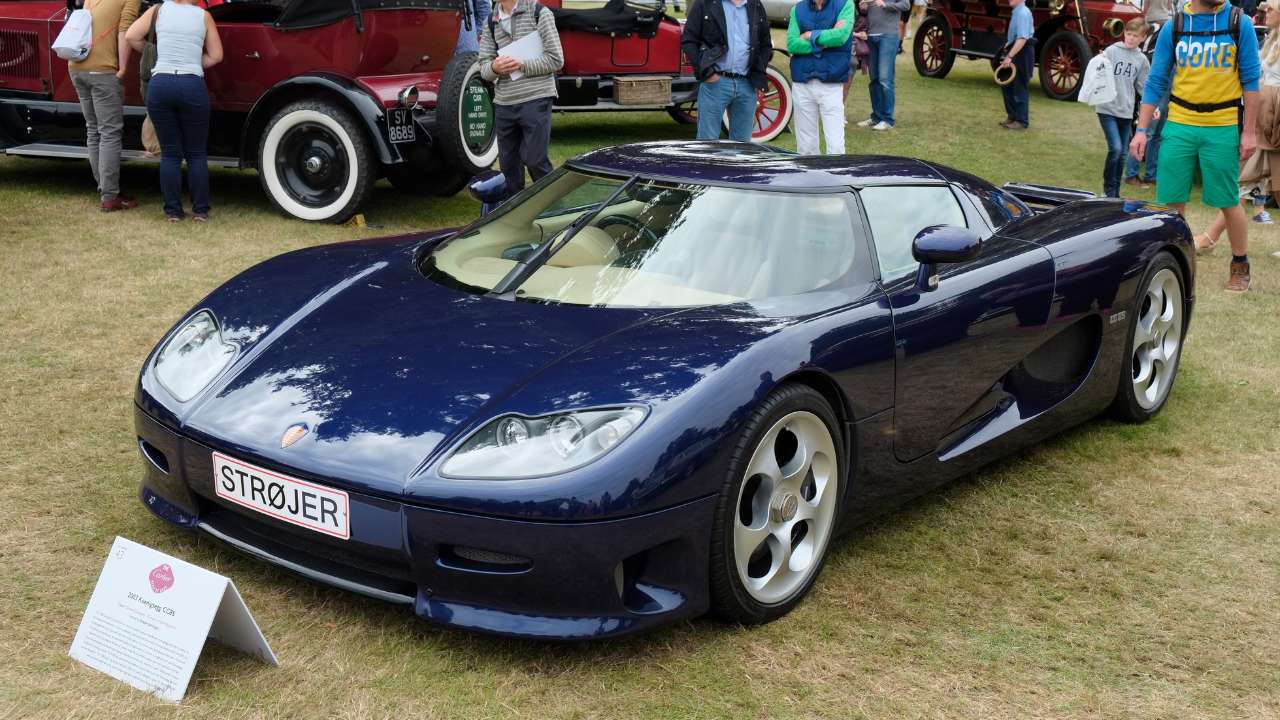
The Koenigsegg CC8S did not just introduce a new Swedish supercar nameplate. In 2002 it arrived with a 4.7‑liter V8 that Guinness World Records recognized as the most powerful production engine of its time, rated at 655 horsepower. That figure put a tiny startup from Ängelholm in direct contention with the most established exotics on the planet and set the tone for the horsepower wars that followed.
From Workshop Dream to Record Book
When the CC8S reached customers in the early 2000s, Koenigsegg was still a young company trying to prove it belonged in the same breath as Ferrari, Lamborghini and McLaren. The car’s mid‑mounted V8, built around a heavily reworked Ford architecture, delivered 655 horsepower and 750 Nm of torque, enough for Guinness World Records to certify it as the most powerful production engine available in 2002. For a first production model, that recognition was extraordinary.
This was not a stripped‑out drag special or a one‑off prototype. The CC8S had to meet road‑car regulations, pass emissions tests and survive real‑world use. That made the Guinness listing more than a publicity stunt. It was validation that Koenigsegg could engineer a complete package: powertrain, cooling, drivetrain and aerodynamics all working together in a car that customers could register and drive on public roads.
At a time when many supercars still hovered in the 400 to 500 horsepower range, the CC8S specification looked almost outlandish. Yet the engine was not a fragile race motor. It was designed to idle in traffic, start on cold mornings and pull smoothly from low revs while still delivering a top‑end rush that matched its record figure.
Inside the 4.7‑Liter V8
The CC8S engine began life as a Ford modular V8, but Koenigsegg treated that block as a starting point rather than a finished product. Displacement was set at 4.7 liters, and the company reworked internal components, cylinder heads and intake to handle far greater specific output than the donor engine ever carried in mainstream applications. The result was 655 horsepower at relatively high revs and a broad torque curve that peaked at 750 Nm.
Rather than resorting to turbocharging, Koenigsegg relied on careful breathing and high volumetric efficiency. The intake manifold, cam profiles and exhaust headers were tuned to keep the engine responsive across the rev range. That approach gave the CC8S a linear power delivery that distinguished it from later turbocharged hypercars, which often deliver a more abrupt surge once boost arrives.
The V8 was mounted longitudinally behind the driver and paired with a six‑speed manual gearbox, putting the driver in direct contact with the engine’s character. Each shift demanded precision, and the sound of the V8, unfiltered by turbochargers, became part of the car’s identity. The engine bay packaging also forced Koenigsegg to innovate in cooling, with large side intakes and carefully managed airflow to keep temperatures under control at sustained high speeds.
Performance That Matched the Numbers
Raw horsepower figures attract attention, but the CC8S had to translate its 655 horsepower into real performance to justify the Guinness recognition. With a lightweight carbon fiber and aluminum chassis, the car tipped the scales far below many contemporaries. That low mass, combined with the powerful V8, produced a power‑to‑weight ratio that rivaled the quickest machines of the era.
Acceleration figures reflected that advantage. The CC8S could sprint from a standstill to highway speeds in a few seconds and continue to pull deep into triple‑digit territory. Its top speed was quoted well above 300 km/h, placing the car among the fastest production vehicles of its day. High‑speed stability, aided by the car’s long tail and integrated rear wing, allowed drivers to exploit that potential on suitable tracks or closed roads.
Braking and handling had to match the engine’s output. Large ventilated discs, multi‑piston calipers and carefully tuned suspension geometry kept the CC8S controllable during aggressive driving. The powertrain was only one part of the performance story, but it served as the headline figure that drew attention to the rest of the package.
Why Guinness Recognition Mattered
For a small manufacturer, independent validation can be the difference between curiosity and credibility. The Guinness World Records listing for the CC8S engine gave Koenigsegg a clear, easily communicated achievement: the most powerful production engine available in 2002, at 655 horsepower. That single line helped potential buyers, investors and suppliers understand that Koenigsegg was not just building another niche sports car.
The record also highlighted a shift in the supercar market. Power figures that once belonged exclusively to racing prototypes were now appearing in road‑legal vehicles. The CC8S stood at the front of that shift, showing that a new entrant could leapfrog established brands by focusing on engineering rather than heritage.
In marketing terms, the Guinness recognition provided a hook that journalists and enthusiasts could repeat. It framed every test drive and review. Instead of asking whether Koenigsegg could compete, the conversation quickly turned to how this newcomer had managed to outgun so many established names on its first attempt.
Context in the Early‑2000s Horsepower Race
The early 2000s were a turning point for performance cars. Ferrari was preparing the Enzo, Mercedes‑Benz had the SL55 AMG, and Lamborghini was transitioning into the Audi era with the Murciélago. Power figures were climbing, but few production engines crossed the 600‑horsepower threshold. Against that backdrop, the CC8S specification looked almost like a challenge to the rest of the industry.
Some competitors relied on larger displacement or forced induction to reach their outputs. Koenigsegg’s 4.7‑liter V8, tuned to 655 horsepower, achieved its figure with a relatively compact package. That efficiency foreshadowed later trends, where smaller engines with advanced breathing or turbocharging would replace the big naturally aspirated V12s that had dominated the 1990s.
The Guinness record also intersected with another contest: the race for the title of fastest production car. High horsepower was a prerequisite for that pursuit, and the CC8S laid the groundwork for Koenigsegg’s later attempts at speed records. Coverage of the world’s fastest production often traces its lineage back to early V8s like the CC8S unit, which proved that extreme power could be engineered into a road‑legal package.
Engineering Lessons That Shaped Later Koenigseggs
The CC8S engine was not an endpoint. It served as a development platform for Koenigsegg’s later powertrains, including the more powerful V8s that powered the CCR, CCX and eventually the Agera line. Each new model pushed output higher, but the basic lessons from the 4.7‑liter unit remained relevant.
Cooling management, for example, became a core competency. The CC8S forced engineers to learn how to route air through tight spaces, how to balance radiator capacity with aerodynamic drag and how to keep intake temperatures under control during extended high‑load operation. Those solutions carried forward into later cars that produced far more power and heat.
Similarly, integration of the engine with the chassis and gearbox informed Koenigsegg’s approach to packaging. The company learned how to keep the center of gravity low, how to manage drivetrain angles and how to service complex components in a mid‑engine layout. As outputs climbed well beyond 655 horsepower in subsequent models, those fundamentals kept the cars drivable rather than overwhelming.
Influence on the Broader Supercar Scene
The CC8S record sent a message to the wider industry. If a small Swedish manufacturer could deliver 655 horsepower in a production car, then the established brands had little excuse for holding back. Over the following years, power figures across the segment climbed steadily, and customers began to expect 600 horsepower or more from any serious flagship.
That escalation changed how supercars were marketed and reviewed. Numbers became part of the story in a new way. Top speed, power output and torque figures were no longer secondary to styling or brand history. The CC8S, with its Guinness‑certified engine, helped normalize the idea that a headline figure could define a car’s identity.
The record also contributed to a cultural shift among enthusiasts. Boutique manufacturers gained new respect, as buyers realized that innovation sometimes came from smaller teams willing to experiment. Koenigsegg’s success encouraged other niche brands to pursue ambitious projects, confident that the market would take them seriously if they could back their claims with measurable performance.
How the CC8S Stacks Up Today
Modern hypercars routinely clear 1,000 horsepower, and some hybrids push far beyond that figure. In that environment, 655 horsepower might look modest on paper. Yet context matters. In 2002, achieving that output in a production‑ready, emissions‑compliant car was a significant engineering feat.
The CC8S engine also holds up in terms of character. Enthusiasts who have experienced the car describe a responsive, naturally aspirated feel, with a rising surge of power that builds toward redline rather than arriving in a sudden wave of boost. That quality differentiates it from many contemporary turbocharged units, which may produce larger numbers but sometimes sacrifice linearity and sound.
From a historical perspective, the CC8S sits at the junction between analog and digital eras. It combined a manual gearbox and mechanical feel with advanced materials and aerodynamics. The engine symbolized that balance, blending traditional V8 virtues with cutting‑edge tuning to claim a place in the record books.
What Comes After a Record
For Koenigsegg, the Guinness recognition for the CC8S engine was both an achievement and a starting point. It set expectations that every subsequent model would push further, whether in power, speed or technology. The company responded with a series of increasingly advanced V8s, culminating in engines that used sophisticated turbocharging, flexible fuels and even camless valvetrain systems.
The legacy of the 655‑horsepower unit is visible in that progression. It proved that Koenigsegg’s engineering philosophy could deliver concrete results, and it gave the brand a foundation of credibility that still supports it today. Customers who order the latest models are buying into a story that began with a small team, a reworked Ford block and a Guinness certificate.
As power figures continue to climb and electrification reshapes performance cars, the CC8S engine stands as a marker of a particular moment. It captured the ambition of a young company, challenged the status quo, and helped trigger a new phase of the horsepower race. For many enthusiasts, that combination of audacity and execution is what makes it memorable, even in an era where four‑digit outputs have become almost routine.
More from Fast Lane Only
- Unboxing the WWII Jeep in a Crate
- 15 rare Chevys collectors are quietly buying
- 10 underrated V8s still worth hunting down
- Police notice this before you even roll window down
*Research for this article included AI assistance, with all final content reviewed by human editors.