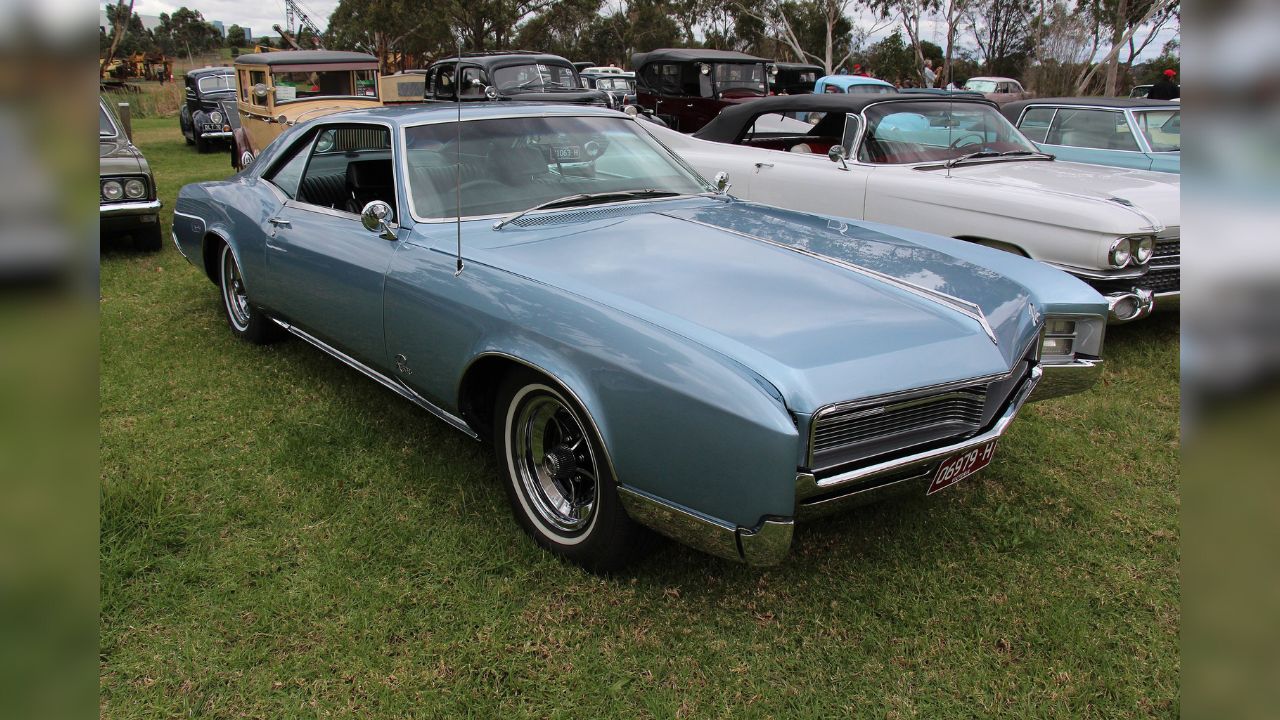
Personal luxury did not start with the 1967 Buick Riviera, but that model is where the idea finally looked and felt complete. You see it in the way the car balances power and restraint, comfort and control, flash and formality, all wrapped in a shape that still turns heads. If you want to understand how American carmakers taught you to expect muscle with your leather and style with your speed, you start with this Riviera.
Look closely and you find a coupe that was engineered to pamper you while quietly insisting you enjoy driving. The 1967 Riviera refined an already daring formula into something coherent and confident, a car that let you arrive in style without ever feeling like you had left the driver’s seat behind.
How Buick taught you what “personal luxury” meant
By the mid‑1960s, Buick had already positioned the Riviera as more than just another big coupe. As General Motors’ first serious entry into the emerging personal luxury segment, the Riviera was praised for mixing comfort with a driver‑focused feel that stood apart from softer full‑size sedans. You were meant to sit low, look out over a long hood, and feel like the car was built around you rather than around a back seat full of luggage.
That positioning did not happen in a vacuum. Buick had already helped Oldsmobile develop the front‑drive Unitized Power Package, a key piece of General Motors’ strategy to answer Fords Thunderbird in the same space. Reporting on the model’s early history notes how Buick and Oldsmobile used that Unitized Power Package to rethink how a big, stylish coupe could drive, which set the stage for the Riviera to define what personal luxury would feel like for you behind the wheel.
The 1967 shape: crisp lines, subtle aggression
By the time you reach the 1967 model year, the Riviera’s styling has settled into a confident, almost architectural form. The car rides on a cruciform frame similar to other Buick chassis but shorter and narrower, with a track that is 2 in (51 mm) narrower, a layout that, according to Its engineering summary, gives the car a slightly firmer ride and a more tailored stance. You feel that in the way the fenders hug the wheels and the roofline flows into a tight rear deck, a look that still reads as tailored rather than bloated.
Walk around a well‑kept example and the details keep reinforcing that impression. In a detailed walkaround video, host Jun introduces you to Adam and his classic car channel as they circle a Riviera, pointing out how the hidden headlights, sweeping side crease, and restrained chrome make the car feel like a rolling sculpture rather than a simple cruiser, a sense you can share when you watch Adam drive it. Contemporary enthusiasts echo that language, describing the 1967 Buick Riviera as “Luxury Meets Muscle” in a “Bold Package,” a phrase that shows up repeatedly in fan posts about the Buick Riviera and underlines how the shape alone still sells the car to you today.
Under the skin: a better V8 for serious driving
The 1967 Riviera did not just look more focused, it backed up the promise with a major mechanical change. The biggest change for 1967 was the introduction of the 430 ci V‑8 rated at 360 hp, and Gone was the 401‑425 “nailhead” that had powered earlier cars, a shift documented in Gone period notes. That move gave you more effortless torque and a smoother, freer‑revving character, exactly what you expect when you press the throttle in a personal luxury coupe.
Technically, that engine was part of a broader family. The 430‑cubic‑inch (7.0 L) V8, produced from 1967 until 1969, used a bore and stroke of 4.1875 in by 3.9 in, figures that show up in engineering data on the 430-cubic-inch Buick V8. When you combine that specification with the Riviera’s relatively taut chassis, you get a car that feels eager without being frantic, the kind of power delivery that lets you glide along a highway in near silence and still have instant response when you need to pass.
Luxury that still lets you feel the road
Personal luxury only works if you feel indulged, and the Riviera’s cabin was designed to do exactly that. Period sales data show that Sales for 1966 rebounded to 45,308, a new record for the model, and that momentum carried into 1967 as Buick added a full range of safety features and richer trim, details captured in a Sales for breakdown. Slide into the driver’s seat and you are greeted by deep‑set gauges, a sweeping dash, and upholstery that feels more like a lounge than a taxi, all while the steering wheel and pedals fall naturally to hand and foot.
Enthusiasts who share photos of the 1967 Buick Riviera today still emphasize that blend of comfort and control. One fan post describes the car as a classic American luxury car with a distinctive “boattail” design and a powerful V8, language that captures how the Buick Riviera lets you enjoy long‑distance cruising without losing the sense that you are piloting something substantial. Another community highlights a custom 1967 Riviera as a “bold reinterpretation” that blends sleek original lines with modern enhancements, a nod to how the Buick Riviera interior and stance still feel like a solid foundation for contemporary tastes.
Gran Sport attitude and the lure of performance
If you wanted your Riviera with a sharper edge, Buick was happy to oblige. The Gran Sport package turned the car into a more serious driver’s machine, with heavy‑duty suspension, a limited‑slip differential, and other upgrades bundled for only $140, a figure preserved in period pricing for The Gran Sport. Add in Strato bucket seats and you had a cockpit that hugged you more tightly, reinforcing the idea that this was a personal car first and a family hauler a distant second.
Contemporary descriptions of the 1967 Buick Rivera Gran Sport underline how special that combination felt. One valuation profile calls the 1967 Buick Rivera a true star at General Motors, noting that it was the only personal luxury E‑body cruiser with rear‑wheel drive, a distinction that made the Buick Rivera feel more traditional and more engaging to you than some of its front‑drive cousins. In enthusiast debates that pit a 1967 Riviera GS against other General Motors personal luxury choices, fans describe the 1967 Buick Riviera as “The ultimate blend of European elegance and Detroit muscle,” a phrase that appears in a spirited The Riviera discussion and neatly sums up why the GS badge still matters to you as a driver.
More from Fast Lane Only