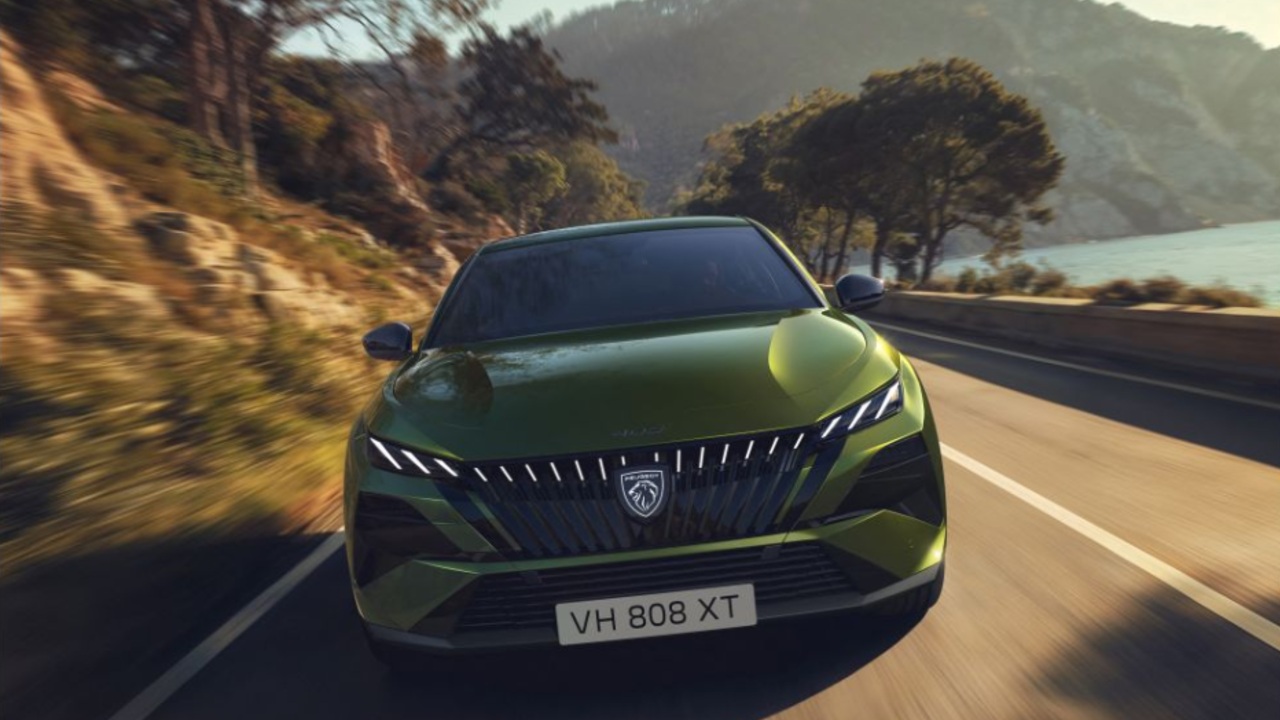
The Peugeot 408 fastback arrives with a clear mission: tempt drivers who might otherwise default to a Volvo XC40 or an Audi Q3 into something lower, sleeker and more overtly design led. Rather than chasing SUV volume, Peugeot is using this car to test how far a mainstream badge can push into premium territory without losing touch with reality. It is a calculated play for buyers who care as much about aesthetics and cabin ambience as they do about badge prestige.
By reshaping a family car into a “lifted fastback” rather than a conventional crossover, the 408 positions itself as a stylish alternative to the upright Scandinavian and German staples. The question is not whether it can match them spec for spec, but whether its blend of French charisma, practicality and price can persuade loyalists to hand over their keys.
Design that undercuts the SUV default
Peugeot has been explicit that the 408 is intended for wealthier customers who want something different than an SUV, and the body style is the clearest expression of that strategy. Instead of a boxy silhouette, the car adopts a fastback profile that sits lower than a typical crossover yet higher than a traditional hatchback, a stance that is reinforced in the 2026 facelift with sharper surfacing and a more assertive front end. Official material describes the Peugeot 408 as “FRENCH CHARISMA WITH UNIQUE ELEGANCE”, signalling that design theatre is not an afterthought but the core product pitch.
Compared with a Volvo XC40 SUV, the Peugeot 408 Liftback Crossover is reported to be 26.2 cm longer and 17.4 cm lower, a combination that visually stretches the car and gives it a planted, almost coupe like presence on the road. That extra length and reduced height, together with the aggressive fastback roofline highlighted in early GT Exclusive previews, are intended to catch the eye of drivers who find compact SUVs too upright and anonymous. For Audi and Volvo owners used to clean Scandinavian or Teutonic lines, the 408 offers a more extrovert alternative without straying into gimmickry.
Premium ambitions on a mainstream badge
Peugeot executives have been clear that the 408 is designed to bridge the gap between mainstream and premium segments, not simply to add another volume model to the range. She and other Peugeot leaders have said the 408 will be aimed at wealthier customers who want something different than an SUV, which explains why the car has been positioned as a flagship within the Peugeot line up rather than a derivative of an existing hatchback. In official presentations, the new Peugeot 408 has been described as the strongest expression of the brand’s commitment to design and technology, underlining its role as a halo product.
Pricing and specification support that ambition. In markets where it is compared directly with the Volvo XC40, the Peugeot 408 2026 is listed from AED 149,900, while the Volvo XC40 2026 starts from AED 189,900. That gap allows Peugeot to undercut a premium rival while still charging a clear step above conventional family hatchbacks such as the Peugeot 308, whose cabin architecture the 408 shares. The strategy is to deliver a premium leaning experience, from materials to technology and even features such as multiple massage modes in higher trims, while keeping the badge accessible enough to tempt buyers who might otherwise feel priced out of a Volvo or Audi showroom.
Cabin, tech and comfort aimed at Volvo and Audi drivers
Inside, Peugeot has opted for continuity rather than reinvention, betting that its established iCockpit layout is distinctive enough to stand against premium rivals. The cabin of the 408 is described as a much quieter affair that shares a lot with the likes of the Peugeot 308 hatchback, including a driver focused cockpit with two 10 inch digital displays and a compact steering wheel. Inside, Peugeot has retained this familiar arrangement in the refreshed 408, signalling confidence that its blend of digital instrumentation and physical shortcuts can satisfy buyers used to the polished interfaces of Volvo and Audi models.
Comfort and perceived quality are equally central to the pitch. Reports highlight that the 408 has been developed specifically to offer a more refined ride and a calmer interior than mainstream crossovers, with attention paid to sound insulation and seat comfort. She and other Peugeot executives have pointed to features such as multiple massage modes in the front seats as evidence that the 408 is intended to feel like a step up from conventional family cars. For Volvo XC40 and Audi Q3 owners accustomed to supportive seating and hushed cabins, Peugeot is effectively arguing that they can enjoy a similar level of serenity and equipment without paying full premium money.
Practicality and packaging: fastback form, family function
One of the key questions for any fastback is whether its style compromises everyday usability, and here the 408 makes a pragmatic case. Boot space figures show that The Peugeot 408 has a pretty impressive 536-litre boot, which places it firmly in family car territory. Boot space in the plug in hybrid versions is reduced because of the battery pack, but the basic layout remains square and usable, with the option to expand capacity further by folding down the rear seats. For buyers cross shopping with an SUV, that number is not just a statistic, it is reassurance that the dramatic roofline does not come at the expense of luggage room.
Dimensional comparisons with the Volvo XC40 reinforce that point. Technical specs indicate that the Peugeot 408 Liftback Crossover offers 21 percent more cargo space than the Volvo SUV, a direct challenge to the assumption that only a traditional crossover can swallow family kit. Combined with the lower ride height and longer body, the 408’s packaging suggests a car that can carry more than an XC40 while looking sleeker and likely feeling more car like to drive. For Audi loyalists used to the practicality of a Q3, the message is similar: the Peugeot may look like a style statement, but it has the numbers to function as a primary family vehicle.
Powertrains, value and the loyalty test
Under the skin, the 408 is not trying to out muscle premium rivals, instead it focuses on efficient turbocharged engines and plug in hybrid options that align with its positioning as a sophisticated daily driver. Comparisons list a Turbo 4, 1.6L unit for the Peugeot, paired with an automatic transmission that prioritises smoothness over outright performance. Safety Rating information in those same comparisons indicates that the 408 is engineered to meet the expectations of buyers who treat Volvo as a benchmark for occupant protection, even if some specific ratings are marked as Not Applicable in early data.
Value, however, may be the Peugeot 408’s most persuasive weapon in prising open brand loyalty. With the Peugeot 408 2026 starting From AED 149,900 against the Volvo XC40 2026 From AED 189,900, the French fastback undercuts its Swedish rival by a meaningful margin while offering more cargo space and a more dramatic design. For Audi drivers, the equation is similar, even if direct price comparisons are not detailed in the available reporting. The refreshed 408, unveiled by Peugeot with subtle design updates and new technology, doubles down on this formula by aligning the car with the brand’s latest styling and digital features without inflating its positioning. The result is a model that asks Volvo and Audi loyalists to consider whether the extra outlay for a premium badge still makes sense when a Peugeot can now match much of the experience, and in some areas, quietly surpass it.
More from Fast Lane Only