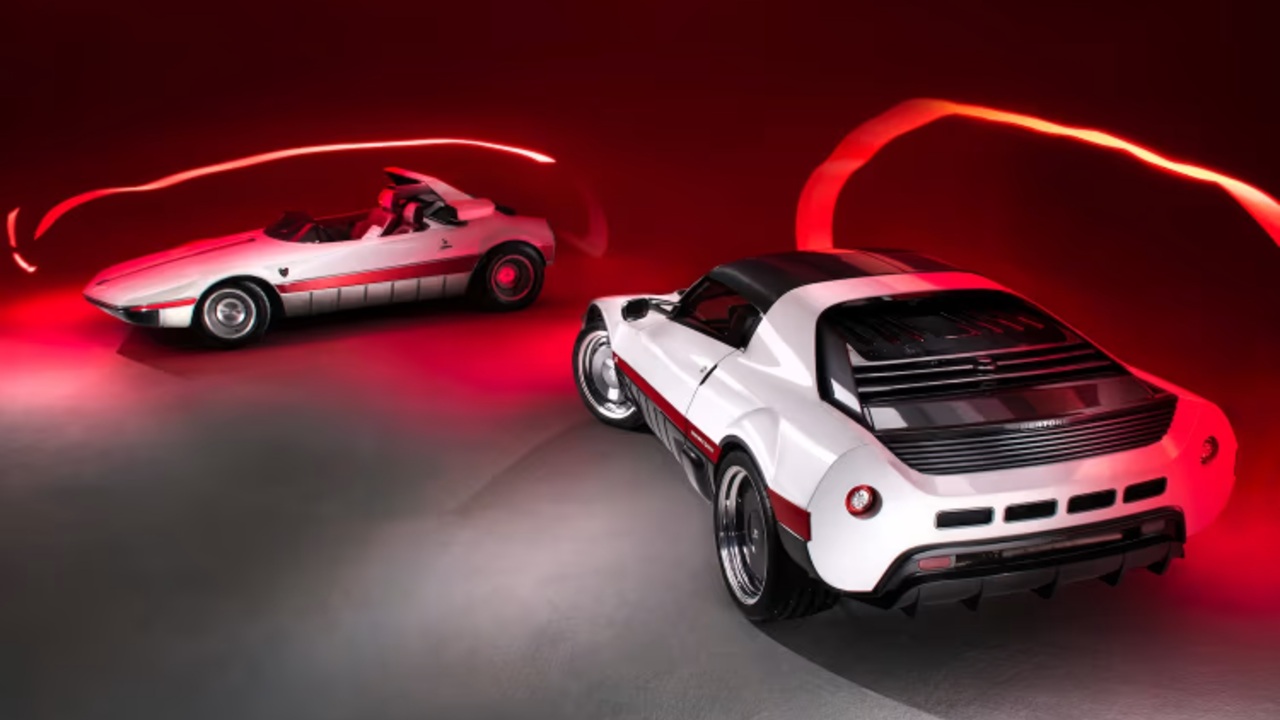
The Bertone Runabout arrives as a rare kind of sports car, one that treats nostalgia not as a costume but as a core engineering brief. With pop-up headlights, a supercharged V6, and a silhouette that could have rolled straight out of a 1960s design studio, it reads like a gearhead wish list made real. Yet beneath the retro theater sits a modern, Lotus-based chassis and serious performance hardware that push this boutique Italian machine far beyond mere tribute.
By reviving a once-obscure concept and turning it into a limited-production supercar, Bertone is betting that enthusiasts still crave analog drama in an era of touchscreens and silent EVs. The Runabout is small, loud, and unapologetically focused, a car that treats every drive as an event and every design flourish as a statement about what sports cars can still be.
From forgotten concept to modern halo car
The new Bertone Runabout traces its lineage directly to a 1969 concept that blended boat-inspired lines with mid-engined proportions and, crucially, pop-up headlights. That original design, created in the late 1960s, went on to influence the Fiat X1/9, with its wedge profile and targa-style layout echoing the Runabout’s experimental form. Designers of the period drew heavily from racing boats of the mid-1960s, and the Runabout’s low prow, wraparound glass, and open cockpit made it feel more like a watercraft translated to asphalt than a conventional coupe.
For decades, the Runabout name sat deep in Bertone’s back catalog, overshadowed by more famous showpieces, even though the concept played a larger role in shaping the studio’s thinking than its obscurity suggests. The decision to resurrect it now, as a fully engineered production car, signals a deliberate attempt to reconnect with that experimental spirit and to showcase where the reborn Bertone brand wants to go next. Turning the 1960s idea into reality required not only aesthetic fidelity but also a modern platform and powertrain capable of delivering performance worthy of a contemporary supercar.
Miata-sized body, Lotus Exige bones
Visually, the Runabout occupies the compact footprint enthusiasts associate with lightweight roadsters such as the Mazda MX-5 Miata, but its stance and detailing are far more aggressive. The car will be offered in two body styles, Barchetta and Targa, both of which lean into the open-air theme that defined the original concept. The Barchetta goes fully open, with a minimalist windscreen and an emphasis on pure, unfiltered airflow over the cockpit, while the Targa adds a removable roof panel that nods to the Fiat X1/9 connection and offers a touch more everyday usability.
Beneath the retro skin, the Runabout is based on the Lotus Exige, a choice that instantly gives it serious performance credibility. The Exige’s mid-engined layout, compact wheelbase, and track-focused suspension provide a proven foundation for a car that is meant to feel alive at speed rather than merely fast in a straight line. Adapting that chassis to the Runabout’s bespoke bodywork and interior allows Bertone to combine classic Italian styling with the kind of precise, communicative handling that has made the Lotus Exige a benchmark among purist drivers, while still assigning the Runabout its own identity and new VIN numbers as a distinct model.
Supercharged V6 theatrics and serious numbers
The centerpiece of the Runabout experience is its mid-mounted, supercharged V6, which transforms the compact body into a genuine performance machine. According to the spec sheet for the 2026 Bertone Runabout, the 3.5 liter supercharged V6 produces 475 horsepower and 361 lb-ft of torque, figures that place it firmly in modern supercar territory despite its relatively small footprint. That output is channeled through a manual transmission, reinforcing the car’s analog character and giving drivers a direct connection to the powertrain that is increasingly rare in a market dominated by dual-clutch automatics.
Performance claims are suitably dramatic. Reporting on the Runabout’s debut notes that the car delivers 469 bhp and is capable of a top speed in the region of 168 mph, numbers that align with its aggressive aero and lightweight construction. A KT500 carbon fiber airbox increases intake flow and reduces turbulence, supported by carefully engineered ducting that helps the supercharger breathe efficiently at high revs. The combination of compact dimensions, a mid-engined layout, and a high-output V6 gives the Runabout the kind of power-to-weight ratio that should make it feel explosive on a back road or circuit, with the supercharger’s instant response adding to the sense of mechanical theater.
Pop-up headlights and retro drama, updated
While the powertrain and chassis make the Runabout objectively quick, its emotional appeal rests heavily on design details that modern regulations have largely erased from mainstream cars. Chief among these are the pop-up headlights, which return here not as a nostalgic gimmick but as a defining visual signature. The Runabout’s front end is clean and low when the lights are stowed, then transforms when the units rise into the airflow, recalling the drama of 1970s and 1980s sports cars while tying directly back to the 1969 concept that inspired this project.
The rest of the exterior continues this blend of retro cues and contemporary execution. The open-top Barchetta configuration emphasizes the boat-inspired theme, with a cockpit that feels almost like a deck sunk into the bodywork, while the Targa version adds a more structured roofline without losing the sense of lightness. Designers have incorporated modern aerodynamic thinking into the classic wedge shape, using subtle sculpting and vents to manage airflow around the mid-mounted engine and over the rear deck. The result is a car that looks unmistakably vintage at a glance yet reveals its modern intent in the details, from the precision of its panel gaps to the integration of contemporary lighting and materials.
Exclusivity, price, and the future of analog exotics
The Runabout is not intended to be a common sight on public roads. Bertone plans to build only 25 examples, a production run that positions the car as a true collector’s item rather than a volume model. That scarcity is matched by a price tag that reflects both the bespoke nature of the project and its underlying Lotus Exige hardware, with reports indicating a cost of over £400,000. In a market where limited-run supercars often serve as rolling brand statements, the Runabout functions as a halo for the revived Bertone name, signaling that the company is willing to invest heavily in craftsmanship and design heritage.
For enthusiasts, the Runabout’s significance extends beyond its rarity and cost. It represents a counterpoint to the industry’s rapid shift toward electrification and driver-assistance technology, offering instead a compact, manually shifted, combustion-powered machine that celebrates mechanical engagement. By turning a 1960s concept into a road-legal supercar with modern performance, Bertone is making the case that there is still room for small-batch, analog exotics that prioritize sensation over efficiency. Whether the Runabout becomes a springboard for further models or remains a singular statement, it crystallizes a particular vision of what a gearhead fantasy can look like in the mid-2020s: small, loud, visually daring, and utterly unconcerned with blending in.
More from Fast Lane Only