A rare McLaren 600LT has been badly damaged in a single-car crash in Toronto after slamming into a roadside light pole, according to photos circulating among supercar enthusiasts. The collision mangled the front of the low-production British coupe and instantly turned a collector-grade machine into a cautionary tale about power, price and public roads.
The wreck underscores how a car built for track-focused precision can become unforgiving in everyday city traffic, especially when its performance envelope far exceeds the environment around it. For Toronto, it is also a visual reminder that the city’s growing supercar scene brings very public, very expensive consequences when something goes wrong.
What happened
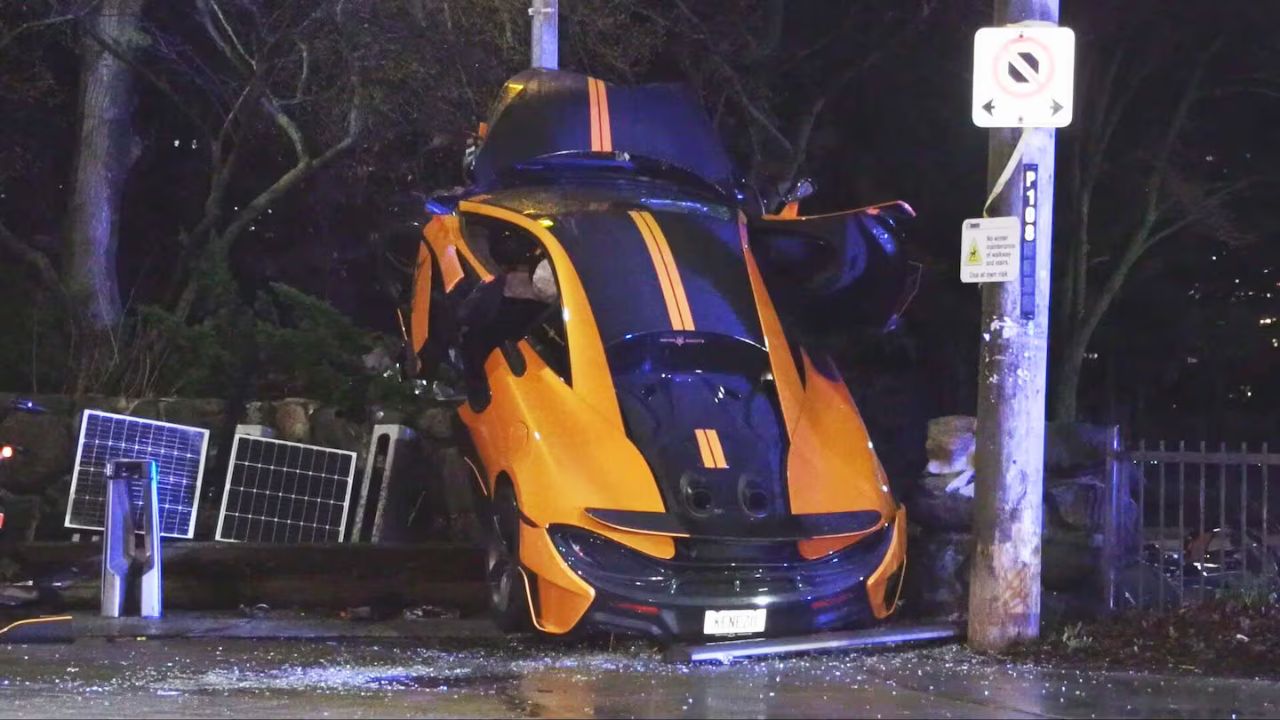
Images from the scene show a McLaren 600LT finished in a bright, high-visibility color sitting skewed across a Toronto street, its nose buried against a metal light pole. The front bumper appears torn away, the hood is crumpled upward and several body panels around the front wheel arches look twisted and fragmented, consistent with a high-impact frontal strike on a fixed object. The car’s ultra-low front splitter, designed for downforce at speed, seems to have taken a direct hit along with the front crash structure, leaving the once sleek supercar looking abruptly truncated.
According to reporting on the incident, the car is identified as a McLaren 600LT, one of the more extreme versions of the McLaren Sports Series line. The coupe reportedly left its lane and struck a streetlight on a Toronto road, with the impact concentrated on the front passenger side. Photos suggest the airbags deployed and the cabin remained structurally intact, indicating that the carbon-fiber passenger cell did its job even as the front end collapsed around it. The collision was described as a road accident within the city rather than a track incident or highway pileup, reinforcing how quickly a car with this level of performance can get into trouble in an urban setting.
The 600LT badge stands for “Longtail,” a name McLaren reserves for lighter, sharper, more aggressive evolutions of its standard models. In this case, the 600LT is a more focused derivative of the 570S, stripped of weight and tuned for sharper responses. That heritage makes the Toronto crash particularly jarring for enthusiasts, since the car in the photos appears to be one of a relatively small number of examples that left the factory. The report characterizes the car as one of the rarest McLarens, a description that reflects both its limited production run and its position as a sought-after collectible among modern supercars.
From the available images, the damage appears severe enough that the car may be written off by insurers as a total loss. The front crash structure, suspension components and multiple carbon-fiber panels look heavily compromised, and the cost of sourcing and fitting replacement parts for a low-volume model is often prohibitive. Even if the car is technically repairable, the structural work and subsequent branded title would likely erase much of its collector value. That kind of outcome is common when limited-run exotics are involved in significant impacts, since the economics of restoration rarely match the theoretical value of a pristine car.
Local context adds another layer. Toronto has seen a growing number of high-end performance cars on its streets, particularly in affluent neighborhoods and along popular cruising routes. Residents and police have periodically raised concerns about speeding, loud exhausts and aggressive driving in these areas. A single-car collision with a light pole fits a pattern that safety advocates often highlight: drivers in ultra-powerful cars may not always adjust their behavior to match road conditions, traffic or weather, especially on city streets that were never designed for 600 horsepower machinery.
Although detailed information about injuries or charges has not been publicly confirmed in the reporting, the visual evidence suggests a significant impact that likely drew a fast response from emergency services. In similar incidents, police typically investigate speed, driver behavior and any possible impairment, while city officials assess whether roadside infrastructure such as light poles or traffic signals needs repair or replacement. The Toronto crash appears to follow that familiar script, with the damaged light standard and debris field indicating that the city will have to address the aftermath beyond the wrecked car itself.
The rarity of the 600LT involved is emphasized in coverage that calls it one of the rarest McLarens to suffer such a fate in Toronto, a description that aligns with how few of these cars were built worldwide. The report on this specific incident, which describes how the car “crashed into a light pole in Toronto,” appears on a specialist site focused on performance cars and supercar culture, highlighting how quickly such events reverberate across enthusiast networks when a limited-production model is involved. That coverage of the rare McLaren 600LT helps confirm both the model and the basic outline of the crash.
Why it matters
On one level, a single-car crash is a local traffic incident. On another, the destruction of a McLaren 600LT in city traffic speaks to a broader tension between modern supercars and public roads. The 600LT is not just fast in the casual sense. Its twin-turbocharged V8 produces roughly 600 metric horsepower, channeled through a dual-clutch gearbox to the rear wheels, and it can sprint from 0 to 100 kilometers per hour in around 3 seconds. That performance is paired with a stiff chassis, aggressive aerodynamics and track-oriented tires. In other words, it is a machine designed to be stable at speeds that are illegal on virtually every public street in Canada.
When that level of capability is dropped into an urban environment filled with crosswalks, bike lanes and aging infrastructure, the margin for error shrinks dramatically. A momentary lapse, an unexpected road surface change or a misjudged throttle input can send a car like the 600LT off line. The Toronto crash visually illustrates that mismatch. A car engineered to lap circuits like Silverstone or Spa at triple-digit speeds ended up crumpled against a light pole beside a city lane marking, a reminder that engineering brilliance cannot fully compensate for human error or unsuitable surroundings.
The financial stakes are just as stark. The McLaren 600LT carried a price tag in the high six-figure range when new, especially once buyers added common options like carbon-ceramic brakes, lightweight seats and bespoke paint. On the secondary market, low-mileage examples have been trading at a premium, driven by limited supply and strong demand from collectors who see the 600LT as one of the purest modern McLarens. Turning one of those cars into a wreck on a city street is not just a personal loss for the owner. It also removes a scarce asset from the pool, nudges market values and fuels debates among collectors about how and where such cars should be driven.
Insurance dynamics add another layer of impact. Exotic car insurers price policies based on a mix of vehicle value, driver profile and perceived risk. High-profile accidents involving rare models can influence how underwriters think about certain cars and certain markets. If incidents like the Toronto crash become more frequent, insurers may respond with higher premiums, stricter usage limitations or more detailed telematics requirements. Owners might be pushed toward track-day coverage and limited-mileage policies, which could in turn change how often cars like the 600LT appear on public roads.
The crash also feeds into a long-running public debate about supercars in dense cities. Residents often complain about noise, street racing and perceived recklessness, while owners argue that they have the same right to use public roads as anyone else, provided they obey the law. A smashed McLaren against a light pole becomes a symbol in that argument. For some, it is evidence that these cars do not belong in traffic at all. For others, it is an unfortunate but isolated incident that should not define an entire community of enthusiasts. Either way, the imagery is potent and likely to be referenced in future discussions about enforcement and road design.
From an engineering perspective, the Toronto crash offers a real-world test of McLaren’s safety claims. The 600LT uses a carbon-fiber “MonoCell” tub that is designed to remain rigid and protect occupants even when the rest of the car sacrifices itself in an impact. In the photos, the front of the car appears to have absorbed the brunt of the collision while the passenger cell looks relatively intact, which is consistent with that design philosophy. For safety advocates and engineers, such incidents provide data points about how exotic materials and structures behave in everyday crashes, not just in controlled crash tests.
There is also a cultural dimension. Supercars like the 600LT are often treated as rolling art, photographed at cars-and-coffee meets and shared endlessly on social media. When one is destroyed, the images travel just as quickly, but the tone shifts from admiration to shock. The Toronto crash has already done the rounds among enthusiast communities, where it has sparked conversations about driver training, respect for power and the wisdom of using track-focused machinery as daily transport. Those conversations have practical consequences, influencing how new owners approach their own cars and what kind of behavior is celebrated or criticized within those circles.
For Toronto itself, the incident reinforces the need to align road safety measures with the realities of modern vehicles. Even if speed was not the primary factor in this crash, the presence of cars capable of rapid acceleration and high cornering forces on city streets means that traditional traffic calming measures may not be enough. City planners and traffic engineers increasingly look at how infrastructure can be designed to reduce the likelihood and severity of single-vehicle impacts, whether through barrier placement, pole design or roadway geometry. A high-profile wreck involving a rare supercar can give those technical discussions a new sense of urgency.
What to watch next
In the short term, the key questions revolve around the investigation and any follow-up actions by authorities. Police will typically examine whether speed, distraction or impairment played a role, and whether any charges are warranted. The outcome of that process will shape how the crash is perceived: as an unavoidable mishap in tricky conditions or as the result of preventable behavior behind the wheel of a very powerful car. If charges are laid, they may feed into broader enforcement campaigns targeting high-performance vehicles in the city.
Another immediate issue is the fate of the car itself. Given the extent of the visible damage, the McLaren is likely to move from the crash scene to a secure storage facility where insurers and repair specialists can assess it. Observers will be watching to see whether the 600LT is declared a total loss or whether a specialist shop attempts a full rebuild. In the exotic car world, such decisions are closely followed because they influence future values and set precedents for how far owners and insurers are willing to go to save a rare chassis.
More from Fast Lane Only