Rivian is turning its own used electric vehicle batteries into a new line of business, supplying packs for grid-scale storage projects led by recycling specialist Redwood Materials. The first major installation will sit next to Rivian’s manufacturing plant in Normal, Illinois, where retired packs from R1T and R1S vehicles will be repurposed into a 10 megawatt-hour energy storage system.
The partnership links two of the most closely watched names in clean transportation and battery recycling and offers an early look at how second-life batteries could support both factory operations and the broader power grid.
What happened
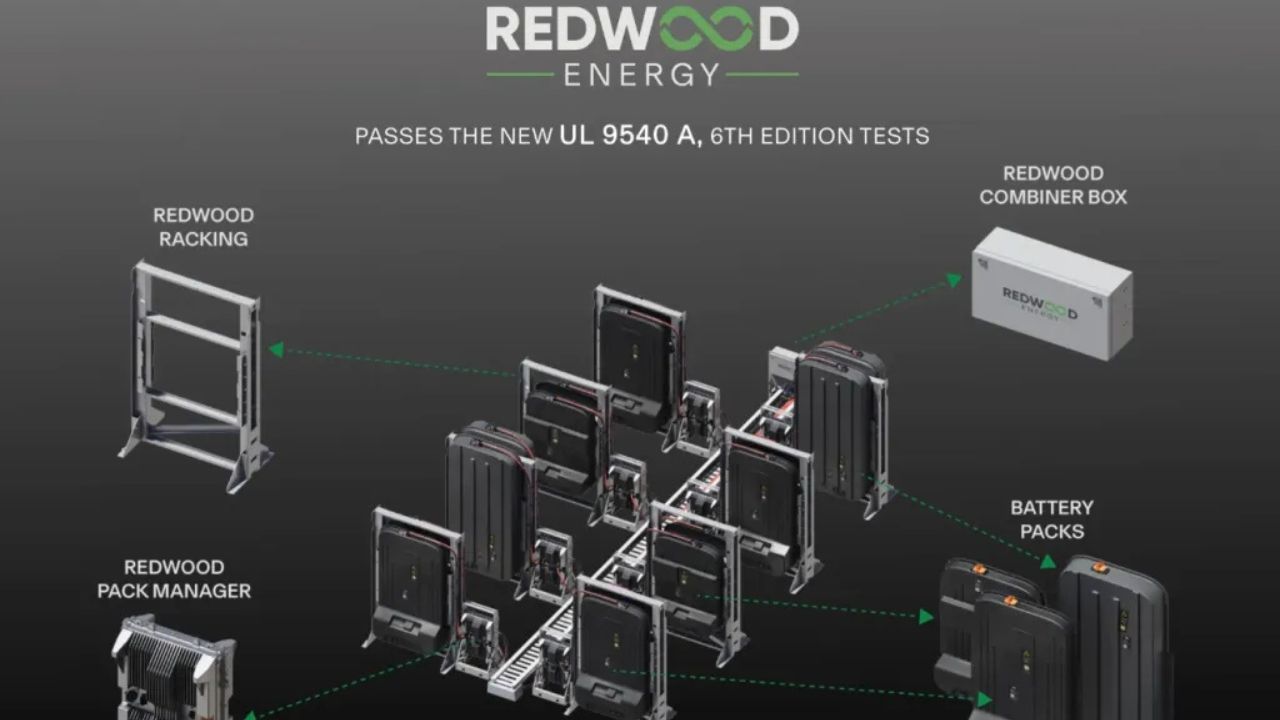
Rivian and Redwood Materials have agreed to an energy storage partnership that will see Rivian supply used and end-of-life battery packs for grid-connected systems engineered and operated by Redwood. According to the companies, the first project is a 10 megawatt-hour installation at Rivian’s assembly plant in Normal, Illinois, built from second-life packs originally designed for Rivian’s electric trucks and SUVs. The system is intended to store electricity for the facility and to interact with the local grid as a flexible resource.
The Illinois project is described as a second-life battery storage system that aggregates modules and packs which no longer meet Rivian’s standards for vehicle use but still retain substantial capacity. Engineering work by Redwood converts those packs into stationary storage units, with new controls, safety systems and grid-tied inverters that allow the batteries to charge and discharge in response to factory demand and utility signals. Reporting on the project specifies that the total capacity is 10 megawatt-hours, a scale large enough to support peak shaving for a manufacturing campus and to provide several hours of backup power during grid disruptions.
Because the system is being deployed on-site at Rivian’s plant, the same company that built and used the batteries in vehicles is now effectively becoming a supplier of battery packs for a grid storage asset. Coverage of the agreement describes Rivian as providing the used packs and collaborating on system design, while Redwood leads integration, installation and operation of the storage units. The project is framed as the start of a longer term relationship in which Rivian batteries feed a pipeline of grid storage deployments that Redwood can place at industrial facilities or on utility networks.
Several reports highlight that Redwood Materials was founded by JB Straubel, a co-founder and former chief technology officer of Tesla, and that the company has built a business around collecting, recycling and reusing lithium-ion batteries. The partnership with Rivian extends that work into what the firms describe as a closed-loop model, in which batteries are first reused in stationary storage and then eventually recycled into raw materials for new cells. One report notes that Rivian is “tapping Tesla co-founder’s Redwood Materials” to convert its used EV batteries into grid resources, underlining the strategic nature of the collaboration between an automaker and a specialist recycler in the same supply chain for grid power.
Energy and infrastructure coverage of the deal stresses that the Illinois installation is designed as a proof-of-concept for second-life EV batteries as grid assets. The 10 megawatt-hour system at Normal is described as a demonstration of how packs that have reached the end of their automotive life can be repurposed for another decade or more of service in stationary storage. Analysts quoted in those reports view the project as an early example of a business model in which automakers retain ownership or control of used packs and channel them into energy storage, rather than selling them for scrap or leaving them to third-party recyclers.
Additional reporting explains that the system will be connected to the local utility grid and configured to support several use cases. These include managing the plant’s peak electricity demand, shifting consumption to off-peak hours and providing backup power during outages. In some scenarios, the batteries could also participate in grid services markets, offering capacity for frequency regulation or other ancillary services, depending on local market rules. The Illinois project is therefore both an internal energy management tool for Rivian and a grid asset that Redwood can operate within the broader power system.
One detailed account from an EV infrastructure outlet describes how Rivian and Redwood are deploying a 10 megawatt-hour second-life battery storage system at the Illinois plant, built from modules sourced from Rivian’s own vehicles and test programs. The report notes that the system is designed to validate performance, safety and economics of second-life packs in a commercial setting, with data collection on cycle life, degradation rates and operating costs. This information will help determine how many additional grid storage projects can be supported by Rivian’s growing pool of used batteries Illinois plant.
Clean energy and ESG-focused coverage frames the partnership as part of Rivian’s broader strategy to reduce the environmental footprint of its manufacturing operations. Reports emphasize that the Illinois factory will be partially powered by recycled batteries, with the new storage system helping to integrate renewable energy sources and cut reliance on fossil-fuel-based grid power. One analysis notes that Rivian and Redwood are presenting the project as a way to power the EV plant with recycled batteries, linking the company’s production activities directly to its own waste stream with recycled batteries.
Industry-focused writeups also stress that the partnership is not limited to a single factory installation. Rivian and Redwood describe the Illinois project as the first of several planned deployments, with the potential for similar second-life systems at other Rivian facilities or at third-party sites. Energy sector coverage characterizes the agreement as a broader plan to use old EV batteries as grid solutions, positioning the two companies as early movers in a market that could grow rapidly as more electric vehicles reach end of life as grid solutions.
Additional trade press reports describe how the second-life storage system is being integrated into the Illinois plant’s energy management strategy. The system is expected to work alongside on-site renewable generation, such as solar installations, to smooth out fluctuations and to store excess energy for later use. Manufacturing sector coverage highlights that the project represents a new way for Rivian’s battery-powered Illinois factory to manage its power needs, using its own retired EV packs as a form of behind-the-meter infrastructure Illinois factory.
EV-focused outlets add further detail on the deployment, noting that the second-life battery storage system at the Illinois plant is already being installed and will be operated as a long-term asset. They emphasize that Rivian and Redwood are deploying second-life battery storage at the plant as a concrete step toward closing the loop on battery materials and building a business case for reuse before recycling second-life storage.
Why it matters
The Rivian and Redwood partnership matters on several levels: it tests the economics of second-life batteries, offers a template for how automakers can manage end-of-life packs and hints at a future in which EV manufacturers also act as energy storage suppliers. Each of these elements carries implications for the cost of electric vehicles, the stability of power grids and the environmental profile of battery production.
The economics of second-life batteries have been widely debated. Automotive packs are typically retired from vehicle use when their capacity falls to around 70 to 80 percent of original, which is insufficient for range-sensitive drivers but still valuable for stationary storage. By aggregating these packs into a 10 megawatt-hour system, Rivian and Redwood aim to show that second-life batteries can compete with new lithium-ion systems on cost per kilowatt-hour, especially when the alternative is sending packs straight to recycling. If the project demonstrates favorable economics, it could encourage other automakers to retain ownership of used packs and monetize them in grid storage applications.
The partnership also offers a concrete model for battery lifecycle management. Instead of treating recycling as the only end-of-life pathway, Rivian and Redwood are inserting a reuse phase between vehicle service and material recovery. In this model, packs first serve in vehicles, then in stationary storage, and only after that do they enter the recycling stream where Redwood can extract lithium, nickel, cobalt and other materials. This extended use of the same hardware reduces the total environmental impact per kilowatt-hour delivered and spreads the embedded manufacturing emissions over a longer service life.
The project could also influence how utilities and grid operators think about distributed storage. A 10 megawatt-hour system at a single factory is significant, but the real scale comes if many plants and facilities adopt similar setups. As Rivian’s fleet grows, so will the number of packs eligible for second-life use. If those packs are aggregated into dozens of grid-connected systems, they could collectively provide hundreds of megawatt-hours of flexible capacity. That capacity can help integrate more wind and solar power, manage peak demand and increase grid resilience during extreme weather events.
The partnership matters for Rivian’s own business strategy as well. By turning used packs into grid storage assets, Rivian effectively creates a new revenue stream that is linked to its existing vehicles. Each EV sold becomes a future source of supply for energy storage projects, which can be monetized through power savings at Rivian facilities or through contracts with utilities and commercial customers. This circular model can help offset the cost of batteries in new vehicles, potentially making Rivian’s products more competitive over time.
For Redwood Materials, the deal reinforces its position as a key player in the battery value chain. The company already collects and recycles large volumes of lithium-ion batteries and has invested heavily in facilities that can process end-of-life packs into new materials. By adding second-life storage projects to its portfolio, Redwood can capture more value from each battery before it is recycled. The partnership with Rivian also provides a steady stream of used packs from a single automaker, simplifying logistics and allowing Redwood to standardize system designs around specific pack formats.
From an ESG perspective, the Illinois project offers Rivian a tangible way to back up its sustainability claims. Powering an EV plant with storage built from its own retired batteries creates a clear narrative of circularity that investors and regulators can understand. It also addresses growing scrutiny around the environmental and social impacts of battery mining and production. By squeezing more service life out of each battery and then recycling the materials, Rivian and Redwood can argue that they are reducing demand for virgin minerals and cutting the overall footprint of their products.
The project intersects with policy trends, too. Governments in major markets are moving toward stricter rules on battery producer responsibility, recycling targets and carbon footprints. A working second-life model gives Rivian and Redwood a head start in complying with such regulations. If regulators eventually require automakers to track and manage end-of-life packs, companies that already operate reuse and recycling programs will be better positioned than those that rely on ad hoc disposal.
More from Fast Lane Only