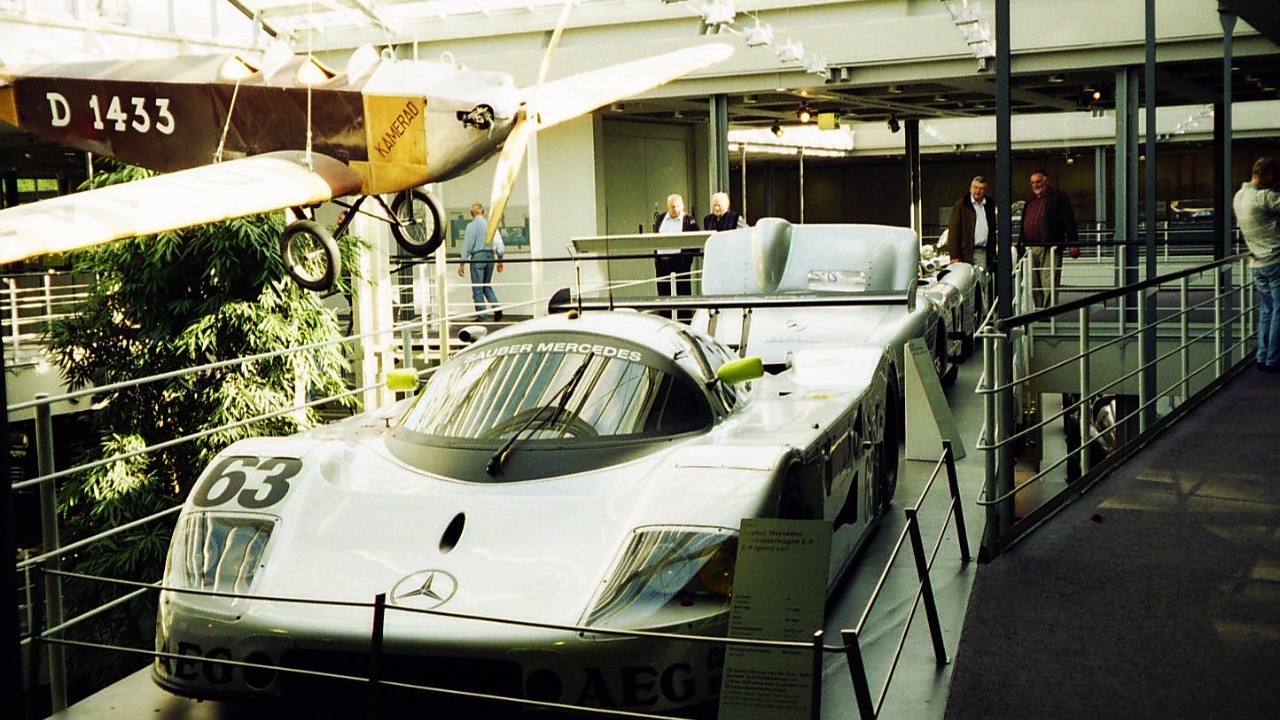
On June 10–11, 1989, three silver Sauber-Mercedes C9s started the 24 Hours of Le Mans, and two of them finished first and second. The third came home fifth. It was Mercedes’ first Le Mans win since 1952, and it came from a twin-turbo V8 car that started the winning run from 11th on the grid.
That result did not come from nowhere. Instead, Sauber, a small Swiss team, had spent most of the 1980s building toward it. By 1989, the Sauber-Mercedes C9 was the class of the World Sports-Prototype Championship.
So how did a Swiss chassis and a German engine beat Jaguar and Porsche at Le Mans? In short, the answer runs through a long build-up, a reworked engine and a car that kept going for 24 hours.
Where the Sauber-Mercedes C9 came from
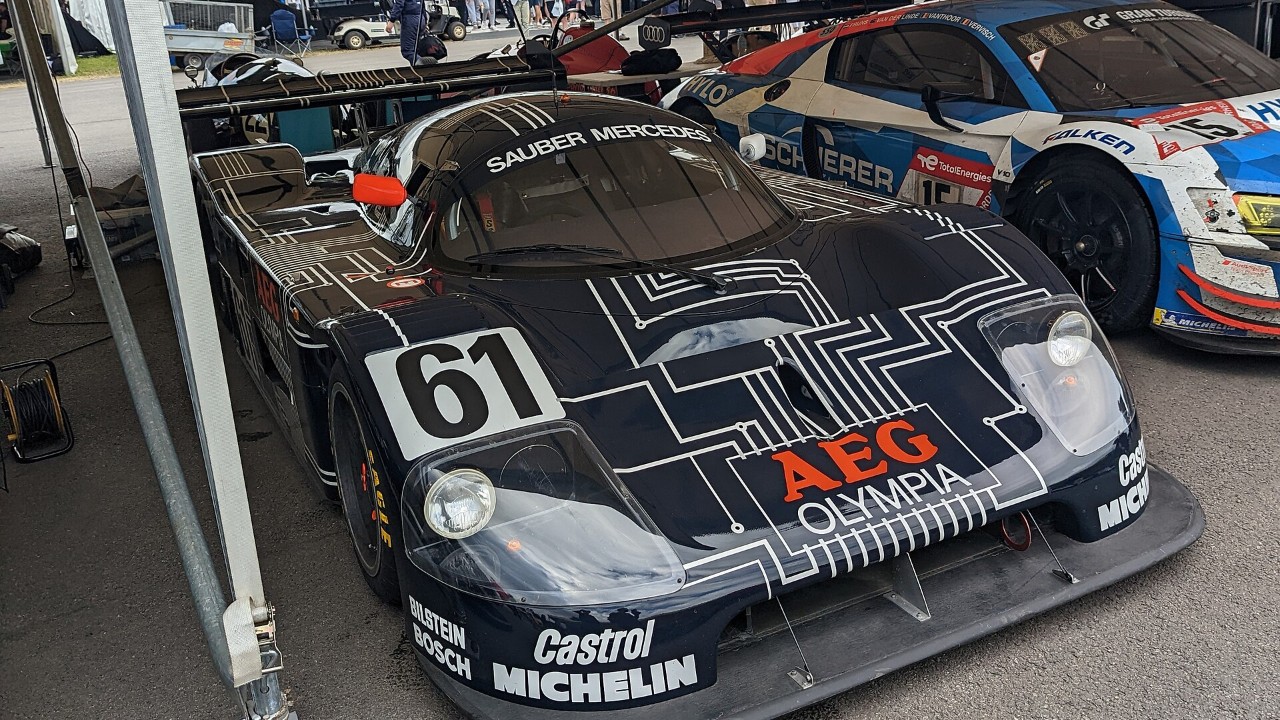
First, Sauber’s proper Group C debut came with the C6 of 1982, which used a Cosworth engine. Next came the BMW-powered C7, and then, in 1985, the C8 became the first Sauber-Mercedes, according to Petrolicious. In 1986, a C8 run as Kouros Racing won the 1000km of Nürburgring with Henri Pescarolo and Mike Thackwell. That was also Sauber’s first Group C win.
After that, the Sauber-Mercedes C9 followed in 1987. It used an all-aluminum monocoque with a steel subframe at the rear to carry the Mercedes engine, Sportscar Digest notes. However, the first season was a development year under the Kouros name, with little success.
For 1988, the car became the official Mercedes-Benz entry. It then won five races, one fewer than Jaguar’s title-winning XJR-9, Petrolicious says. Meanwhile, Sauber moved the radiators to the nose and mounted the rear wing on a central support. By then, the car weighed 905 kg, or 1,995 lb, by that outlet’s figure.
The twin-turbo V8 behind the 1-2
At the heart of the car sat a 5.0-liter twin-turbocharged Mercedes V8 built for Group C. Swiss engineer Heini Mader developed its production-based block. Earlier versions peaked at 720 bhp but often ran at 650 or less to save fuel, Sportscar Digest says.
Then, for 1989, Mercedes overhauled it. The new M119HL had aluminum heads with twin overhead camshafts and ran more boost. According to Petrolicious, it made 820 hp and 579 lb-ft. Even so, the team capped revs at 7,000 rpm, which that outlet credits with better reliability and a flatter torque curve.
As a result, that power showed up on the Mulsanne Straight. In qualifying, the No. 61 car hit 400 km/h, or 248 mph, Petrolicious reports. Sportscar Digest gives the C9’s 1989 Mulsanne mark as 247 mph, or 398 km/h. Either way, the car ran within a few mph of 250 on the straight.
How the 1989 Le Mans race played out
At Le Mans, Mercedes entered three cars, and it also started from the front. Jean-Louis Schlesser put the No. 62 on pole with a lap of 3:15.04, an average of 249 km/h, according to the race organizer’s history of the 57th running. Fifty-five cars started.
The winning No. 63, however, began 11th. Jochen Mass, Manuel Reuter and Stanley Dickens worked it forward over the 24 hours. In the end, they covered 389 laps, or 5,265.115 km, at an average of 219.990 km/h, per Sportscar Digest. By comparison, only 19 cars finished.
Behind them, the No. 61 of Mauro Baldi, Kenny Acheson and Gianfranco Brancatelli took second. The third-place Joest Porsche 962C finished two laps down, Sportscar Digest says. Then the No. 62 of Schlesser, Jean-Pierre Jabouille and Alain Cudini placed fifth.
The win also made history for the team. The organizer notes that Sauber became the first Swiss manufacturer to take pole and win at Le Mans. For Mercedes, it was a second Le Mans victory, 37 years after the first in 1952.
The drivers who won it
Mass, a longtime Porsche factory driver, won on his tenth Le Mans start. In fact, it was his only Le Mans victory, the organizer’s car profile notes. Reuter, by contrast, would win again in 1996 with a TWR-Porsche, alongside Alexander Wurz and Davy Jones.
The cars also wore silver, a color that dates to the 1930s and became the signature of Mercedes’ factory racers. That mattered, because Mercedes had stayed out of top-tier racing for more than three decades before the C9, Petrolicious notes.
The season around Le Mans
Le Mans was the peak of a dominant year. Overall, the Sauber-Mercedes C9 won seven of the eight championship races in 1989, Petrolicious says. It lost only at Dijon, where Michelin tire problems in extreme heat held it back. As a result, the car took the 1989 world title, and Autosport named it Racing Car of the Year, Sportscar Digest reports.
Sauber built only six C9 chassis between 1987 and 1989, by Petrolicious’ count. Today, that outlet says, they sell for well over $5 million each.
After the 1989 Le Mans win
For 1990, the C11 replaced the C9. Neither it nor the later C291 matched the C9’s record, and Mercedes ended its factory Group C program in 1991. That same year, a young Michael Schumacher set the fastest race lap at Le Mans in a Sauber-Mercedes, the organizer notes.
Still, the C9 itself has not disappeared. A C9 is on display at the Mercedes-Benz Museum in Stuttgart, and one appeared at FuoriConcorso in May 2025, Petrolicious reports.
More from Fast Lane Only