Frank Sinatra’s production company bought a 1957 Dual-Ghia convertible new, and Sinatra later gave the car to his ex-wife, the actress Ava Gardner. By the count Top Gear reported, it was one of only 117 Dual-Ghias ever built. Each one crossed the Atlantic twice before a customer could drive it.
The recipe was simple to describe but hard to build. Detroit supplied a Dodge frame and V8, and Carrozzeria Ghia in Turin hand-built the body and interior. The price was nearly $7,500, a figure RM Sotheby’s calls startling for the time.
That price bought entry to a small club. RM Sotheby’s says examples went to Sinatra, Dean Martin, Desi Arnaz and Richard Nixon, and it reports that the man behind the car was said to hand-pick his customers. Here is how a Dodge show car became a Hollywood favorite, and why it lasted only three model years.
How a Dodge show car became the Dual-Ghia
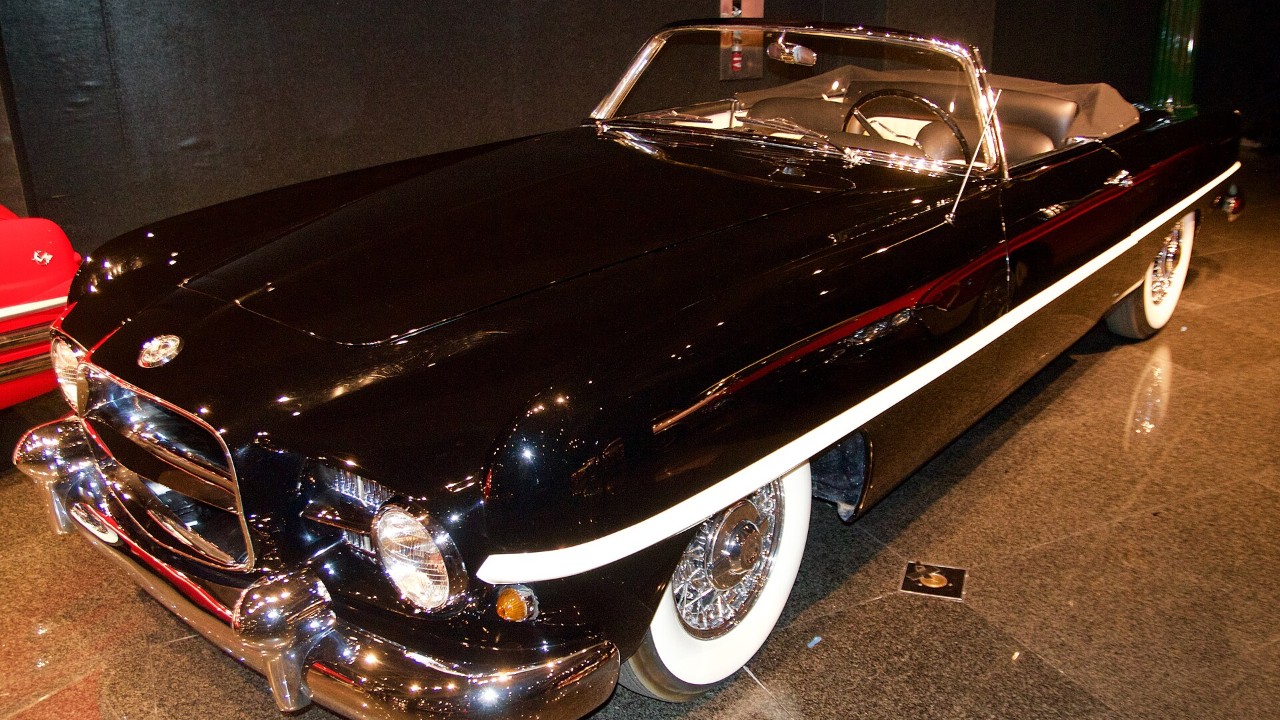
The man behind the car, in fact, was Eugene Casaroll. His Detroit firm, Auto Shippers, Inc., delivered new Chrysler products to dealers, according to a history published by Hyman Ltd. His other company, Dual Motors, had built massive twin-engine tank haulers for the US military during World War II. He also sponsored an Indianapolis 500 car, RM Sotheby’s notes.
At the 1953 New York Auto Show, Casaroll saw the Dodge Firearrow, a Ghia-built concept car. Dodge then decided not to pursue the Firearrow concepts, so Casaroll acquired the design rights. In 1955, he unveiled an evolution of the Firearrow IV that he called the Firebomb, as RM Sotheby’s lot history explains. The prototype toured the show circuit and drew orders. Driven to Write adds two details. The car appeared at the 1955 Geneva Motor Show, and Casaroll got the design rights from Dodge general manager William Newberg, but not the Firearrow name.
Casaroll also needed someone to turn a show car into a product. That job went to Paul Farago, Ghia’s US representative, who ran a racing-car shop in Detroit. The finished car combined a Dodge chassis and V8 running gear with Ghia coachwork, and it reached buyers in 1956 under a new name: the Dual-Ghia.
Built in Detroit, bodied in Turin
Every Dual-Ghia made a long trip. First, Dodge’s frame and V8 started out in the United States. Next, the rolling chassis sailed to Italy, where Ghia added the body and interior. Finally, the car came back to the US for final assembly, Top Gear reports.
Ghia’s craftsmen did not press the body panels. Instead, RM Sotheby’s describes small sections of steel that were hand-hammered to shape and matched to a buck for fit. Workers then welded the sections together and ground them smooth. Inside, English hides covered seats built over coil springs and foam rubber.
Meanwhile, power came from Dodge’s V8. Hyman Ltd lists a 315-cubic-inch Hemi or a 315-cubic-inch Poly-head V8, and the classic-car site Driven to Write describes a 5.2-liter Hemi. The same history puts top speed at over 120 mph, with 0 to 60 mph in 8 to 9 seconds. That was brisk for a four-seat luxury convertible in the mid-1950s.
The Sinatra car and the Hollywood client list
The Sinatra Dual-Ghia convertible has a paper trail that most celebrity cars lack. Top Gear says the car was “purchased new by Frank Sinatra’s production company,” and Sinatra later handed it to Gardner. Decades on, the car appeared in the 1992 TV series Sinatra, and it was once displayed at the Petersen Automotive Museum in Los Angeles.
After a recent restoration, the St. Louis dealer Daniel Schmitt & Co. said it may be among the best survivors. Sinatra was far from the only star in the club, though. Different auction and dealer histories name different owners, but the lists overlap. RM Sotheby’s names Sinatra, Dean Martin, Desi Arnaz and Richard Nixon. Meanwhile, Hyman Ltd adds Ronald Reagan, Debbie Reynolds and Lucille Ball.
How many Dual-Ghia convertibles Detroit and Turin made
The production total depends on whom you ask. Top Gear says Dual-Ghia planned 150 cars and that “only 117 were built before the plug was pulled,” and Driven to Write also gives 117. However, RM Sotheby’s says marque experts believe “as few as 100” convertibles were made from 1956 through 1958. Hyman Ltd cites historian Dr. Paul Sable’s estimate of about 100, including one or possibly two hardtops.
Survivor counts vary too. Daniel Schmitt & Co. estimates that just 34 examples still exist, while Hyman Ltd counts about 80 complete cars. Either way, a Dual-Ghia is a rare sight at any show.
In the end, the money never worked. Driven to Write puts the loss at an estimated $2,000 on each car sold. Then Chrysler switched to torsion-bar front suspension for 1957, so the old chassis supply was running out by 1958, and re-engineering the car would have cost too much. Casaroll’s health problems and a labor dispute also played a part, and RM Sotheby’s adds slow business at his trucking concern.
The idea lived on in the Ghia L6.4, which debuted at the 1960 Paris Motor Show. It used a 335-horsepower, 6.4-liter Chrysler wedge-head V8 and cost $13,500. Even so, it found only 26 owners, according to Driven to Write, which is half the number Ghia had hoped for.
The original car’s value has held up far better than its maker’s finances. At its 2013 Art of the Automobile sale in New York, RM Sotheby’s sold a 1957 Dual-Ghia convertible, chassis 145, for $456,500.
More from Fast Lane Only