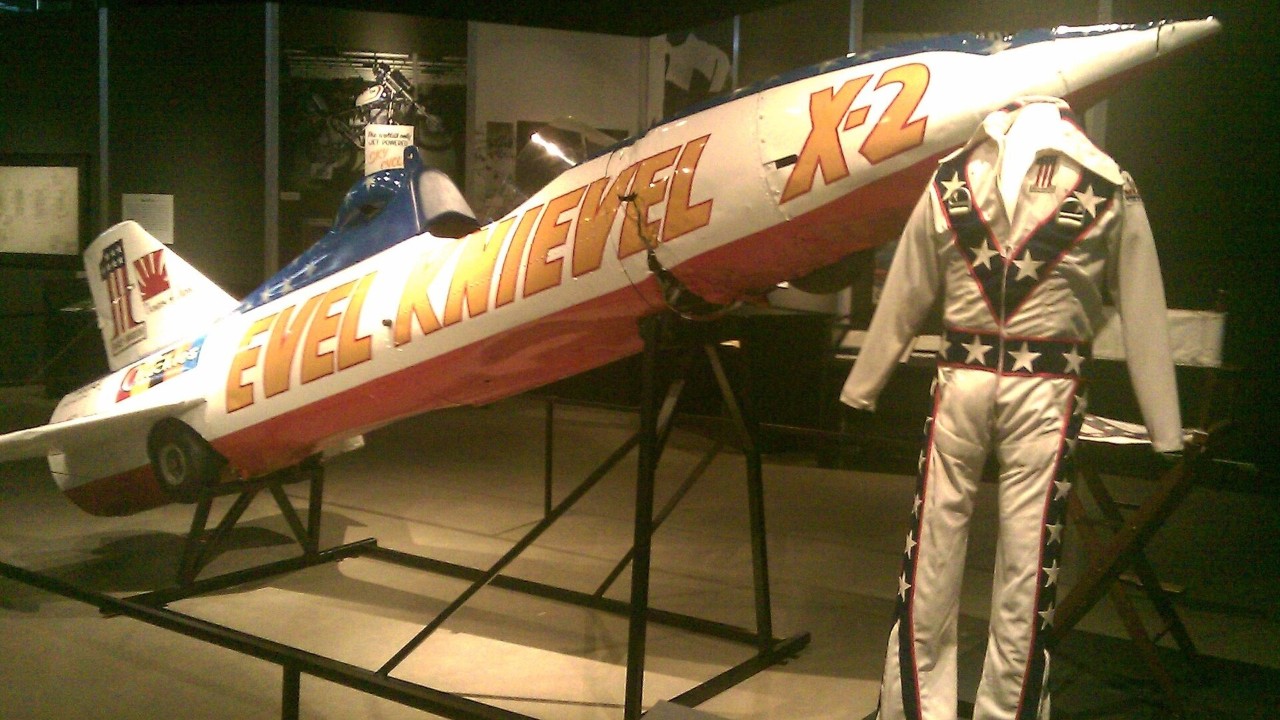
Evel Knievel’s most famous machine was not really a motorcycle. The Skycycle X-2 he rode at Idaho’s Snake River Canyon on September 8, 1974, was a steam-powered rocket. A veteran rocket engineer named Robert Truax built it.
Truax had worked on military missiles and at Aerojet before Knievel ever called him. His machine launched from a steep ramp in front of a big crowd. Then a parachute opened too early, and the jump fell short.
Here’s who Truax was, how the Skycycle worked, and why his family kept trying to prove it would have made it.
The rocket man behind the stunt

Truax started building rockets as a young naval officer in the 1930s, according to a history by Greg Autry. He led teams that developed self-igniting hypergolic propellants and JATO rocket packs for aircraft. Later, at Aerojet, he headed the design of Sea Dragon, a giant orbital rocket meant to launch from the sea.
SpaceNews adds that Captain Truax organized the propulsion research lab at the Naval Missile Test Center in Point Mugu, California. He also led development work on the Thor, Viking and Polaris missiles. In addition, he won the 1951 Robert H. Goddard Memorial Award and served as president of the American Rocket Society in 1957.
So how did a missile engineer end up working for a stunt rider? According to Popular Science, Truax built steam engines for drag racers as a hobby. That work brought him to Knievel’s attention.
Why the Skycycle X-2 ran on steam
Knievel first wanted a rocket bike. However, Truax convinced him it wasn’t practical and pitched a rocket ship instead, Popular Science reports. Truax built the X-2 from a project that engineer Doug Malewicki had started, Autry writes.
The Skycycle X-2 ran on steam rather than hydrogen-oxygen fuel. Popular Science puts the steam temperature at 467°F. Truax liked to adapt existing parts, his son Scott told the magazine, and he even used a dog-food can lid as a diaphragm to hold in the steam.
Steam also had a practical appeal. Truax told Sports Illustrated in 1973 that steam was reliable because it needed no ignition system. That same Sports Illustrated report said the X-2 had a drag chute and a shock absorber in the nose. It had handlebars, but no steering and no throttle.
Testing in Idaho
First came a dress rehearsal with the earlier X-1. That test cycle landed in the Snake River instead of across the canyon, Sports Illustrated reported. Even so, Knievel called it a success, because the launch track worked and the machine stayed intact.
The test ramp sat at 22 degrees, but the real ramp would tilt to 56 degrees. Meanwhile, the plan called for two new X-2 models, each with about 5,000 pounds of thrust, the magazine said. It expected the X-2 to pass 200 mph and put Knievel under about four Gs.
Truax also had his own stake in the outcome. He asked for a $10,000 bonus if Knievel succeeded, and Knievel raised it to $25,000, Sports Illustrated wrote.
September 8, 1974
More than 10,000 people turned out at the canyon, Popular Science reports. Knievel aimed to cross about 1,600 feet. The Skycycle launched from a 150-foot earthen mound topped by a steel tower, tilted at 56 degrees.
The climb looked good at first. Then the landing parachute deployed early, and the wind caught it and pushed the rocket back toward the launch side. The Skycycle came down in the canyon. Knievel emerged bruised but not seriously hurt, Autry writes.
Engineer Craig Adams later explained the cause to Popular Science. Steam from the engine created low-pressure “base drag” behind the rocket. As a result, the lid came off the parachute canister, which sat next to the exhaust nozzle.
A son finishes the job
Scott Truax spent four years and $1.5 million building a replica of his father’s design, The Drive reported in 2016. “The whole point is to prove the rocket my dad designed would have worked,” he said.
That replica, called Evel Spirit, crossed the canyon in 2016 with stuntman Eddie Braun aboard, Autry writes. By then, Robert Truax had died. SpaceNews reports that he passed away on September 17, 2010, in Vista, California, at 93.
Pieces of the original still turn up. Barn Finds reported an eBay listing for the Skycycle X-2’s drogue chute retention cover, signed by Scott Truax, with a Buy It Now price of $1,000,000.
More from Fast Lane Only