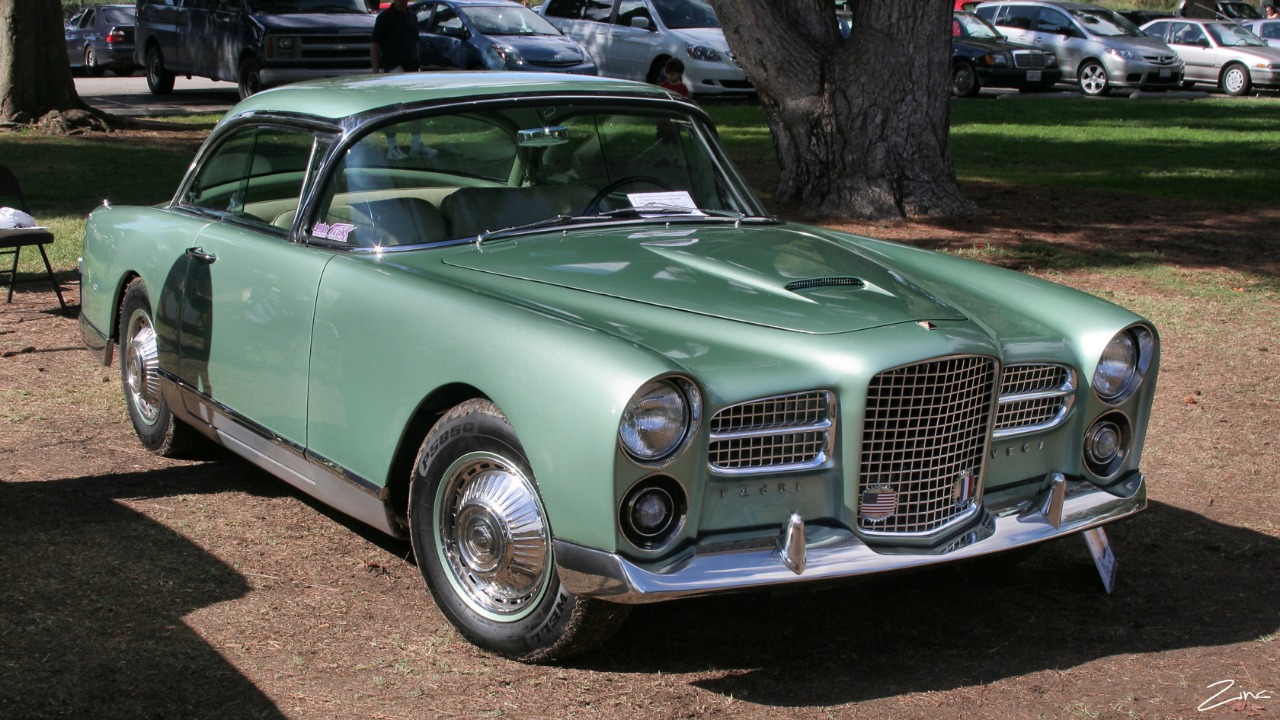
The Facel Vega HK500 arrived in the late 1950s as a rare case of French coachbuilt glamour wrapped around serious American power. In 1957 the concept of a hand-finished grand tourer that could genuinely run with contemporary sports cars while offering the cabin finish of a Parisian luxury hotel set the HK500 apart. It was a car that treated performance and elegance as equal priorities, and it did so with a level of exclusivity that still fascinates collectors.
From coachbuilder to grand tourer specialist
The story of the HK500 starts with Facel, a French metalworking and coachbuilding firm that had supplied bodies for other manufacturers before deciding to build its own cars. Earlier in the decade the company introduced the first Facel Vega as a 2+2 GT, with elegant bodywork created by its French industrialist founder, a move celebrated in period with the exclamation Vive la France. That first Facel Vega established the template: a glamorous coupe with restrained lines, rich materials and a chassis designed for fast continental travel rather than track use.
By the time the HK500 concept took shape, Facel had refined its formula. The company understood that to compete with established grand tourers from Italy and Britain, it needed more power and more sophistication in the suspension and brakes, without losing the French identity that made the cars distinctive. The HK500 would become the most famous expression of that ambition.
Introduced as a Franco American hybrid
Introduced in 1958 and produced until 1961, the Facel Vega HK 500 was presented as one of the most recognizable models from the Frenc luxury performance scene of its era, a car that mixed national styles in a deliberate way. Contemporary descriptions emphasize that the HK500 was a French luxury grand touring car produced from 1958 to 1961 that combined European elegance with American V8 muscle, a formula highlighted in several period accounts of The Facel Vega.
That blend was not accidental. French buyers expected refinement, coachbuilt detailing and a sense of artisanal craftsmanship. At the same time, the most straightforward path to high performance involved sourcing large displacement engines from across the Atlantic, where Chrysler and others were already building powerful V8s in significant numbers. The HK500 was the car that united those two worlds most convincingly for Facel.
French luxury, American horsepower
Under the long hood, the HK500 used big block Chrysler V8 engines that delivered performance far beyond what most French cars of the period could offer. One celebrated specification lists a 383 cubic inch OHV Chrysler V 8 engine with dual 4 barrel carburetors and an output of 355 bhp at 4,800 rpm, paired with a 4 speed manual transmission in a 1959 Facel Vega HK500 Coupé. That configuration, documented in period material on a 1959 Facel Vega, shows how aggressively the company pursued power.
There were variations within the model line. Another 1959 Facel Vega HK500 is described as using a 6.3-litre V8 engine, a displacement that pushed the car firmly into the territory of contemporary American muscle. That specification, noted in a discussion of a car linked with Tony Dale and All Classic Cars Australia as a Public post about a 1959 Facel Vega, underlines how far Facel was willing to go in search of effortless speed.
Despite this American heart, the HK500 remained unmistakably French in its presentation. The bodywork was clean and almost architectural, with a wide grille, subtle tail fins and a pillarless side profile that gave the cabin an airy feel when the windows were lowered. Inside, the dashboard featured a full array of instruments set into a polished metal or painted panel that mimicked the look of turned aluminum, while the seats and door panels were trimmed in high grade leather. The result was a cabin that looked more like a Paris salon than a Detroit product.
Performance numbers that matched the promise
The HK500 was not just about straight line power. Performance data for the Facel Vega HK 500 383 version describe a coupe with a curb weight of 1,760 kg and a front engine, rear wheel drive layout, characteristics detailed in a table of Facel Vega HK. That curb weight reflected the heavy drivetrain and generous equipment, yet the available power meant the car could still deliver serious speed.
Accounts of the HK500 from enthusiasts and historians often quote acceleration and top speed figures that placed the car among the quickest grand tourers of its day. With 355 bhp from the 383 cubic inch engine or even more from the 6.3-litre version, the HK500 could credibly challenge contemporary Italian and British rivals on long autostrada runs. The combination of a long wheelbase, relatively soft springing and powerful brakes made it suitable for high speed cruising, which was exactly the type of driving its clientele expected.
A grand tourer built for real roads
Period and modern commentary describe the HK500 as a car designed for real world use rather than just showpiece status. A video walkaround of a Vega HK 500 made in France, which describes it as a very different design to a lot of stuff on the roads and a very very rare car, captures how distinctive the model still looks in modern traffic. That same behind the scenes view notes a reference to 500 m when discussing aspects of the car, a detail that appears in the description of the Vega HK 500 during service.
Chassis tuning focused on stability and comfort at speed rather than razor sharp turn in. The steering was weighty but precise, and while the car could not match lightweight sports cars in tight bends, it excelled on sweeping roads where the engine could stretch and the suspension could settle into a rhythm. In that sense, the HK500 fulfilled the classic grand touring brief: cover long distances quickly, with the driver and passengers arriving unruffled.
Inside the cabin: French craftsmanship on display
The interior of the HK500 was where Facel could most clearly display its roots as a French luxury specialist. Reports emphasize generous use of leather, carefully fitted carpets and a dashboard that appeared almost like a piece of fine furniture. The instrument cluster was comprehensive, with multiple dials giving the driver detailed information about the engine and running gear, an arrangement that echoed aviation design more than typical mass market cars.
Buyers could specify a range of colors and trims, and each car was effectively hand finished, which contributed to the sense of exclusivity. The seating layout followed the 2+2 pattern, with ample room in the front and occasional seating in the rear. For owners who used the car as intended for touring, the rear seats often served as additional luggage space, complementing the formal trunk.
“The French Rolls Royce” and the HK500’s image
The HK500 quickly acquired a reputation that went beyond raw specifications. One account of a long stored example refers to a Garage Find After 50 Years, describing a Facel Vega HK500 and using the phrase The French Rolls Royce to capture its character. That description, attached to a story about a Garage Find After half a century, reflects how the car was perceived as a French answer to the most prestigious British luxury brand.
The comparison to Rolls Royce did not imply that the HK500 matched the British marque in sheer opulence or silence. Instead, it suggested that Facel was attempting to create a national flagship, a car that could stand for French craftsmanship and style in the same way that Rolls Royce symbolized British luxury. The presence of a muscular American V8 under the hood only added to the drama, giving the HK500 a dual identity as both limousine and sports car.
Production run and rarity
Sources that discuss the model as a whole consistently describe the Facel Vega HK500 as a French luxury grand tourer produced from 1958 to 1961, with relatively low production compared to mainstream manufacturers. One overview notes that the Facel Vega HK500, produced from 1958 to 1961, was a French luxury grand tourer combining elegance, performance and exclusivity, a summary found in a profile of The Facel Vega that emphasizes those three qualities.
Exact production numbers are not specified in the available material, so the total quantity remains Unverified based on available sources. What is clear is that the HK500 was built in far smaller numbers than contemporary mass produced coupes, and that survival rates have been affected by the complexity and cost of maintaining such a specialized vehicle. The rarity mentioned in modern service videos and enthusiast discussions reflects both the limited original run and the attrition that has taken place over decades.
A car that still invites reinterpretation
The HK500 has not only survived as a collector piece in original form. Some enthusiasts have treated it as a canvas for reinterpretation. One discussion describes a modified Facel Vega HK500 with a Zagato inspired design and other changes, while still recognizing that the base car was a French luxury grand touring car produced from 1958 to 1961 and that it combined European elegance with American V8 power. The description of this modified project, which refers again to Combining European and American influences, shows how flexible the underlying design can be.
Such modifications are controversial among purists, who prefer to preserve the car as Facel built it. Yet they also highlight the strength of the original concept. A chassis and body that can accommodate reinterpretation while retaining its core identity speaks to a design that was both distinctive and adaptable.
Modern appreciation and driving experience
Contemporary commentators often describe driving an HK500 as an event. The act of starting a large Chrysler V8 in a French coupe, then setting off through traffic in a car that looks nothing like modern vehicles, creates a sense of occasion. A modern video profile that introduces the car as the Facel Vega HK 500 and notes that it was introduced in 1958 and produced until 1961, describing it as one of the most famous and recognizable models from the Frenc performance scene, captures the enthusiasm that still surrounds the Facel Vega HK.
Behind the wheel, drivers report that the HK500 feels substantial but not clumsy. The engine delivers strong torque at low revs, making it easy to flow with traffic, while the suspension smooths out imperfections in the road. The brakes, especially on later cars with improved systems, are powerful enough for spirited use, although they require more pedal effort than modern setups. The steering, unassisted in many examples, demands some muscle at low speeds but rewards with good feedback once underway.
Why the HK500 still matters
The Facel Vega HK500 occupies an unusual place in automotive history. It came from a relatively small French company, yet it aspired to compete with the most prestigious international brands. It used American mechanical components, yet it presented them in a distinctly European and specifically French package. It was both a symbol of national pride and an example of pragmatic engineering, since sourcing engines from Chrysler allowed Facel to focus on design and craftsmanship.
More from Fast Lane Only