When enthusiasts discuss the high-performance legends of the 1960s, the spotlight usually falls on midsize muscle cars. Names like the Pontiac GTO, Chevrolet Chevelle SS, Plymouth Road Runner, and Oldsmobile 442 dominate the conversation. These cars became symbols of Detroit’s horsepower wars and helped define an entire era of American performance.
Yet while many enthusiasts were focused on lightweight intermediates, Pontiac was building something very different.
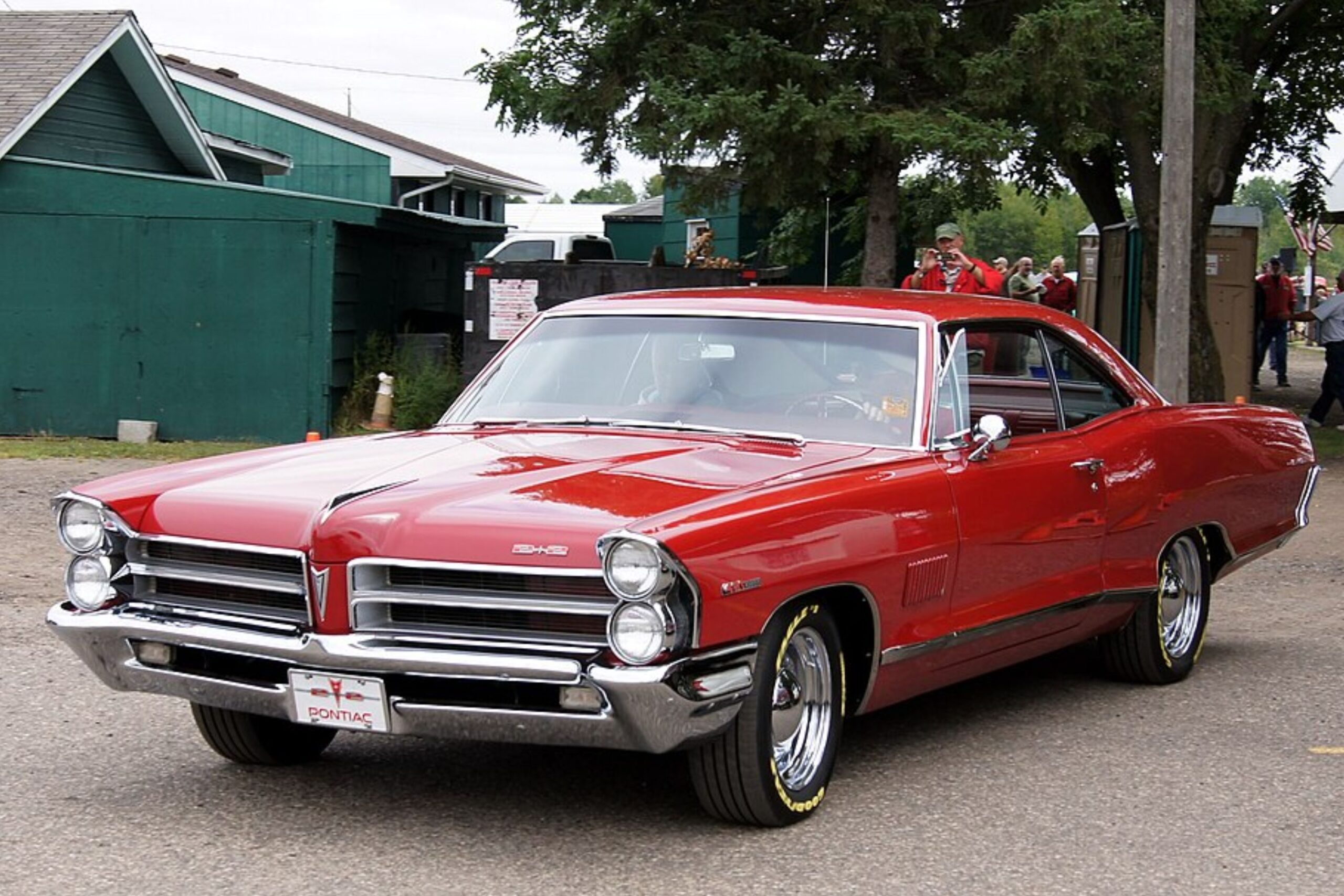
The 1965 Pontiac Catalina 2+2 was a full-size automobile. It was large, comfortable, spacious, and designed to carry passengers in style. On paper, it seemed more suited for long highway journeys than stoplight races.
But hidden beneath its substantial sheet metal was one of the most powerful performance packages available from any American manufacturer.
Equipped with Pontiac’s legendary 421-cubic-inch V8 and the right combination of options, the Catalina 2+2 could accelerate with surprising urgency. It delivered the kind of performance that often caught competitors off guard and earned respect from automotive journalists across the country.
The car never achieved the fame of the GTO, but for a brief period in the mid-1960s, the Catalina 2+2 quietly became one of the fastest full-size cars available anywhere in America.
Pontiac’s Performance Revolution Extended Beyond the GTO
The success of the Pontiac GTO has a tendency to overshadow the rest of Pontiac’s performance lineup.
When the GTO arrived for 1964, it helped create the muscle car formula by placing a large-displacement V8 into a midsize platform. The idea proved enormously successful and quickly attracted attention throughout the industry.
But Pontiac’s commitment to performance extended far beyond a single model.
Under the leadership of executives and engineers who understood the marketing value of speed, the division worked to build a performance-oriented image across much of its lineup. Racing success, powerful engines, and enthusiast-friendly options became key components of Pontiac’s identity.
The Catalina 2+2 emerged from that philosophy.
Rather than focusing exclusively on smaller vehicles, Pontiac explored how performance could be incorporated into a full-size automobile.
The result was one of the most intriguing performance cars of the decade.
The 2+2 Package Added a Sporting Character
The 2+2 package first appeared in 1964 as an option for the Catalina.
The name referred to the car’s sporty seating arrangement, emphasizing front and rear bucket seats that created a more personal and performance-oriented atmosphere than traditional bench-seat configurations.
The package included numerous upgrades designed to separate the car from an ordinary Catalina.
Performance enhancements, unique trim, special badging, and interior improvements helped create a distinct identity.
Pontiac wasn’t trying to build a luxury car.
Nor was it attempting to create a stripped-down drag racer.
Instead, the company sought to combine comfort and performance in a single package.
The 2+2 became Pontiac’s interpretation of the grand touring concept—a large, powerful coupe capable of covering long distances quickly and comfortably.
For 1965, that formula became even more compelling.
The Redesigned Catalina Arrived at the Perfect Time
The 1965 model year brought a complete redesign to Pontiac’s full-size lineup.
The new Catalina featured cleaner styling, more sculpted bodywork, and a wider stance than its predecessor. The updated appearance looked modern and athletic without sacrificing the elegance expected from a large Pontiac.
The redesign also reduced weight compared to earlier models.
Although the Catalina remained a substantial automobile, the lighter structure improved performance and handling.
For enthusiasts interested in speed, that reduction mattered.
Every pound removed made it easier for the engine to do its job.
Combined with Pontiac’s powerful V8 offerings, the redesigned body helped create one of the quickest full-size cars of the era.
The 421 V8 Was the Real Star
The heart of the Catalina 2+2’s performance story was Pontiac’s 421-cubic-inch V8.
Originally developed as a high-performance engine for both street and competition use, the 421 had already earned a reputation as one of the strongest powerplants available from Detroit.
Its large displacement allowed it to produce impressive horsepower and abundant torque.
Torque was particularly important in a full-size automobile.
Moving a large car quickly requires substantial low-end pulling power, and the 421 delivered exactly that.
Drivers didn’t need to rev the engine aggressively to experience its strength.
The power was available almost immediately.
As a result, the Catalina 2+2 felt remarkably responsive despite its size.
Contemporary road testers frequently commented on the engine’s ability to propel the large Pontiac with surprising ease.
Tri-Power Turned the Catalina Into a Serious Performer
For buyers who wanted maximum performance, Pontiac offered one of the most famous induction systems of the muscle car era.
Known as Tri-Power, the setup utilized three two-barrel carburetors mounted atop the 421 engine.
Under normal driving conditions, the center carburetor handled fuel delivery. When the driver demanded more power, the outer carburetors opened, dramatically increasing airflow.
The effect could be spectacular.
Acceleration became noticeably stronger, and the engine developed a distinctive personality that enthusiasts loved.
Tri-Power-equipped Catalina 2+2s earned a reputation for delivering performance that rivaled many purpose-built muscle cars.
The combination of a lightweight-for-its-size body and one of Pontiac’s most powerful engines created a genuinely formidable package.
Four-Speed Buyers Got the Best Experience
While automatic transmissions remained popular among full-size car buyers, performance enthusiasts often selected the available four-speed manual gearbox.
This option transformed the Catalina 2+2’s character.
Instead of simply relying on the engine’s abundant torque, drivers could actively manage gear selection and keep the 421 operating in its optimal power range.
The experience felt surprisingly sporting.
The four-speed emphasized the car’s performance credentials and appealed to buyers who wanted a more involved driving experience.
Road tests of four-speed cars frequently produced acceleration figures that startled readers.
Many people simply didn’t expect a large Pontiac to be that quick.
The Catalina repeatedly proved otherwise.
Performance Numbers Challenged Expectations
One reason the Catalina 2+2 earned such a strong reputation among enthusiasts was its ability to perform far beyond what its size suggested.
Many competitors assumed that a full-size automobile would inevitably be slower than smaller performance cars.
The Catalina challenged that assumption.
Period testing often showed the 421-powered Pontiac delivering quarter-mile times and acceleration figures that compared favorably with many well-known muscle cars.
Its immense torque allowed it to launch aggressively from a stop, while the powerful V8 continued pulling strongly at highway speeds.
The car’s performance wasn’t merely respectable.
It was genuinely impressive.
For a large personal coupe, it was exceptional.
The Highway Was Where It Truly Excelled
While acceleration attracted attention, the Catalina 2+2’s true strength may have been its ability to combine speed with comfort.
Many muscle cars of the era excelled in short bursts but sacrificed refinement in the process.
The Pontiac took a different approach.
Its spacious interior, long wheelbase, and substantial dimensions created a stable and comfortable highway cruiser. Passengers could enjoy long-distance travel without the compromises often associated with more focused performance machines.
Yet when the driver pressed the accelerator, the 421 reminded everyone that this was no ordinary family car.
The combination made the Catalina uniquely versatile.
It could dominate interstate highways just as effectively as local stoplights.
The GTO Stole the Headlines
Despite its capabilities, the Catalina 2+2 lived in the shadow of Pontiac’s most famous performance model.
The GTO captured public attention and became the symbol of the muscle car movement. Magazine covers, advertising campaigns, and enthusiast discussions frequently centered on Pontiac’s midsize sensation.
The Catalina rarely received the same level of recognition.
That lack of attention wasn’t a reflection of its performance.
It was simply a consequence of timing.
The industry had become fascinated with smaller and lighter performance cars, leaving many full-size machines overlooked.
As a result, the Catalina 2+2 quietly built its reputation among enthusiasts who understood what it could do.
Collectors Are Finally Giving It Credit
In recent years, appreciation for full-size performance cars has grown significantly.
Collectors increasingly recognize that vehicles like the Catalina 2+2 represent an important chapter in American automotive history.
The car offered something many modern vehicles struggle to replicate.
It combined genuine high-performance capability with exceptional comfort and road-trip practicality.
Well-preserved examples equipped with the 421 engine, especially those featuring Tri-Power induction and four-speed transmissions, have become increasingly desirable among enthusiasts.
Their rarity and historical significance continue to attract attention.
The Gentleman Giant of Pontiac Performance
Looking back, the 1965 Pontiac Catalina 2+2 occupied a unique position in the marketplace.
It wasn’t a pure muscle car in the traditional sense.
It wasn’t a luxury coupe either.
Instead, it blended the best qualities of both categories.
Buyers received a spacious full-size automobile capable of carrying passengers comfortably while also delivering performance that could surprise many supposedly sportier rivals.
The combination made the Catalina 2+2 one of the most versatile performance cars of its era.
The Fast Pontiac Nobody Expected
The 1965 Pontiac Catalina 2+2 never became as famous as the GTO, and it rarely appears on lists of the greatest muscle cars ever built.
Yet its accomplishments deserve recognition.
Powered by Pontiac’s legendary 421 V8 and available with Tri-Power induction and a four-speed manual transmission, the Catalina 2+2 quietly evolved into one of the fastest full-size cars available in America.
It proved that size and performance were not mutually exclusive.
More importantly, it demonstrated that some of the most interesting performance cars of the 1960s existed outside the traditional muscle car spotlight.
The Catalina 2+2 wasn’t trying to redefine the industry.
It was simply trying to be a fast Pontiac.
In the process, it became one of the most underrated high-performance automobiles of the decade.
More from Fast Lane Only