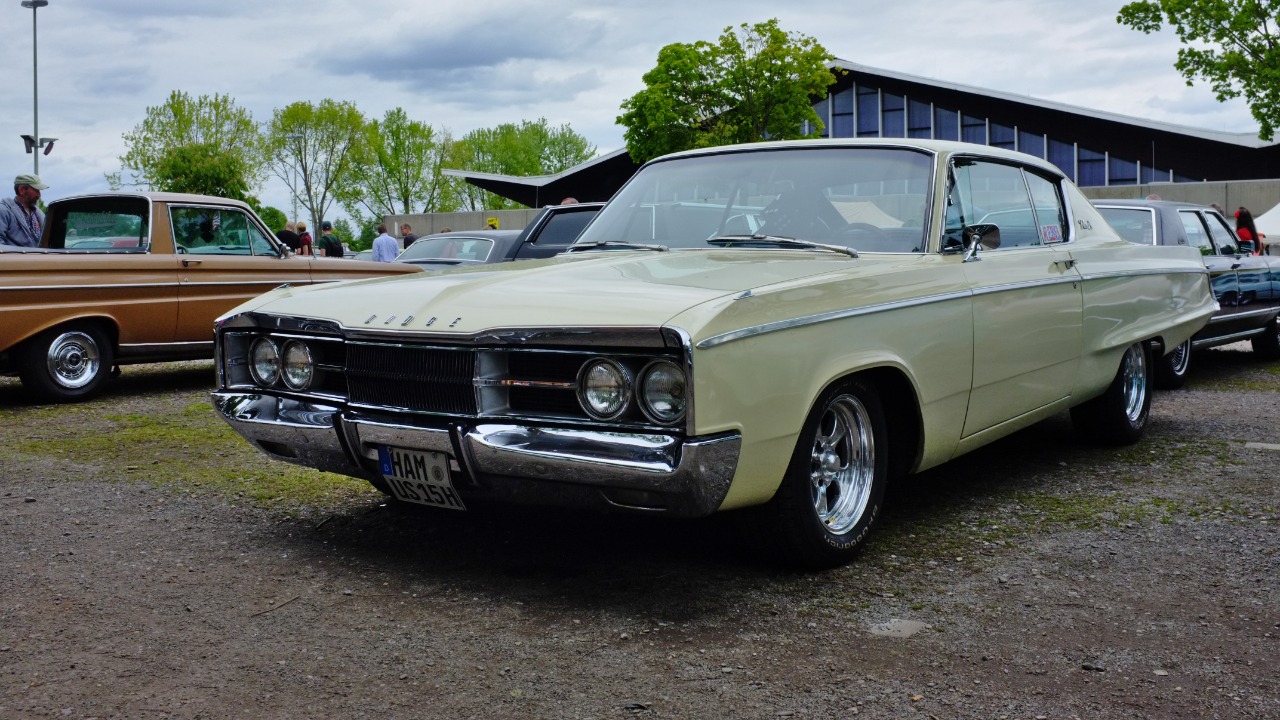
The 1967 Dodge Monaco arrived as a full-size statement piece, trimmed in brightwork and wicker, aimed squarely at buyers who wanted comfort as much as speed. Yet when I talk with owners and watch these cars in motion, what lingers is not the vinyl and veneer but the way a big-block Monaco shoves you back in the seat when the light turns green. It was marketed as an upscale cruiser, but its legacy rests on torque, displacement, and the quiet confidence of a car that could haul a family and still haze the rear tires.
From luxury experiment to muscle-tinged flagship
To understand why the 1967 Monaco feels so conflicted, I start with its roots. The Monaco nameplate did not begin as a bare-knuckle muscle sedan, it arrived as a premium trim on the Dodge Custom 880, a car explicitly pitched as a step up in the full-size hierarchy. As It All Started with that first version, The Dodge Monaco was Dodge’s attempt to dress up its big-car platform and court buyers who might otherwise drift to more established prestige badges. By 1966 through 1968, Dodge leaned into that strategy, turning the Monaco and its siblings into the high-end evolution of the Polara, effectively replacing the older Custom trim and positioning the car as the top of the full-size line.
That upscale mission is clear in the way the 1967 model was packaged. Contemporary valuation data notes that from 1966 through 1968, Dodge treated the Monaco and its stablemates as the premium expression of the Polara chassis, a move that culminated in the nameplate’s retirement for the 1970 model year when the full-size lineup shifted again. The Monaco was not a stripped fleet sedan, it was the car Dodge expected to impress neighbors in the driveway, a point underscored by how the brand framed it as a high-end version of the Polara and the successor to the Custom in period brochures and in later analyses of the Dodge Monaco and its place in the lineup.
Styling that tried to look like money
When I picture a 1967 Monaco, the first image that comes to mind is the front fascia, a wide, confident face that tried hard to look like it belonged in a country club parking lot. The front end was dominated by a broad grille with hidden headlights on upper trims, a design that gave the car a clean, modern look that enthusiasts still describe as almost European in its restraint. Period photos and later commentary on the 1967 Dodge Monaco Hardtop Sedan emphasize how that grille and the concealed lamps created a sense of width and presence, a visual trick that made the car appear even more substantial than its already generous footprint, as seen in surviving front end shots.
The same face turned up in popular culture, which helped cement the Monaco’s image as a stylish, if slightly understated, full-size. In the 1968 movie “With Six You Get Eggroll,” a 1967 Dodge Monaco appears on screen with that broad grille and hidden headlights, its sheetmetal playing the part of respectable family transport even as the car’s mechanicals hinted at more mischievous potential. Enthusiasts who share stills from that film point out how the Monaco’s clean lines and restrained chrome read as “modern” for the late 1960s, a look that still resonates in fan groups that trade images of the 1967 Dodge Monaco in that role.
Inside, comfort tried to keep up with power
Open the door of a Monaco 500 and the luxury pitch becomes even more obvious. Inside, the 1967 Dodge Monaco 500 carried over its hallmark wicker accents, a decorative flourish that appeared on door panels and trim pieces to signal that this was not a basic fleet sedan. A reclining passenger seat arrived as a new option, a small but telling detail that aligned the car with the comfort-first ethos of personal luxury coupes. Period descriptions of the Dodge Monaco 500’s cabin emphasize how those wicker touches, the upgraded upholstery, and the available console created a space that felt more like a lounge than a taxi, reinforcing the idea that the Monaco was meant to be enjoyed as much from the right seat as from behind the wheel, a point underscored in coverage of the Inside details of the Dodge Monaco 500.
The Monaco’s interior story did not stop at wicker and recliners. The Monaco received special badging and a sportier interior with a full-length center console on certain trims, a layout that wrapped the driver in gauges and controls more reminiscent of a muscle coupe than a staid sedan. Under the hood, that sportier intent was backed up by serious hardware, including a 383 cu in (6.3 L) V8 rated at 325 horsepower on performance-oriented versions, figures that appear in factory-style summaries of The Monaco and its specifications. When I sit in one today, the mix of plush seating and floor-mounted shifter feels like a deliberate attempt to bridge two worlds, a car that could take clients to dinner and still satisfy the driver who cared about quarter-mile times.
Engines that made the brochure copy believable
For all the wicker and chrome, the Monaco’s reputation among enthusiasts rests on its engines. At the entry level, Dodge offered a 318 CID V-8 with Overhead valves, a Cast iron block, and Five main bearings, a workhorse that delivered smooth, reliable power for buyers who prioritized comfort over outright speed. Technical sheets list the Displacement at 318 cubic inches with a Bore and stroke of 3.91 x 3.31 inches, figures that underline how even the “small” V8 in these cars was anything but modest by modern standards. Those numbers, preserved in detailed fact sheets on 318 CID engines, show why a base Monaco still felt muscular in everyday driving.
Move up the range and the story shifts from adequate to exuberant. The Monaco shared corporate big-blocks with other Dodge performance models, and enthusiasts often connect it to the era when the Coronet, more famous for spawning the Charger and the Super Bee, had full access to Chrysler’s high-compression V8s. In that context, the Monaco could be ordered with serious displacement, and later retrospectives on Dodge’s full-size performance note how the brand eventually brought back the Monaco R/T with a Hemi positioned above the RB-block 440, a reminder that the same engineering mindset shaped the 1960s cars. Analyses of that lineage point to the Even broader family of big Dodges, where the Charger and the Super Bee and the Coronet all drew from the same well of Chrysler power.
Marketing luxury while selling torque
What fascinates me is how Dodge tried to talk about the Monaco in public. Period advertising leaned heavily on the luxury angle, often casting the car in playful, serialized spots that echoed silent-film cliffhangers. One memorable commercial featured Dodge spokesmodel Pamela Austin in a scenario modeled on The Perils of Pauline, with the Monaco positioned as the glamorous escape vehicle that combined style and safety. That campaign, which survives in archival clips of Dodge advertising, framed the car as “where the luxury is,” a tagline that tried to nudge buyers to see the Monaco as a sophisticated choice rather than a brute.
Yet when I watch modern owners talk about their cars, the conversation keeps circling back to torque. In one enthusiast video, host Lou of My Car Story meets Diane in the western suburbs of Illinois to showcase her 1967 Dodge Monaco 500 in Daffodil Yellow, and the discussion quickly shifts from paint and trim to how the car feels when the V8 digs in. That clip, which captures the car idling and accelerating on local roads, shows how the Monaco’s character today is defined less by its wicker accents and more by the way its big engine pulls, a theme that runs through fan-made features like My Car Story segments on these cars.
More from Fast Lane Only: