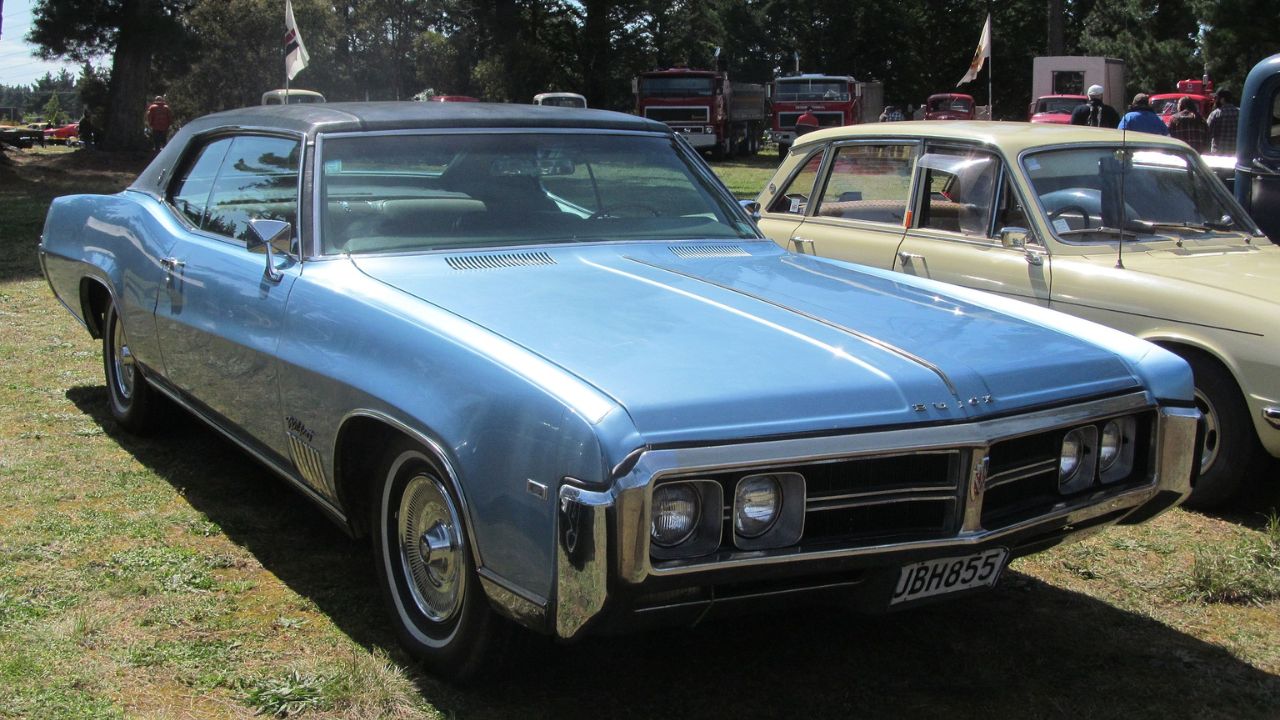
The 1969 Buick Wildcat looked like a gentleman’s express, not a stoplight brawler, yet its big-block power and chassis tuning could embarrass plenty of better-publicized muscle cars. Buick marketed the Wildcat as an upscale full-size cruiser, but under the vinyl roofs and woodgrain trim sat hardware that shared more with street racers than with soft luxury sedans. That mismatch between image and ability is exactly what makes the car so fascinating more than half a century later.
From today’s vantage point, the Wildcat captures a moment when Detroit still believed a car could be both quiet and brutally quick without shouting about it in stripes and spoilers. The 1969 model year refined that formula and left a legacy that modern enthusiasts are finally starting to recognize.
From quiet cruiser to hidden bruiser in 1969
By 1969, Buick had already built a reputation for torquey big-blocks that delivered serious thrust with minimal drama. The company’s 430 cubic inch V8, used across the lineup, was part of the family that would later evolve into some of the most powerful Buick of the muscle era. In the Wildcat, that engine turned a seemingly conservative full-size coupe into a car that could surge from low speed with surprising force.
Buick positioned the Wildcat above the LeSabre and below the Electra, which meant buyers expected comfort first. The 1969 redesign kept the long, flowing body sides and formal rooflines that signaled luxury, not aggression. Yet the standard 430 V8, with its high torque output and four-barrel carburetor, gave the car performance that rivaled many midsize muscle machines in real-world driving, especially from a rolling start where weight mattered less than torque.
What changed for 1969 was not just the powertrain, but how Buick integrated that power into a more composed package. Chassis tuning, power front disc brakes on many examples, and variable-ratio power steering helped the Wildcat feel more controlled at speed than earlier big Buicks. The car still floated when pushed hard, but on the highway it could cruise at elevated speeds with an ease that made its performance feel almost casual.
Styling updates also played a role in its sleeper status. The Wildcat carried discreet “Wildcat” scripts and modest wheel designs rather than the bold graphics that defined cars like the GS 400. That visual restraint kept insurance agents calmer and allowed owners to enjoy strong acceleration without attracting the same attention as overt muscle cars. In a period when horsepower was starting to trigger higher premiums, that subtlety mattered.
Sharing DNA with Buick’s headline muscle
To understand why the Wildcat’s performance exceeded its image, it helps to look at what Buick was doing on the muscle front at the same time. The brand’s GS line, especially the later GS 455, used closely related big-block architecture to deliver headline-grabbing power. The 455 cubic inch V8 that arrived soon after was celebrated in cars like the 1970 GS 455, which enthusiasts remember for its massive torque and quarter-mile capability, as documented in period coverage of the 1970 Buick GS.
That family connection matters because the Wildcat’s 430 was not some detuned, economy-focused engine. It came from the same engineering mindset that produced the later 455 monsters, prioritizing low-end and midrange torque rather than peaky horsepower. On the street, where most driving took place between idle and 70 miles per hour, that torque made the Wildcat feel far quicker than its curb weight and luxury image suggested.
Buick also had a habit of underrating its performance hardware. The 1969 GS 400 Stage 1, for example, was famous for delivering far more real-world muscle than its published numbers, a fact that modern analysis of the 1969 GS 400 continues to highlight. While the Wildcat did not receive that exact package, it benefited from the same conservative rating culture. Owners often discovered that the car’s acceleration felt stronger than the brochure figures implied.
The transmission and axle choices reinforced that impression. Many Wildcats left the factory with performance-friendly rear-end ratios and Buick’s smooth but quick-shifting automatic. Combined with the big-block’s torque, the result was a car that could surge past slower traffic with a short stab of throttle, all while keeping the cabin quiet and composed. It was not a drag-strip special, yet in highway passing and long-distance travel it could keep pace with more glamorous muscle cars.
Why the Wildcat’s understated speed resonates now
Modern enthusiasts are increasingly drawn to cars that blend performance with subtlety, and the 1969 Wildcat fits that brief better than many of its contemporaries. In a collector market that has heavily rewarded overt muscle icons, the full-size Buicks have remained relatively attainable, which makes them appealing entry points for buyers who want big-block power without six-figure price tags.
The car’s character also aligns with current tastes. Drivers who enjoy vintage machinery often want something that can handle long trips without fatigue. The Wildcat’s soft ride, spacious interior, and quiet cabin make it a genuine grand tourer, not just a weekend drag racer. Its ability to cover distance at modern highway speeds, while still delivering that satisfying surge when the throttle is opened, feels surprisingly contemporary.
There is also a cultural shift in how people view performance. The loudest, most aggressive machines are no longer the only heroes. Sleeper cars, which hide their capability behind ordinary styling, have become cult favorites. The 1969 Wildcat fits that mold perfectly. Parked at a show next to a GS or a rival brand’s stripe-covered coupe, it looks like the older, more conservative cousin. On the road, it can surprise anyone who underestimates it.
From a historical perspective, the Wildcat helps tell a broader story about Buick’s identity. The brand has long balanced comfort and speed, from early straight-eight models to turbocharged Regals decades later. The 1969 Wildcat sits at a midpoint in that arc, a car that carried big-block muscle into a package aimed at buyers who valued refinement. For collectors who care about narrative as much as numbers, that dual identity is a major part of the appeal.
Future prospects for Buick’s quiet heavyweight
Looking ahead, the 1969 Wildcat seems poised for a gradual rise in recognition rather than a sudden spike. As prices for headline muscle cars continue to climb, attention tends to drift toward overlooked models that share similar hardware. The Wildcat’s connection to Buick’s big-block family, and its place alongside cars like the GS 400 and GS 455, gives it a strong foundation for that kind of reassessment.
Survivor cars and lightly modified examples are especially well positioned. Enthusiasts who want to drive their classics rather than park them often prefer full-size platforms that can handle modern traffic with less stress. The Wildcat’s long wheelbase, strong brakes when properly maintained, and relaxed cruising manners make it a practical choice for road trips and events. As more owners showcase these cars in that context, their reputation as capable grand tourers is likely to grow.
Restoration trends could also shape the Wildcat’s future. Some owners will lean into the sleeper angle, keeping exterior trim stock while upgrading suspension, tires, and discreet engine internals. Others may choose to highlight the car’s luxury side with factory-correct interiors and period accessories. Either approach reinforces the same core message: this was a car that did not need loud graphics to deliver satisfying performance.
There is an educational angle as well. Younger enthusiasts, who often know the headline muscle names but not the supporting cast, are starting to discover that brands like Buick built more than just a handful of famous models. The 1969 Wildcat offers a tangible link to that broader story, one that clubs, museums, and online communities can use to show how performance and comfort coexisted in the late 1960s.
Ultimately, the Wildcat’s legacy rests on that contradiction. It looked like a banker’s coupe yet moved with the urgency of a street racer when asked. As collectors and drivers continue to value authenticity and character over hype, that quiet competence may turn the 1969 Buick Wildcat from an underappreciated full-size into one of the era’s most satisfying all-around classics.
More from Fast Lane Only
- Unboxing the WWII Jeep in a Crate
- 15 rare Chevys collectors are quietly buying
- 10 underrated V8s still worth hunting down
- Police notice this before you even roll window down
*Research for this article included AI assistance, with all final content reviewed by human editors