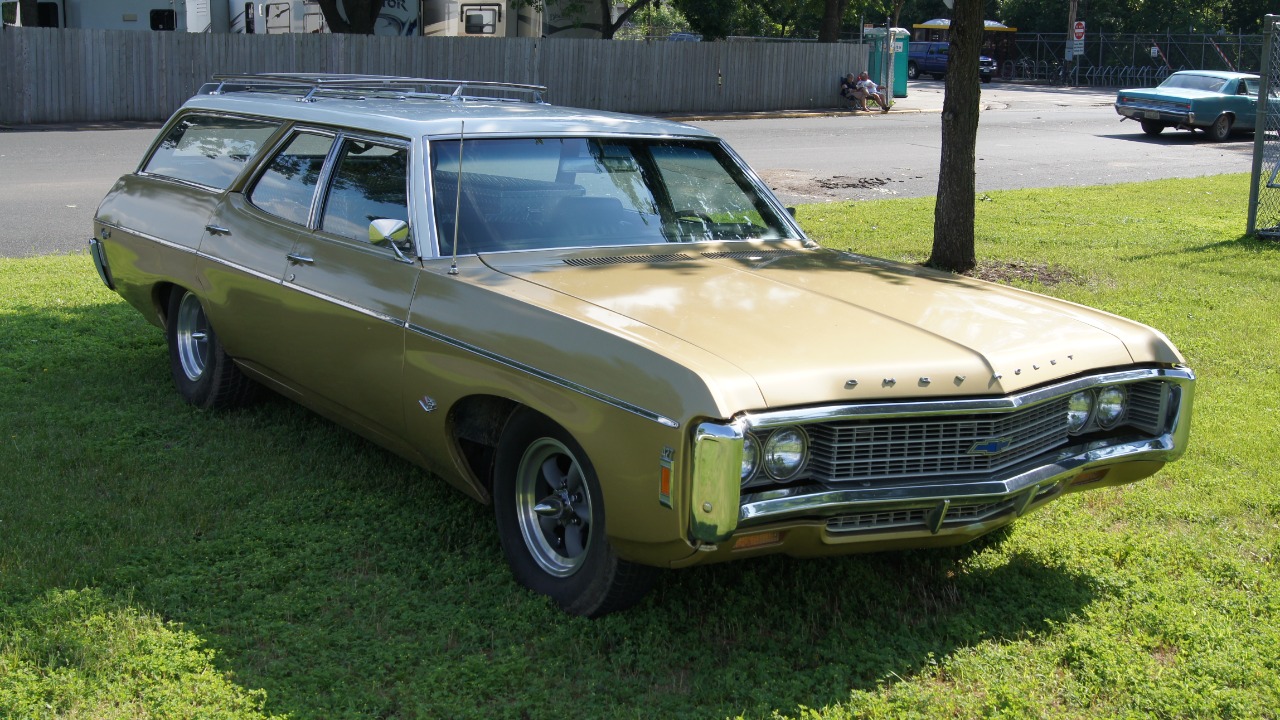
The 1969 Chevrolet Kingswood did something family cars are rarely allowed to do: it hauled kids, camping gear, and groceries while quietly packing the kind of power usually reserved for big-block muscle coupes. In an era before anyone said “crossover,” this long-roof Chevy showed how a wagon could be both the default family choice and a serious performance machine. By looking closely at how it was engineered, optioned, and remembered, I see a blueprint for what family performance really meant at the height of Detroit’s horsepower wars.
That story starts with the Kingswood name itself, which had already built a reputation for blending comfort and utility, then hits its stride in 1969 when Chevrolet turned the full-size wagon into a stealth muscle car. From the way the 427-cubic-inch engines were slipped under the hood to the way collectors chase these cars today, the 1969 Chevrolet Kingswood shows that practicality and speed were never mutually exclusive.
From family hauler to muscle-era heavyweight
By 1969, The Kingswood name had already been used to signal a wagon that aimed higher than basic transportation, and it returned that year on a model based on the Impala with its own distinct wagon identity. According to period descriptions, The Kingswood was positioned as a full-size family car that shared bones with the Impala but wore unique wagon nameplates instead of simply copying sedan badges. That separation mattered, because it framed the car not as a compromise but as a purpose-built long-roof that could carry people and cargo with the same presence as Chevrolet’s big coupes and sedans.
Even before 1969, Chevrolet had pitched its wagons as a way to get passenger car luxury without giving up utility, and the Kingswood lineage leaned into that idea. Contemporary catalog copy notes that it (The Kingswood) set itself apart with its blend of passenger car comfort and cargo-carrying ability, promising a family vehicle that did not compromise on style or ride quality, a balance captured in descriptions of how The Kingswood mixed luxury and practicality. By the time the name returned for the 1969 model year, that formula was ready to be turned up with serious power.
Big-block power hiding in plain sight
What made the 1969 Chevrolet Kingswood Estate so compelling was how far you could push it mechanically while it still looked like a straight family wagon. A Dec overview of the car points out that a Big Block V8 Was An Option, and that flexibility is what turned the Kingswood into a true sleeper. While the exterior read as a long, wood-trimmed hauler, the availability of a 427-cubic-inch engine meant this Kingswood Estate could run with full-size muscle cars, a contrast highlighted in coverage that calls the Chevrolet Kingswood Estate a standout in wagon history.
The engine menu was unusually rich for a family wagon, and that is where the performance story really comes into focus. Specs tables list the top engine as a 427-cubic-inch (7.0L) Turbo-Jet V8 (L36), with the 427 configuration delivering big-block torque that put the car squarely in muscle territory, as detailed in the Chevrolet Kingswood Estate. According to Hagerty, that L36 version packed 390 horsepower, a figure that placed the Kingswood Estate in the middle of Detroit’s heavy hitters, a point reinforced where According to Hagerty the L36 is described as a serious performance engine.
Configurable performance for every driveway
Part of the Kingswood’s appeal, at least as I see it, is that Chevrolet did not force every buyer into the same high-strung setup. Dec reporting on the 1969 model emphasizes how many ways you could configure it, noting that What made the 1969 model especially interesting was the range of engines, including a small-block 327 with 235 horsepower for drivers who wanted a more modest but still capable family car. That flexibility, from the 327 to the 427, is captured in coverage that explains how What made the stand out was its broad engine spread.
Other period and retrospective accounts back up just how deep the options list ran. One comparison of full-size wagons notes that Wagon options lists were long, with each brand offering one straight-six and four V-8 displacements, a pattern that applied directly to Chevrolet’s big wagons and helped the Kingswood compete with rivals like the Ford Country Squire, as described in a review of Wagon choices. Enthusiast summaries of the 1969 Chevrolet Kingswood 427 Wagon underline that this full-size Station wagon was known for its spacious interior and powerful performance, showing how the 427 option turned a practical layout into something enthusiasts still talk about, as seen in descriptions of the Chevrolet Kingswood 427.
Design, space, and the pre-SUV mindset
Performance alone does not explain why the Kingswood still resonates; its design and packaging captured a moment before SUVs took over family duty. Back in 1969, the term SUV did not exist in the way we use it now, and even the idea of a minivan was barely formed, so if you wanted three rows, real cargo space, and highway comfort, you bought a wagon. One detailed look at a restored example notes that, Back in 1969, the term SUV was not part of the vocabulary, and that context frames the Kingswood as the default choice for big families, a point made clearly in a feature that opens with Back in that era. Chevrolet’s own wagon brochure underscored this by telling buyers, “For 1969, we give you a choice of two wagon sizes. Our biggest are called Kingswood Estate, Kingswood, Townsman and Brookwood,” a line that shows how the company grouped its largest wagons together as a family of serious haulers, as laid out in the period document that begins with Our wagon choices.
Inside, the Kingswood delivered the kind of space and comfort that made the performance feel like a bonus rather than the main event. Descriptions of similar Chevrolet interiors from that period highlight ample legroom, generous headroom, and a large cargo area that could be configured for different needs, with one account noting that it featured a big, flexible load bay that owners could adapt for work or play, a versatility echoed in a summary that says it “featured ample legroom and headroom, as well as a large cargo area that could be configured to meet various needs,” as captured in a piece describing how It featured that kind of space. On the outside, the 1969 Kingswood’s long body and, in Estate form, woodgrain paneling gave it a classic wagon profile that still looks right at home in a modern parking lot, a look that later inspired scale models and restorations.
Rarity, nostalgia, and the collector market
Today, the 1969 Chevrolet Kingswood 427 Wagon sits at the intersection of nostalgia and scarcity, which is exactly where collector interest tends to spike. Enthusiast groups point out that the 1969 Chevrolet Kingswood 427 Wagon is a full-size station wagon known for its spacious interior and powerful performance, and some accounts note that only 546 were built in 1969, a figure that helps explain why these cars are so closely tracked, as mentioned in a discussion of the Chevrolet Kingswood Wagon. Another enthusiast post describes a 69 Kingswood grocery getter with 427 V-8 4 speed with bench seat, and notes that 1969 CHEVROLET KINGSWOOD 427 Station wagons are not usually thought of as muscle-cars, but the Kingswood deserves the label, a sentiment that captures how owners see these cars as sleepers that punch above their image, as shared in a group focused on CHEVROLET KINGSWOOD Station builds.
More from Fast Lane Only: