When people think about the muscle car era, their minds usually jump to roaring big-block coupes, tire-smoking drag racers, and brightly colored performance machines. Station wagons rarely enter the conversation.
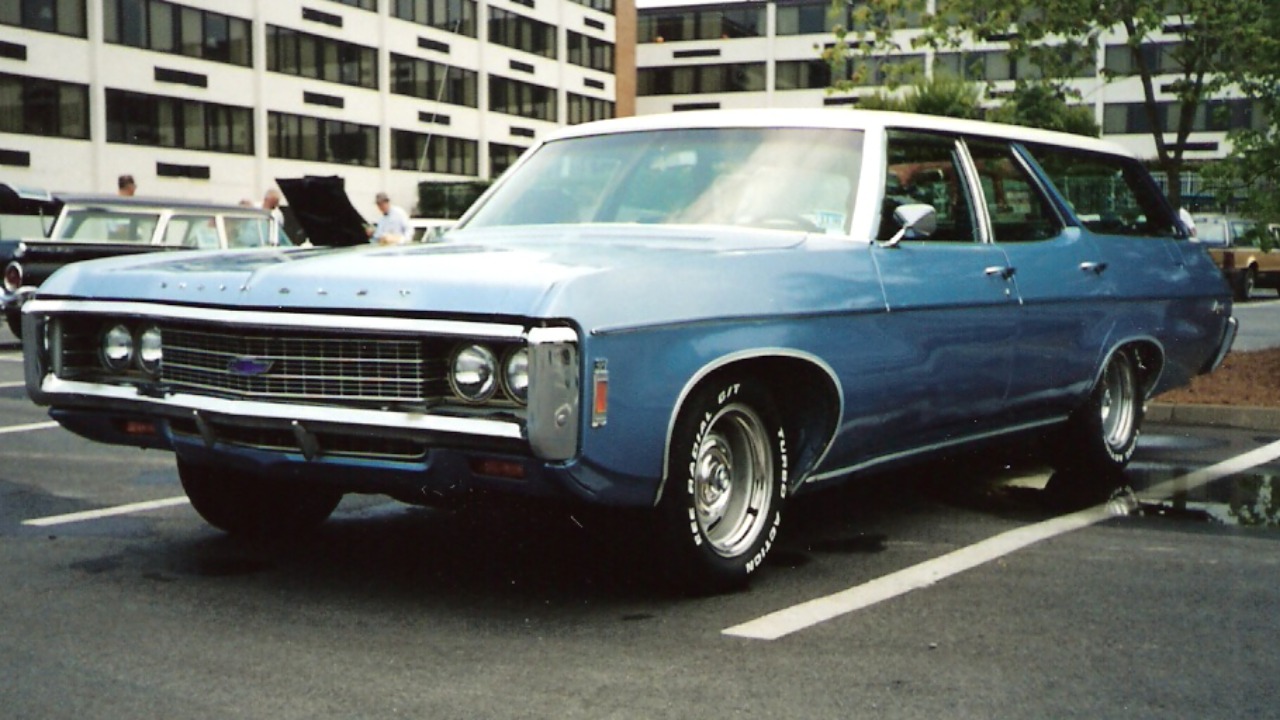
That makes the 1969 Chevrolet Kingswood one of the most overlooked vehicles of its time.
At first glance, the Kingswood looked exactly like what most buyers expected from a late-1960s family wagon. It was large, practical, and designed to carry passengers, luggage, groceries, and everything else that came with American family life. It featured three rows of seating, a spacious cargo area, and enough room for long road trips.
What many people didn’t realize was that the Kingswood was also remarkably capable when it came to towing.
Equipped with the right engine and options, Chevrolet’s full-size wagon could pull loads that would surprise many modern drivers. In some configurations, it offered towing capability that rivaled or exceeded what many buyers expected from dedicated trucks of the era.
The Kingswood serves as a reminder that during the late 1960s, the line between family transportation and heavy-duty utility was often much blurrier than it is today.
The Era Before SUVs
To understand the Kingswood’s appeal, it’s important to remember that modern SUVs didn’t yet dominate American roads.
Today, buyers looking to tow a boat, camper, or utility trailer often choose a pickup truck or large SUV. In 1969, many of those vehicles either didn’t exist or hadn’t yet become mainstream family transportation.
For millions of Americans, the station wagon filled that role.
Large wagons functioned as family haulers, vacation vehicles, moving vans, and tow rigs all at once. A single vehicle was expected to handle nearly every transportation task a household might encounter.
Manufacturers understood those expectations.
As a result, many full-size wagons were engineered with considerable strength and durability.
The Kingswood was among the most capable.
Chevrolet Built the Kingswood on a Full-Size Platform
The Kingswood wasn’t based on a compact or midsize platform.
It rode on Chevrolet’s full-size B-body architecture, the same foundation used for many of the company’s largest passenger cars.
That gave the wagon several important advantages.
The wheelbase was long, helping improve stability when towing. The frame was robust enough to handle substantial loads. The suspension was designed to support large numbers of passengers and significant amounts of cargo.
Weight, which often hurts performance, became an advantage when towing.
A heavier tow vehicle generally feels more stable when pulling a trailer, particularly at highway speeds.
The Kingswood’s substantial dimensions gave it a reassuring presence on the road.
Big-Block Power Was Available
One reason the Kingswood could tow so effectively was the availability of Chevrolet’s larger V8 engines.
Buyers weren’t limited to small-displacement powerplants.
Depending on configuration, Chevrolet offered engines ranging from economical six-cylinders to powerful big-block V8s. The most impressive towing capability came from the larger engines, particularly the 396-cubic-inch and 427-cubic-inch V8 options.
These engines weren’t merely powerful by passenger-car standards.
They produced the kind of low-end torque that towing demands.
Horsepower often receives the headlines, but torque is what helps a vehicle launch a heavy trailer from a stop, climb grades, and maintain speed under load.
The Kingswood had plenty of it.
With a big-block under the hood, the wagon possessed enough pulling power to make towing a camper or boat feel relatively effortless.
The Focus Was Torque, Not Speed
Unlike muscle cars, which were designed to maximize acceleration and quarter-mile performance, the Kingswood’s mission was different.
Its engines were expected to move substantial weight.
That meant engineers emphasized smooth power delivery and strong low-rpm performance.
The large-displacement V8s available in Chevrolet’s full-size lineup excelled in exactly those conditions.
Drivers didn’t need to rev the engine aggressively to access useful power. Instead, the engines delivered abundant torque across a broad range of operating speeds.
That characteristic proved especially valuable when towing.
Whether pulling away from a stoplight or climbing a long hill, the Kingswood had the mechanical muscle necessary to get the job done.
The Trailer Towing Package Made a Difference
Buyers who planned to tow regularly could equip their Kingswood with factory towing-related options.
These packages often included upgrades designed to improve durability and performance under load.
Depending on specifications, owners could receive heavy-duty cooling systems, stronger suspension components, specialized gearing, and other features intended to enhance towing capability.
Cooling was particularly important.
Pulling heavy trailers places significant strain on an engine and transmission. Additional cooling capacity helped ensure reliable operation during long trips or hot weather conditions.
The availability of these factory-installed upgrades demonstrated that Chevrolet understood many customers would use the wagon for serious towing duties.
This wasn’t an afterthought.
It was part of the vehicle’s design mission.
Family Vacation Culture Drove Demand
The Kingswood arrived during a period when family road trips were a major part of American culture.
Campers, travel trailers, and recreational boats were becoming increasingly popular. The expanding interstate highway system made long-distance travel easier than ever before.
Families needed vehicles capable of carrying passengers while also pulling recreational equipment.
The Kingswood fit perfectly into that lifestyle.
A family could load children into all three rows of seats, pack luggage into the cargo area, and tow a camper to a national park hundreds of miles away.
The wagon’s versatility became one of its greatest selling points.
It wasn’t merely transportation.
It was a vacation machine.
The Rear-Facing Third Row Added Utility
One of the Kingswood’s most memorable features was its available rear-facing third-row seat.
Children often loved riding in the back, waving at motorists and watching the road disappear behind them.
The feature increased passenger capacity significantly, allowing large families to travel together comfortably.
More importantly for towing, it meant buyers didn’t need a separate vehicle for people and cargo.
The wagon could carry both.
This combination of passenger space and towing capability helped make vehicles like the Kingswood indispensable for many households.
Few other passenger vehicles offered such a broad range of capabilities.
Overshadowed by Muscle Cars
Despite its impressive versatility, the Kingswood never received the attention given to Chevrolet’s performance models.
The late 1960s were dominated by horsepower wars.
Cars like the Chevrolet Chevelle SS, Chevrolet Camaro, and Chevrolet Corvette captured magazine covers and showroom attention.
Station wagons quietly handled everyday responsibilities.
They didn’t participate in drag races or dominate performance headlines.
Yet many of the same engineering ingredients that made Chevrolet’s performance cars successful also benefited the Kingswood.
Powerful engines, durable drivetrains, and robust chassis components translated naturally into towing capability.
The wagon simply used those strengths differently.
Why Modern Enthusiasts Are Rediscovering Them
In recent years, interest in classic station wagons has grown significantly.
Collectors increasingly appreciate vehicles that represent everyday American life during the 1960s and 1970s. Wagons offer nostalgia, practicality, and a refreshing alternative to more common collector cars.
The Kingswood occupies a particularly interesting niche.
Its size, styling, and utility make it stand out at car shows where muscle cars often dominate.
Enthusiasts are also discovering how capable these vehicles remain.
Many restored examples still perform towing duties, proving that the engineering which impressed buyers decades ago remains effective today.
The Kingswood wasn’t pretending to be a truck.
It simply happened to possess many truck-like capabilities.
A Family Wagon With Hidden Strength
The 1969 Chevrolet Kingswood succeeded because it delivered far more than basic transportation.
It carried large families, swallowed enormous amounts of cargo, and tackled long-distance travel with ease. Yet one of its most impressive traits was its ability to tow substantial loads when properly equipped.
Thanks to its full-size chassis, available big-block V8 engines, and towing-oriented options, the Kingswood possessed capabilities that many modern observers never expect from a station wagon.
Its appearance suggested practicality.
Its engineering delivered strength.
More Than Just a Grocery Getter
Looking back, the 1969 Chevrolet Kingswood represents a time when family vehicles were expected to do everything.
They transported children to school, hauled supplies for home projects, carried luggage across the country, and pulled campers to vacation destinations.
The Kingswood handled those tasks with remarkable competence.
While muscle cars earned the headlines, wagons like the Kingswood quietly served as the workhorses of American family life.
And when it came time to hook up a trailer, Chevrolet’s big wagon proved it was far stronger than most people expected.
For many families, that combination of comfort, space, and towing ability made the Kingswood one of the most versatile vehicles on the road.
More from Fast Lane Only