By the early 1970s, American car buyers had become accustomed to dramatic styling changes. Detroit’s designers constantly searched for ways to make their products stand out, and every few years manufacturers introduced bold new shapes intended to capture public attention.
Even in that environment, the 1972 Buick Riviera managed to surprise people.
The Riviera had already established itself as one of the most stylish personal luxury cars in America. Since its debut in 1963, the model had earned praise for its elegant proportions, sophisticated appearance, and ability to blend luxury with performance. Earlier Rivieras were widely regarded as some of the best-looking American cars ever built.
Then Buick took a dramatic turn.
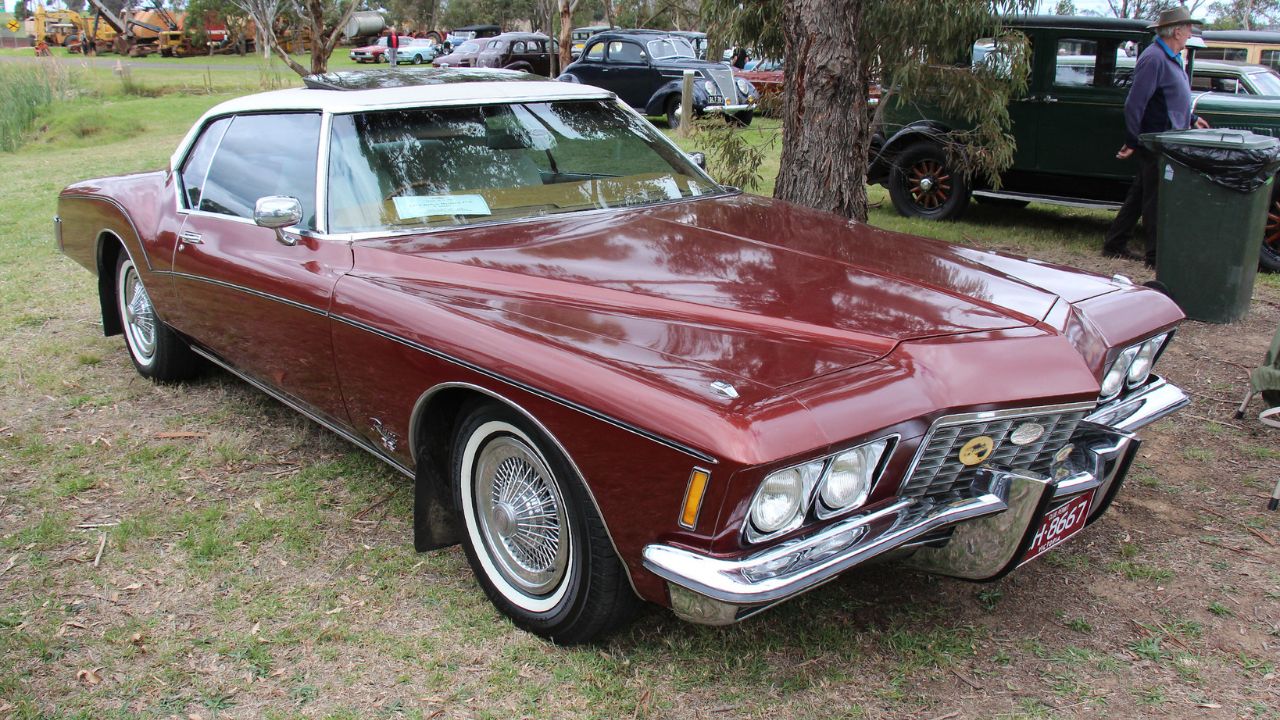
The 1971-1973 Riviera generation—of which the 1972 model is perhaps the best-known representative—abandoned the restrained elegance of its predecessors in favor of one of the most distinctive and controversial designs Detroit had ever produced. Its massive pointed rear end, sweeping body lines, and dramatic proportions looked unlike anything else in American showrooms.
Some buyers loved it.
Others hated it.
Almost nobody ignored it.
More than fifty years later, the 1972 Riviera remains one of the boldest styling statements ever made by Buick—a car that proved the division was willing to take risks even when doing so challenged conventional wisdom.
The Riviera Already Had a Strong Reputation
Before examining the 1972 model, it’s important to understand what came before it.
The original Buick Riviera debuted in 1963 and immediately established itself as one of the most sophisticated personal luxury cars in America. Designed under the leadership of General Motors styling chief Bill Mitchell, the Riviera featured clean lines, balanced proportions, and a level of elegance rarely found in domestic automobiles.
The second-generation Riviera, introduced for 1966, built upon that success.
Many enthusiasts still consider those early Rivieras among the most beautiful American cars ever produced.
Because of that reputation, buyers expected future Rivieras to continue following a similar design philosophy.
Buick had other ideas.
The Personal Luxury Market Was Evolving
By the late 1960s, the personal luxury segment had become one of the most competitive areas of the automotive industry.
Cars such as the Ford Thunderbird, Oldsmobile Toronado, and Cadillac Eldorado were attracting buyers who wanted style, comfort, and prestige wrapped into a dramatic package.
Manufacturers realized that distinctive design could be just as important as horsepower or equipment levels.
Standing out mattered.
In response, designers across Detroit became increasingly adventurous.
The Riviera’s next redesign would embrace that philosophy more aggressively than almost anyone expected.
The “Boat Tail” Became the Defining Feature
The most famous element of the 1972 Riviera was its rear styling.
Inspired in part by classic boattail speedsters of the 1930s, Buick’s designers created a dramatically tapered rear section that narrowed toward the center of the car.
The shape was unlike anything else on American roads.
Viewed from above, the rear deck appeared almost pointed. The body sides curved inward, creating a distinctive profile that immediately separated the Riviera from every competitor.
The design quickly earned a nickname.
Enthusiasts began referring to the car as the “Boat Tail Riviera.”
The name stuck.
Today, many people know the 1971-1973 generation almost exclusively by that description.
Bill Mitchell’s Influence Was Everywhere
Much of the Riviera’s dramatic appearance reflected the influence of Bill Mitchell.
Mitchell believed automobiles should be emotional objects. Throughout his career, he encouraged designers to create memorable shapes rather than merely functional transportation.
He admired dramatic forms and often drew inspiration from boats, aircraft, and classic European automobiles.
The Boat Tail Riviera reflected those interests perfectly.
Its styling wasn’t driven primarily by practicality.
It was driven by visual impact.
Mitchell wanted people to notice the car.
Mission accomplished.
More than five decades later, few American automobiles are as instantly recognizable.
The Design Divided Opinions Immediately
Although the Riviera attracted attention, not all of that attention was positive.
Some buyers admired the car’s boldness. They appreciated Buick’s willingness to create something genuinely different.
Others viewed the design as excessive.
Critics argued that the pointed rear end looked awkward or overly dramatic. Some felt Buick had abandoned the clean elegance that defined earlier Rivieras.
Automotive journalists expressed mixed opinions as well.
Many praised the originality of the design while questioning whether buyers would embrace such a radical departure from convention.
The Riviera became a conversation piece.
Even those who disliked it found themselves discussing it.
From a design perspective, that alone represented a significant achievement.
The Rest of the Car Was Equally Dramatic
While the rear styling attracted the most attention, the entire vehicle reflected Buick’s bold new direction.
The front end featured a prominent grille and dramatic proportions. The long hood emphasized the car’s substantial dimensions. Curved body panels created a sense of motion even when the Riviera was standing still.
The car looked large, powerful, and expensive.
That appearance aligned perfectly with the expectations of the personal luxury market.
Buyers weren’t merely purchasing transportation.
They were purchasing presence.
The Riviera delivered plenty of it.
Performance Remained Part of the Formula
Despite its emphasis on styling, the Riviera wasn’t simply a design exercise.
Under the hood sat Buick’s large-displacement V8 engines, which provided strong performance and effortless highway cruising.
The standard powerplant for 1972 was Buick’s 455-cubic-inch V8.
Known for producing substantial torque, the engine suited the Riviera’s grand touring mission perfectly.
Rather than emphasizing high-rpm performance, the 455 delivered smooth and abundant power throughout the driving range.
The combination of luxury, comfort, and torque-rich performance appealed to buyers seeking a sophisticated driving experience.
The Riviera wasn’t a muscle car.
But it certainly wasn’t slow.
It Shared Technology With the Toronado
Like its cousin, the Oldsmobile Toronado, the Riviera utilized a front-wheel-drive platform.
This arrangement remained relatively unusual for large American automobiles during the early 1970s.
Front-wheel drive provided packaging advantages that helped create a spacious interior while contributing to the car’s distinctive proportions.
The technology also reinforced the Riviera’s image as a sophisticated and advanced automobile.
Buick wasn’t simply offering bold styling.
It was pairing that styling with innovative engineering.
That combination enhanced the car’s appeal among buyers interested in something beyond the ordinary.
Sales Reflected a Mixed Reception
Although the Riviera continued attracting buyers, sales declined compared to some earlier generations.
Several factors contributed to that outcome.
The personal luxury market was becoming increasingly competitive. Economic conditions were changing. Most importantly, the Boat Tail styling proved polarizing.
Some customers embraced it enthusiastically.
Others preferred more conservative alternatives.
The design’s divisive nature likely limited its overall market appeal.
Yet it also ensured the Riviera would remain memorable.
Many cars achieve strong sales and then fade from public consciousness.
The Boat Tail Riviera followed a different path.
Collectors Eventually Reconsidered It
Over time, perceptions of the 1972 Riviera began to change.
Designs that initially generate controversy often benefit from historical distance. As decades passed, enthusiasts gained a greater appreciation for Buick’s willingness to take risks.
The Boat Tail Riviera gradually evolved from an oddity into a collectible.
Its rarity helped.
Its distinctive appearance helped even more.
Collectors increasingly recognized that few manufacturers would have the courage to approve such a design today.
That realization enhanced the car’s appeal.
The Riviera became celebrated precisely because it refused to follow convention.
It Represented the End of an Era
The 1972 Riviera also occupies an important place in automotive history because it arrived during a period of transition.
The muscle car era was fading. Emissions regulations were tightening. Insurance rates were climbing. The industry was moving toward a very different future.
The Boat Tail Riviera represented one of the last examples of Detroit’s willingness to embrace unapologetically dramatic styling without significant compromise.
In many ways, it reflected the confidence and optimism of an earlier era.
That historical context makes the car even more fascinating today.
Buick’s Boldest Styling Gamble
Looking back, the 1972 Buick Riviera stands as one of the most daring production cars ever built by a major American manufacturer.
Buick could have continued refining the elegant formula established by earlier Rivieras.
Instead, the company chose a radically different path.
The result was a car that challenged expectations, divided opinions, and ensured that nobody would mistake it for anything else on the road.
That willingness to take risks remains admirable.
The Car Nobody Saw Coming
The 1972 Buick Riviera took styling in a direction few expected because Buick deliberately rejected the safe choice.
Rather than following established design trends, the company embraced a dramatic Boat Tail shape inspired by classic automotive forms and driven by a desire to create something memorable.
The decision generated controversy.
It also created a legend.
More than fifty years later, the Riviera remains one of the most distinctive American cars ever built. Whether viewed as a masterpiece or an experiment, it continues to command attention.
And perhaps that’s the greatest measure of success for any automotive design.
People are still talking about it.
More from Fast Lane Only