Most production cars are designed with compromise in mind.
Automakers must balance comfort, practicality, styling, fuel economy, reliability, and performance. Even the most powerful muscle cars typically need to function as everyday transportation. They have to survive traffic jams, grocery runs, family road trips, and all the other duties expected of a street-legal automobile.
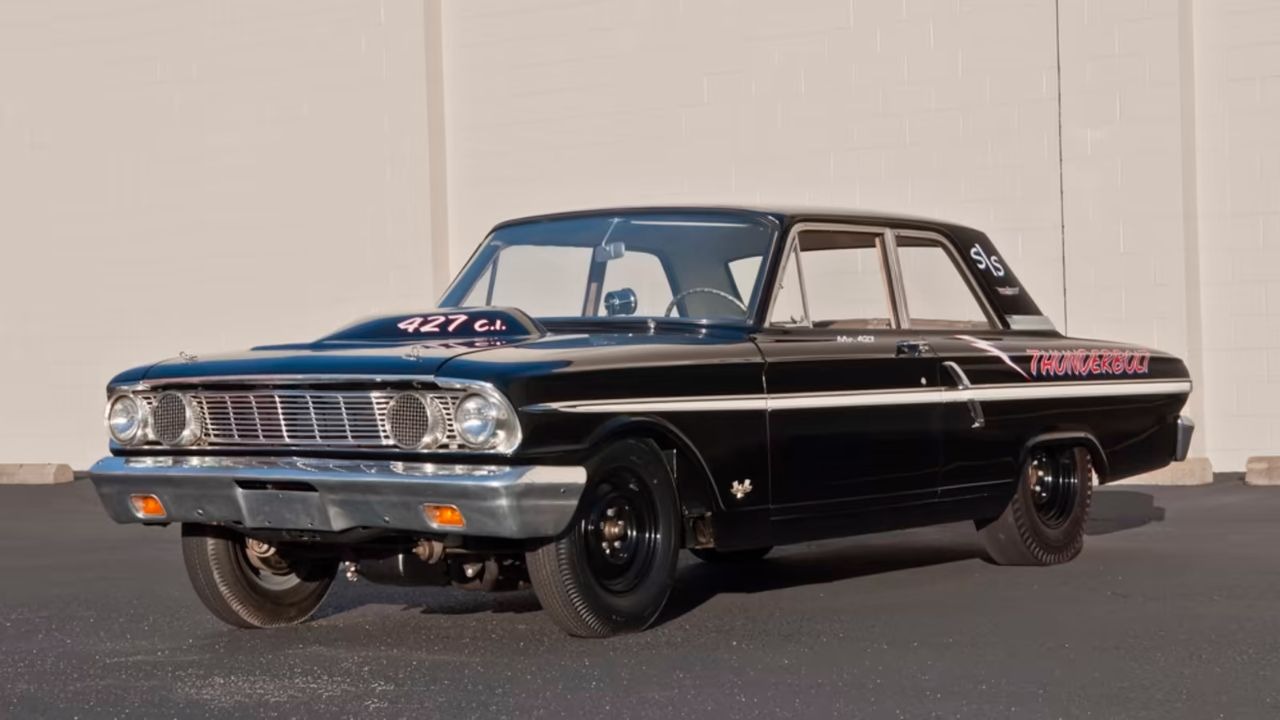
The 1964 Ford Thunderbolt was different.
Although it carried a vehicle identification number, could technically be registered for road use, and was sold through Ford dealerships, the Thunderbolt was never intended to be an ordinary production car. It wasn’t designed for commuting. It wasn’t built for comfort. It wasn’t even created to appeal to a broad range of buyers.
The Thunderbolt existed for one reason and one reason only.
It was built to win drag races.
Everything about the car—from its engine and lightweight body panels to its stripped interior and unusual weight distribution—served that single purpose. Ford didn’t create the Thunderbolt to compete in the muscle car market. The company built it because it wanted to dominate the drag strip.
More than sixty years later, the Thunderbolt remains one of the most focused factory performance cars ever produced, a machine that blurred the line between production automobile and race car.
Ford Was Locked in a Horsepower War
The early 1960s were a period of intense competition among American manufacturers.
Although corporate policies often publicly discouraged racing involvement, manufacturers understood the marketing value of motorsports success. Victories on race tracks helped attract customers to dealerships, and drag racing had become one of the most visible battlegrounds.
The National Hot Rod Association (NHRA) was growing rapidly. Enthusiasts packed drag strips across the country to watch increasingly powerful factory-backed machines compete for supremacy.
Ford wanted to win.
The company already possessed powerful engines, but success in drag racing required more than horsepower. To compete effectively under NHRA rules, manufacturers needed production-based vehicles capable of maximizing the performance potential of their engines.
That challenge led directly to the Thunderbolt.
The Goal Was NHRA Super Stock Domination
The Thunderbolt was created primarily to compete in NHRA Super Stock racing.
The class required vehicles to maintain a connection to production automobiles, meaning manufacturers had to build and sell a limited number of examples to the public before they could qualify for competition.
This process, known as homologation, produced some of the most fascinating vehicles in automotive history.
Manufacturers often built just enough examples to satisfy the rules while designing the cars specifically for racing success.
The Thunderbolt became one of the most extreme examples of that philosophy.
Ford wasn’t interested in building a balanced street machine.
It wanted a winner.
The Fairlane Became the Foundation
Rather than starting with a full-size Ford, engineers selected the midsize Ford Fairlane as the basis for the project.
The Fairlane offered an important advantage.
It was relatively lightweight compared to many other Ford models.
Weight is critical in drag racing. Reducing mass improves acceleration and allows available horsepower to work more effectively.
The Fairlane provided a compact platform capable of accommodating Ford’s largest performance engine while remaining lighter than many competitors.
It was exactly what engineers needed.
The challenge was fitting an enormous engine into a relatively small car.
The 427 Was the Heart of the Project
At the center of the Thunderbolt sat Ford’s legendary 427-cubic-inch V8.
This wasn’t an ordinary street engine.
The 427 had already established itself as one of the most formidable powerplants in American motorsports. Designed with competition in mind, it featured components capable of surviving sustained high-performance use.
For Thunderbolt duty, the engine received extensive preparation.
Official horsepower ratings listed output at 425 horsepower, but many enthusiasts and historians believe the actual figure was considerably higher.
Regardless of the precise number, performance was extraordinary.
The engine delivered the kind of acceleration required to compete at the highest levels of drag racing.
More importantly, it gave Ford a weapon capable of challenging anything Detroit’s rivals could offer.
Weight Reduction Became an Obsession
Ford engineers understood that horsepower alone wouldn’t guarantee success.
Reducing weight became a major priority.
As a result, the Thunderbolt received numerous modifications intended to eliminate unnecessary mass.
Fiberglass replaced steel in several areas.
Lightweight body panels helped trim pounds wherever possible.
The front bumper utilized aluminum.
Sound deadening materials largely disappeared.
Comfort features that might appeal to ordinary buyers were viewed as unnecessary burdens.
Every pound removed improved performance.
The Thunderbolt wasn’t designed to pamper occupants.
It was designed to reach the finish line first.
The Interior Was Barely Civilized
The Thunderbolt’s cabin reflected its racing mission perfectly.
Compared to ordinary production cars, the interior felt remarkably sparse.
Lightweight bucket seats replaced heavier alternatives. Basic trim replaced more luxurious materials. Many comfort-oriented features simply weren’t included.
The atmosphere was closer to that of a competition vehicle than a conventional passenger car.
Drivers understood immediately that this was not a luxury automobile.
Even simple conveniences often took a back seat to performance objectives.
Ford’s priorities were clear.
The car existed to go fast.
Everything else was secondary.
Engineers Relocated Components for Better Traction
One of the Thunderbolt’s most interesting engineering features involved weight distribution.
Drag racing places enormous importance on traction. The more effectively a car transfers power to the pavement, the quicker it accelerates.
To improve rear-wheel grip, Ford relocated several components.
The battery moved to the trunk.
Additional changes helped shift weight toward the rear of the vehicle.
These modifications increased the amount of force pressing the drive wheels into the track surface during acceleration.
The strategy worked.
The Thunderbolt launched with remarkable effectiveness, helping maximize the performance potential of its powerful engine.
The Car Was Surprisingly Difficult to Drive
Although the Thunderbolt delivered impressive performance, it wasn’t necessarily easy to operate.
The enormous engine, lightweight construction, and race-oriented setup created a demanding driving experience.
Controlling the car required skill.
The available power could overwhelm the tires if not managed properly. The vehicle’s behavior reflected its singular focus on acceleration rather than overall refinement.
Professional racers appreciated those characteristics because they understood the mission.
Casual drivers often found the Thunderbolt far less friendly than ordinary production automobiles.
Ford accepted those compromises.
Winning races mattered more than everyday usability.
The Thunderbolt Quickly Proved Itself
Once the Thunderbolt reached drag strips, its effectiveness became obvious.
The car immediately emerged as one of the most competitive vehicles in NHRA Super Stock competition.
Its combination of lightweight construction and massive horsepower proved difficult for rivals to match.
Drivers consistently posted impressive elapsed times and trap speeds.
Victories accumulated rapidly.
The Thunderbolt accomplished exactly what Ford intended.
It won.
The car’s success helped reinforce Ford’s performance image and demonstrated the company’s engineering capabilities in one of motorsports’ most visible arenas.
Production Numbers Remained Small
Because the Thunderbolt existed primarily to satisfy homologation requirements, production remained extremely limited.
Ford built only enough examples to qualify for competition and support selected racers.
As a result, the Thunderbolt never became a common sight on public roads.
Its rarity would later become one of its defining characteristics.
Collectors prize vehicles produced in small numbers, particularly when those vehicles possess significant historical importance.
The Thunderbolt offers both.
Every surviving example represents a direct connection to one of the most intense periods of factory-backed drag racing.
It Helped Define Ford’s Performance Reputation
The Thunderbolt arrived during a crucial period for Ford performance.
The company was establishing itself as a serious competitor across multiple forms of motorsports, including NASCAR, drag racing, and endurance racing.
Success mattered.
Each victory enhanced Ford’s reputation among enthusiasts and reinforced the connection between competition and production vehicles.
The Thunderbolt played an important role in that effort.
Its achievements demonstrated that Ford was willing to build specialized machines when necessary to achieve success.
The company wasn’t merely participating.
It was competing to win.
Collectors View It as a Factory Race Car
Today, many enthusiasts regard the Thunderbolt less as a traditional production car and more as a factory-built race car that happened to be street legal.
That perception reflects reality.
Virtually every aspect of the vehicle was optimized for drag racing performance.
Unlike many muscle cars that balanced speed with practicality, the Thunderbolt made almost no concessions to comfort or convenience.
Its singular purpose is precisely what makes it so fascinating.
The car represents an era when manufacturers pushed the boundaries of what could qualify as a production automobile.
A Car Built With One Goal
Looking back, the 1964 Ford Thunderbolt stands as one of the purest expressions of factory performance ever created.
Ford didn’t build the car to attract casual buyers or impress luxury-minded customers. It didn’t exist to serve as everyday transportation.
The Thunderbolt existed because Ford wanted to dominate drag racing.
Every engineering decision supported that objective.
The lightweight construction, powerful 427 V8, stripped interior, and race-focused modifications all pointed toward the same goal.
Win races.
The Street-Legal Drag Car
The 1964 Ford Thunderbolt remains legendary because it embraced its purpose completely.
At a time when most production vehicles required compromise, the Thunderbolt sacrificed almost everything in pursuit of performance. It blurred the distinction between race car and road car more aggressively than nearly any contemporary vehicle.
The result was one of the quickest and most intimidating factory-built machines of its era.
More than sixty years later, it continues to symbolize a remarkable moment in automotive history when manufacturers built cars not merely to compete, but to dominate.
And in the case of the Thunderbolt, domination was exactly the point.
More from Fast Lane Only