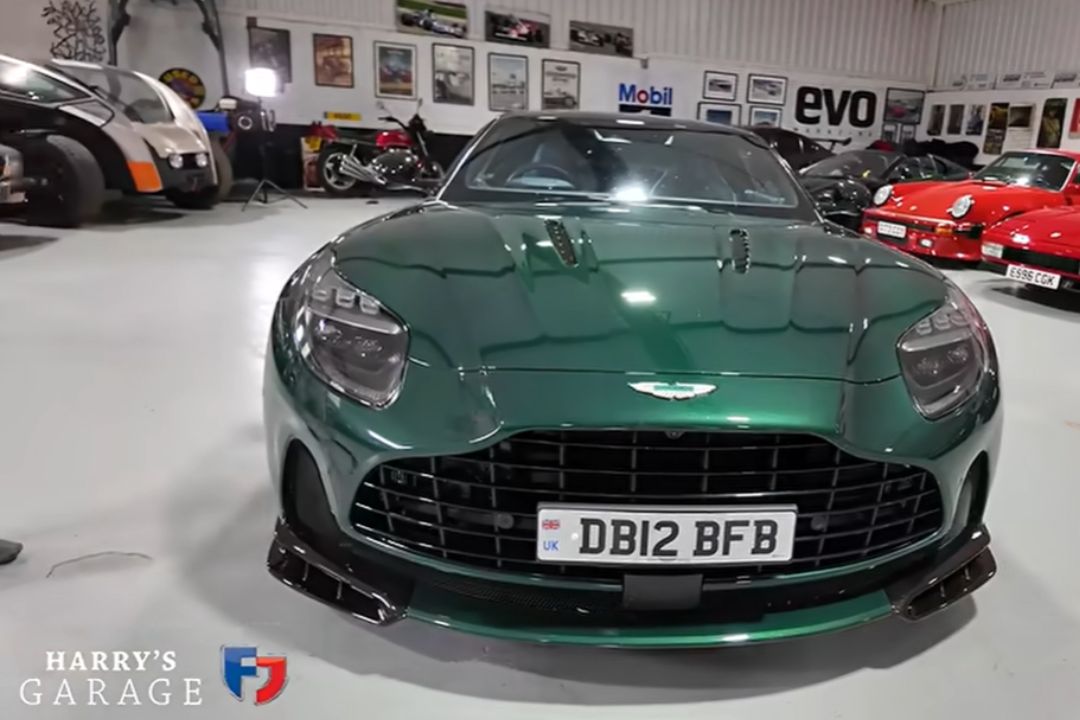
Everyone loves a big horsepower number. It is shiny, it is easy to shout across a bar, and it makes for a great headline. Seven hundred horsepower certainly qualifies. But every so often, a car comes along where the horsepower is not even the best part of the story, and that is exactly what happened when veteran reviewer Harry Metcalfe got behind the wheel of the new Aston Martin DB12 S.
Metcalfe has spent decades driving some of the most exciting performance cars on the planet through his channel, Harry’s Garage, so when he gets genuinely excited about something, car people tend to lean in and listen. And this time, the thing that had him grinning was not the extra power. It was how the car handled a bumpy back road.
That is a fun twist for a car packing a 700 horsepower twin-turbo V8. Aston Martin clearly wanted this car to be fast, and it is. But based on Metcalfe’s time with it, the real party trick is what the chassis does once the road stops being smooth.
What Aston Actually Changed
The DB12 S builds on the standard DB12 rather than starting from scratch, and the upgrades are worth knowing before diving into how it drives. Power from the 4.0-liter twin-turbo V8 climbs to 700 metric horsepower, up from 680 hp in the regular DB12. It keeps the same clever “hot V” engine layout, with the turbochargers nestled between the cylinder banks, and stays proudly rear-wheel drive with no hybrid system and no fancy 48-volt anti-roll bars to lean on. Power flows through a ZF automatic gearbox.
Aston quotes a 0 to 60 mph sprint of 3.4 seconds, and Metcalfe put the car on his own scales, clocking it at 1,820 kg with a nearly full tank. Weight distribution lands at 48 percent front and 52 percent rear, a nice balanced starting point for any car built to carve corners. Carbon ceramic brakes come standard, and buyers chasing a little extra drama can add a titanium exhaust that shaves about 11.5 kg and cranks up the volume by roughly 1.5 decibels.
There are some fun visual upgrades too, including an optional double-vane carbon front splitter, carbon hood vents, a carbon roof, and chunkier 21-inch wheels. All good stuff. But none of it is what had Metcalfe buzzing.
The Chassis Is the Real Star
Metcalfe had driven the standard DB12 two years earlier, so he had a solid baseline for comparison. His big takeaway on the DB12 S was how dramatically more compliant the car felt over rough country roads, all while keeping the tight, controlled feel that makes a sports car fun in the first place. That is not an easy combination to nail. A big part of the trick comes from Aston’s dynamic override system, which lets a driver soften the suspension independently from the rest of the drive mode settings. Translation: you can keep the engine and steering feeling sharp while letting the dampers relax over bumps.
That flexibility seems to be exactly what won Metcalfe over. A grand tourer that only feels great on a freshly paved test track is not much fun in the real world, where roads are rarely perfect. Metcalfe found the DB12 S soaked up bumps that had unsettled the earlier car, and for a machine built to eat up long drives in comfort and style, that is a genuinely big deal.
He put it plainly, saying the DB12 S felt like the car he had hoped the original DB12 would be back in 2024. That is high praise coming from someone who has driven nearly everything with four wheels and a steering rack.
The cabin backed up that real-world focus too. Metcalfe measured ambient noise at just 74 decibels on rough roads, quieter than he expected from a current Porsche 911. Chunky physical switches control the seat cooling, exhaust valve, and traction settings, giving the whole interior a tactile, built-for-driving feel rather than a screen-heavy showroom vibe.
A Few Honest Gripes
Metcalfe did not hand out a perfect score, and that is part of why his chassis praise carries so much weight. He noted the steering feels a touch light at low speeds, and the exhaust note is quieter than earlier Aston V8s, a change tied to new 2026 EU drive-by noise rules rather than anything Aston chose on its own. Small nitpicks, sure, but they show he was giving the car an honest look rather than just gushing.
Finding Its Spot in the Lineup
The DB12 S carries a base price of £211,500, slotting neatly between the sportier Vantage at £175,500 and the flagship Vanquish at £332,000. Metcalfe weighed those two as well for fun, finding the Vantage about 80 kg lighter than the DB12 S and the Vanquish roughly 120 kg heavier, with the Vanquish edging ahead to 60 mph in 3.3 seconds.
Metcalfe called the DB12 S the sweet spot in Aston’s current lineup, sitting comfortably between something lighter and sharper and something bigger and pricier. Considering how much of his enthusiasm centered on how the car actually feels to drive rather than outright numbers, that sweet spot label makes a lot of sense.
The Number That Actually Matters
Horsepower is fun to talk about, and 700 is a genuinely great number to have on a spec sheet. But Metcalfe’s time in the DB12 S is a nice reminder that the most exciting thing about a car is not always the biggest number attached to it. Sometimes it is how the car feels when the road gets messy and the driver starts having a little fun with it. Aston Martin clearly put real effort into getting that part right, and Metcalfe’s reaction says it paid off.
More from Fast Lane Only: