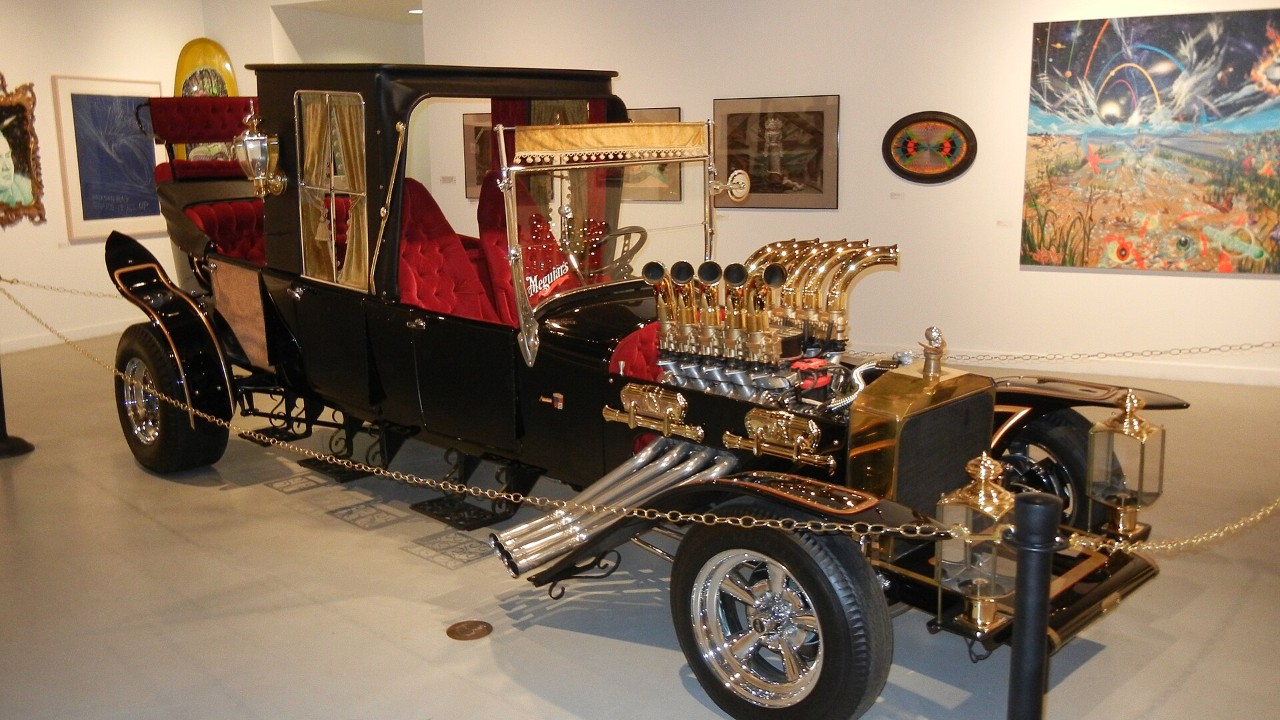
Herman Munster’s Munster Koach started as a $200 sketch and became a custom car that TV fans recognize on sight. George Barris paid designer Tom Daniel that fee for the drawing, and then his shop had just three weeks to turn it into a running car.
The result looked like a hot rod and a hearse had collided at speed. Three Ford Model T bodies stretched the car to about 18 feet. Meanwhile, a Ford 289 V8 sat up front under a forest of chrome carburetor stacks. It was loud, black and absurd, and that was exactly the point for a family of friendly ghouls.
Today the car is more than a TV prop. It is a snapshot of 1960s Kustom Kulture, built by hand by some of the best metal shapers in Hollywood. Here is how it came together, what was under the scrollwork, and where the original lives now.
A $200 drawing and a 21-day deadline
The design came first. According to Consumer Guide, Tom Daniel drew the concept and Barris paid him $200 for it. Daniel later designed the Red Baron model kit for Monogram, so the show car launched a long career in miniature as well.
Then the clock started. Consumer Guide says Barris had 21 days to build the car, and his shop, including Dick Dean, turned Daniel’s drawing into metal. The National Hot Rod Association’s history of the car gives the same deadline. In fact, NHRA says the short schedule and the hand-built work explain the price, which it puts at about $18,000 for the first Koach. Consumer Guide also says Barris was paid $18,000. However, a Hagerty profile gives the cost as $21,000, so the exact figure depends on whose records you trust.
How the Munster Koach body came together
The Munster Koach rode on a 133-inch frame made by hand, NHRA says. Up front sat a dropped axle with split radius rods and T springs, standard hot rod hardware of the day. Three Model T bodies formed the shell, and NHRA describes them as ’27 Model T bodies. Consumer Guide, by contrast, calls them fiberglass bodies.
The real labor went into the trim. NHRA says the brass radiator and fenders were formed by hand, and the rolled-steel scrollwork alone took 500 hours. Hagerty adds spiderwebs on the windshield and headlights, gold drapes with tassels in the windows and twin casket handles on the front fenders. It also counts six doors.
The paint was just as fussy. NHRA lists Black Spyder Pearl with gold leaf trim, laid on in 40 hand-rubbed coats. Inside, the seats wore blood-red velvet. As Consumer Guide points out, that color was lost on viewers, because the show aired in black and white.
The cabin also carried gadgets. NHRA lists a Muntz tape deck, an electric shoe polisher, a Sony TV and two antique French telephones, all powered by a special Autolite electrical system. Hagerty describes “Grandpa’s laboratory” between the front and rear seats, plus an elevated rumble seat at the back for Eddie.
The Ford 289 V8 and its ten-carburetor stack
Every account agrees on the basic engine: a Ford 289 V8. Beyond that, the stories split. NHRA and Hagerty both describe a 289 Cobra engine bored out to 425 cubic inches. That is a big jump for a 289, and the two outlets don’t explain how it was done. Either way, the parts list reads like a 1960s speed catalog, with Jahns high-compression pistons, an Isky cam and Bobby Barr racing headers.
The carburetors are the best-known detail, and also the most disputed. Hagerty says the engine wore ten chrome-plated Stromberg carburetors. However, NHRA reports that Dick Dean later admitted the ten Strombergs were fake. According to Dean, a real four-barrel carburetor sat hidden under the box, on a Mickey Thompson manifold. Consumer Guide tells the same story: a fake ten-carb setup that hid a single four-barrel.
The gearbox is another open question. NHRA and Hagerty both list a four-speed manual, and NHRA adds an Ansen Posi-Shift shifter and a 4.11 rear end. NHRA also says the car rolled on 11-inch Mickey Thompson slicks mounted on Astro chrome spoke wheels.
Still, the car really ran. NHRA says TV Guide tested it in January 1964 and recorded 0 to 60 mph in 10 seconds flat. For an 18-foot hearse with a brass radiator, that was a respectable number.
On screen with Herman, Grandpa and the Drag-u-la
The car made its debut in “Rock-A-Bye Munster,” the show’s fourth episode, according to Consumer Guide. In the story, Lily went to a used-car lot to buy Herman a birthday present. She liked a T-bucket and a 1920s hearse, so she asked a customizer to combine the two.
Driving it was not simple for Fred Gwynne. Consumer Guide notes that Gwynne stood 6 feet 5 inches and reached about 7 feet in costume. As a result, the crew removed the seat cushion so he could fit behind the wheel. One day, Consumer Guide adds, Gwynne drove the cast right off the Universal Studios lot, to the delight of people in Universal City.
The Koach also inspired a second famous car. In “Hot Rod Herman,” Herman lost the Koach in a drag-race bet. Grandpa then turned a casket into the Drag-u-la, and the family won the Koach back. Barris’s shop built that car from another Tom Daniel sketch, and Consumer Guide says it used a 289 Ford V8 with exhaust headers shaped like organ pipes. Hagerty rates that Mustang V8 at 350 horsepower and says it breathed through two four-barrel carburetors.
Replicas, a second Koach and where the original is now
The fame of the car soon led to copies. AMT sold Munster Koach and Drag-u-la model kits in the 1960s, and Consumer Guide says both have been reissued. Barris Kustoms later built a handful of replicas of both TV cars, according to Hagerty. NHRA says a second Koach followed in 1985, with Dick Dean of the original Barris team leading the build.
That leaves the question every fan asks: where is the real one? Hagerty says the original Munster Koach is on display at the Volo Auto Museum in Volo, Illinois, about 50 miles northwest of Chicago.
More from Fast Lane Only