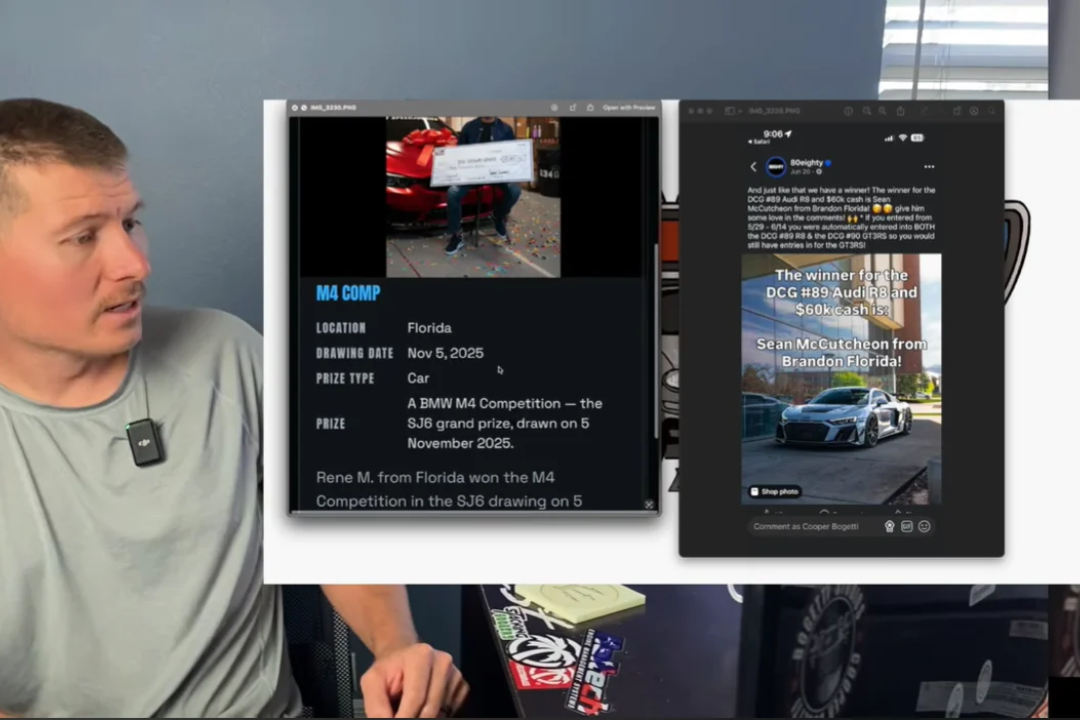
Winning a $100,000 car giveaway once is remarkable. Winning it seven or eight times, across seven or eight completely unrelated companies, is either the luckiest man in America or proof that something about these giveaways isn’t what it appears to be. A YouTuber going through car sweepstakes websites found exactly that pattern, and once he started pulling the thread, the same handful of faces kept turning up again and again across brands that had no obvious connection to each other.
It started small. A man named Shawn showed up as the winner of an Audi R8 giveaway from one company, then an R8 from a second company, then a BMW M4 Competition from a third, the same photo shot in the same location under a different brand name each time. That alone could have been coincidence. One person can genuinely win multiple sweepstakes. But digging further turned up a second repeat winner named Marty T., listed from Washington state, and his case made the pattern impossible to explain away as luck.
One man, seven giveaways, the same $100,000 check
Marty T. appeared as the winner of a giveaway from The Dad Frontier structured as a Ford Bronco plus $30,000 cash, or $100,000 outright. He also won what appeared to be the same prize range from Folded Steel, in a different outfit but posed with what looked like the same check and background. He won an M4 or $100,000 from MZM Auto Works, this time photographed holding a hat, with the check still visible beside him. He won the Welder Up giveaway for $100,000 through a platform the video captions as Shred Sweeps, then popped up again on a company called 060 winning the same amount, then on Wink Active holding an unrelated item that looked like a supplement bottle, then on Sinister Speed with the option of an Audi RS6 or $100,000 cash. Each appearance used a slightly different photo or a subtly edited version of the same one, but the pattern was unmistakable: the same person, the same prize range, across companies with no apparent relationship to one another.
That repetition led to the actual explanation, a company called Shared Sweeps that operates as a shared backend for hundreds of independent e-commerce brands running giveaways. Rather than each company funding its own $100,000 prize individually, brands sign up and contribute a percentage of their sales into a shared pool, all competing for the same eventual winner and the same eventual prize. It’s a legitimate business, not a scam in the legal sense, but it fundamentally changes what a customer is actually buying into when they see “win a car” advertised on a single company’s website.
Spreading the odds thin while keeping the marketing loud
If two hundred different websites, or by the host’s own account, potentially hundreds, are all pooling into the same shared prize, a purchase from any one of them isn’t really competing against that single brand’s other customers. It’s competing against the combined customer base of every other participating website at the same time. The exact number of individual entries in that pool was never disclosed in the video, but the underlying math holds regardless of the precise figure: the more brands drawing from a shared pot, the thinner any single purchase’s real odds become.
Making things murkier, several brands were caught actively editing winner photos to imply an exclusive relationship that didn’t exist. Sinister Speed, for instance, photoshopped itself alongside a winner named Greg who had actually won through Fresh Clean Threads, a completely different company, pairing him with fabricated prize options, an Audi, a Raptor, a Noble, or cash, that he never actually had access to. A company called 060 did something similar, putting its own branded shirt on an unrelated winner to suggest a purchase history that never happened. The host was blunt about what this actually represented: these customers never bought from the website now claiming them as a customer success story, and presenting it otherwise misrepresents how the giveaway actually functioned.
The tells hiding in plain sight
Once the pattern became visible, spotting it elsewhere got easier. Several smaller participating brands, including Graveyard Carz, Junkie Boutique, Cloud9 Supplements, Portside Giveaways, and Overkill Battalion, listed countdown timers on their giveaway pages that all expired within roughly the same ten-to-fourteen-hour window, a strong signal that these were simultaneous draws pulling from the same shared pool rather than independent company-specific giveaways ending on their own separate schedules. Overkill Battalion turned out to share past winners with the very first repeat winner identified in the video, Shawn, who also claimed a tabletop griddle giveaway on top of his multiple vehicle wins. Gas Monkey Garage, meanwhile, had recently stopped publicly displaying its past winners altogether, a page that previously existed and had since gone dark, even as it was separately confirmed as one of the platforms advertising winner Dan C.
Lucky Joe’s Garage handled its winner list a little more carefully than most, displaying names in plain text rather than photos, presumably making the overlap less visually obvious to a casual visitor. It didn’t hold up under a simple search. Typing “Marty” into the page turned up Marty T. from Seattle yet again, this time having had the option between a Dodge Hellcat and $100,000 cash. He took the cash, matching the same choice he appears to have made in every other documented appearance.
A business model built on the assumption you’ll take the money
None of this necessarily makes any individual sweepstakes illegal, and the video’s host was careful not to claim otherwise. What it does reveal is a business model built around a fairly safe bet, at least based on the one repeat winner documented in detail: that a winner given the choice will take the cash over the car, which is exactly what let a company like Shared Sweeps advertise a headline prize as enormous as “$100,000 or a car” without necessarily expecting to give away many actual vehicles. The cash prize functions less like a lottery jackpot and more like an insurance policy funded collectively by every participating brand’s customer base, precisely so no single company ever has to absorb the cost of an actual car giveaway on its own.
The host’s closing take avoided painting every sweepstakes with the same brush, acknowledging that plenty of people involved in this industry aren’t running anything outright dishonest. But the specific practice of quietly pooling entries across hundreds of unrelated brands while marketing each one as an independent, winnable giveaway, then dressing up other companies’ winners in your own branded merchandise to imply a purchase that never happened, is the part he flagged as genuinely deceptive regardless of whether the underlying prize structure is technically legal.
More from Fast Lane Only
- Unboxing the WWII Jeep in a Crate
- 15 rare Chevys collectors are quietly buying
- 10 underrated V8s still worth hunting down
- Police notice this before you even roll window down
*Research for this article included AI assistance, with all final content reviewed by human editors.