The Benz Patent-Motorwagen is often presented as the tidy starting line of automotive history, a single moment when the car arrived fully formed. The real story is stranger and more tangled, involving forgotten inventors, steam contraptions, and a marketing narrative that later turned one machine into “the first car” for the sake of a simple origin myth. Understanding how that happened reveals as much about branding and memory as it does about engineering.
Following the Motorwagen’s rise from obscure patent to museum icon shows how history gets edited. The vehicle itself was innovative, but its legend grew because it fit a clear story that companies and museums could sell, even as earlier self-propelled road vehicles were pushed to the margins.
How a three-wheeled curiosity became “car zero”
When Karl Benz filed his patent for a three-wheeled motor carriage in 1886, he was not working in a vacuum. Steam-powered road vehicles had been chugging along European streets and country roads since at least the early nineteenth century, and inventors in France, Britain, and the United States had experimented with internal combustion engines long before Benz drew his plans. His key move was to create a compact, gasoline powered machine that was purpose built as a road vehicle rather than a converted carriage or a small locomotive.
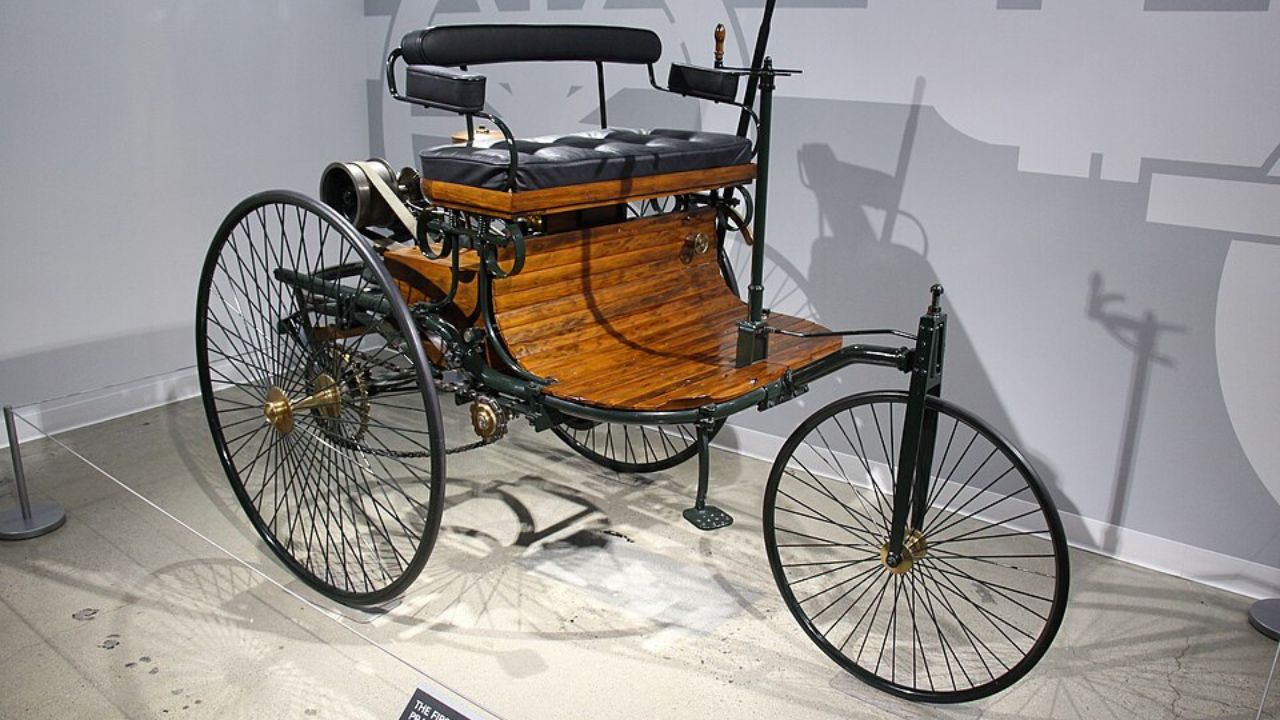
The Patent-Motorwagen used a single-cylinder, four-stroke engine mounted horizontally at the rear, with a tubular steel frame and wire-spoke wheels that made it look more like an oversized tricycle than a modern car. It had belt and chain drive, rudimentary steering, and no bodywork in the modern sense, but it was recognizably a self-contained automobile, not a horse carriage with an engine bolted on. That coherence made it easier, in retrospect, to draw a line from Benz’s machine to the cars that followed.
Even then, the Motorwagen might have remained a technical footnote without Bertha Benz. In 1888, Karl’s wife undertook a long-distance journey in the vehicle, driving more than 60 miles to visit her mother and turning a private prototype into a public spectacle. The trip forced her to improvise repairs, refuel at pharmacies that sold ligroin, and navigate roads that had never seen such a machine. Her journey later became a core part of the Benz legend, a ready-made narrative of daring, practicality, and proof that the invention worked outside the workshop.
Only later did corporate storytelling polish these elements into the neat claim that Benz had “invented the car.” As automotive historians have pointed out, that phrase ignores a long list of predecessors. Critics of the simplified story have highlighted earlier steam vehicles and internal combustion experiments, arguing that the Motorwagen was one important step in a chain rather than a singular beginning, and that the idea of a lone inventor suits marketing better than historical accuracy, a point made sharply in one detailed critique.
What actually changed with the Benz Patent-Motorwagen
Sorting out what the Motorwagen did differently starts with a basic question: what counts as a “car”? Historians who try to answer that usually point to several criteria. A car must be a self-propelled vehicle designed for roads, powered by an onboard engine, and intended for personal or small-group transport rather than rail or heavy freight. By those standards, a number of earlier machines qualify as automobiles in some sense, even if they look primitive to modern eyes.
Steam carriages in Britain, such as those built by Goldsworthy Gurney and Walter Hancock, carried passengers on public roads decades before Benz. In France, inventors like Étienne Lenoir and Alphonse Beau de Rochas experimented with internal combustion engines that were later adapted to vehicles. An overview of early efforts to “invent the car” lists multiple contenders, from Nicolas-Joseph Cugnot’s eighteenth-century steam wagon to American gasoline car builders of the 1890s.
What the Benz Patent-Motorwagen changed was less the basic concept and more the integration of parts into a workable package. The lightweight engine, the relatively low center of gravity, and the layout that put the power unit at the rear combined into something that could be built and refined in series. It was not yet mass production, but it was a platform that could plausibly become a product rather than a one-off curiosity.
The Motorwagen also arrived at a moment when cities were beginning to grapple with congestion, manure, and the limits of horse-drawn transport. Urban planners and industrialists were looking for alternatives, and a compact gasoline vehicle looked like a promising answer. The machine fit into emerging ideas about individual mobility and modernity, which helped it stand out among earlier, bulkier steam designs that felt closer to small trains than personal vehicles.
Another shift with Benz’s work involved the legal and commercial framework. The patent itself, and the subsequent formation of a company to build improved versions, created a structure for investment and competition. That framework allowed other engineers, including Gottlieb Daimler and Wilhelm Maybach, to iterate on similar ideas and push performance and reliability forward. The Motorwagen did not invent the car in a single stroke, but it helped crystallize a new industry around a recognizable template.
Why the origin story still matters in the age of EVs
The fight over who “invented the car” might seem academic in an era of electric crossovers and software updates, yet the way the story is told still shapes how people think about innovation. When a single figure such as Karl Benz is presented as the lone creator, the contributions of others, including lesser-known engineers and financial backers, fade from view. So do the political and social conditions that made the technology possible.
For museums and brands, a clean origin story is valuable. It simplifies exhibits, strengthens corporate identity, and gives marketing departments a tidy slogan. That is why the Benz Patent-Motorwagen is often displayed as if it were the starting point rather than one node in a network. The risk is that this approach turns history into a product, with inconvenient predecessors and parallel experiments quietly edited out.
The debate also connects directly to current arguments about electric vehicles and autonomy. When companies claim to have created “the first true” electric SUV, or the “world’s first” fully self-driving taxi service, they are drawing from the same playbook that elevated the Motorwagen. Those claims often gloss over earlier prototypes, regional services, or less polished but functionally similar systems. The pattern shows how narratives of firstness can obscure a more collaborative and incremental reality.
There is another reason the Motorwagen story resonates now. As cities rethink transport, from cycling infrastructure to congestion pricing, the car’s symbolic role is under review. Revisiting the messy birth of the automobile helps break the sense that private cars were an inevitable endpoint. The fact that early road vehicles included steam buses, experimental electric carriages, and hybrids of public and private transport suggests that other paths were possible and might be again.
What the next chapter of the Motorwagen myth might look like
Over the next few years, the story told around the Benz Patent-Motorwagen is likely to keep changing. As more archives are digitized and local histories surface, earlier and parallel inventions gain visibility. That process has already started, with historians and enthusiasts highlighting neglected figures and machines that do not fit neatly into the Benz-centric narrative.
Automotive companies are also under pressure to show continuity between their past and their electric future. For a brand that traces its lineage to Karl Benz, the Motorwagen can be framed not only as the first gasoline car in its corporate story but as the beginning of a broader tradition of engineering. Such framing might shift the emphasis away from a disputed claim of outright invention and toward a story of long-term adaptation.
More from Fast Lane Only
- Unboxing the WWII Jeep in a Crate
- 15 rare Chevys collectors are quietly buying
- 10 underrated V8s still worth hunting down
- Police notice this before you even roll window down
*Research for this article included AI assistance, with all final content reviewed by human editors