The 1936 Cord 810 arrived in the middle of the 1930s and looked like it had slipped through a crack in time. Its low nose, hidden headlights, and clean bodywork made contemporary rivals seem instantly old, and nearly a century later the car still reads as a concept sketch brought to life. Designers and historians continue to treat the 810 as a benchmark for how far ahead a production car can be.
That reputation is not nostalgia alone. The 810 bundled radical styling with engineering that prefigured later performance cars, and its influence keeps resurfacing in everything from pop-up lights to today’s obsession with smooth, aerodynamic shapes.
How the Cord 810 rewrote the visual rulebook
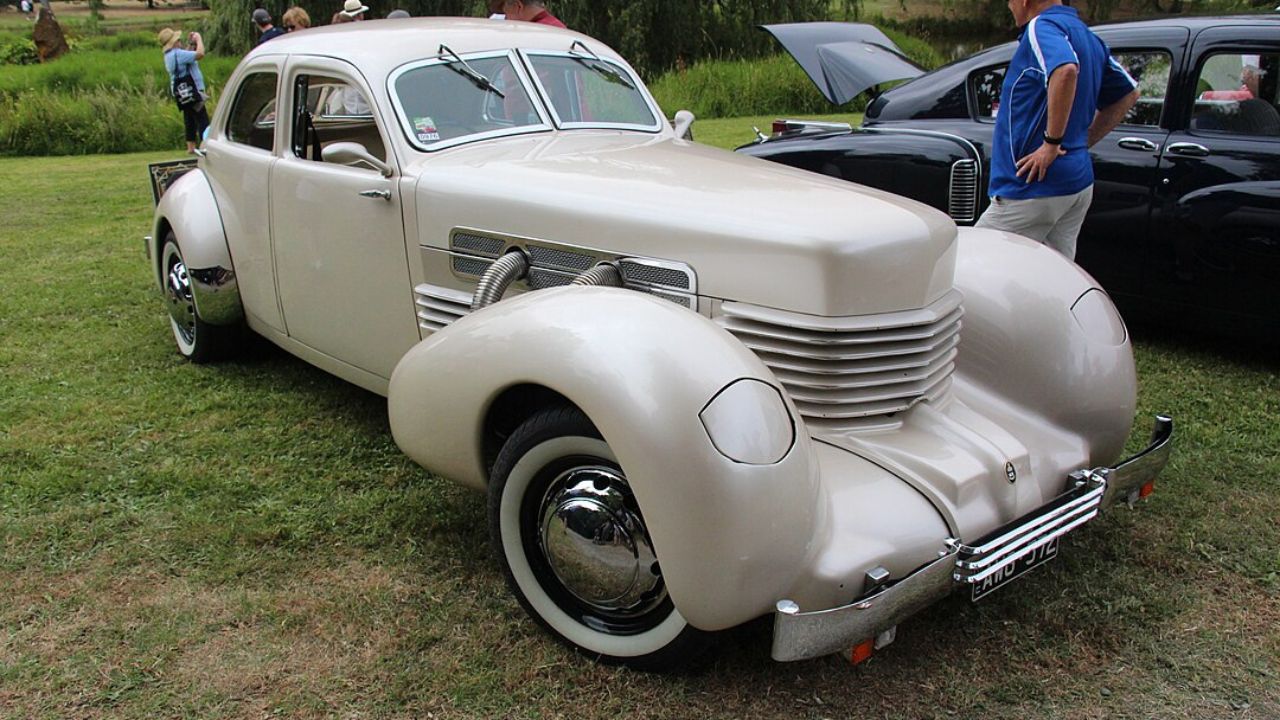
When Gordon Buehrig shaped the Cord 810 for the 1936 model year, most American cars wore tall radiators, exposed headlights, and separate fenders that visually split the body into pieces. The 810 replaced that clutter with a low, coffin-shaped grille, integrated fenders, and a hood line that flowed uninterrupted into the windshield. In profile, it looked closer to a modern fastback than to its upright contemporaries.
The details were just as startling. Instead of chromed headlamp pods, the Cord used retractable units that folded into the front fenders. These were not a styling afterthought but a core part of the design, which relied on a smooth nose without protruding lamps. Later sports cars turned pop-up lights into a visual signature, and historians regularly cite the Cord among the earliest production examples when tracing the evolution of hidden headlights.
Inside, the car looked like an Art Deco aircraft. Engine-turned panels, a central cluster of round gauges, and a dashboard-mounted gear selector all pushed the 810 away from carriage heritage and toward a machine-age identity. The cabin’s horizontal lines and integrated controls previewed the way postwar designers would treat interiors as cohesive environments rather than a collection of separate parts.
Engineering that matched the futuristic style
The Cord 810 did not only look advanced. It was one of the first American production cars to combine front-wheel drive with an independent front suspension. That layout allowed the low, grille-like nose and eliminated the need for a bulky driveshaft tunnel, which in turn let passengers sit lower in the chassis. The stance that made the car appear so modern was directly tied to its mechanical layout.
Buyers could specify a supercharged version of the later 812, with external exhaust pipes that snaked from the hood sides and announced the engine’s intent. Even without forced induction, the 810’s drivetrain and suspension gave it handling and traction advantages that set it apart from many rear-drive rivals on rough or slippery roads. Contemporary testers highlighted its ability to track straight and maintain grip where heavier, higher cars struggled.
This combination of front-wheel drive, a relatively low center of gravity, and a powerful engine foreshadowed later performance sedans and grand tourers. The formula would not become mainstream for decades, yet the Cord treated it as a production reality in the 1930s.
From sales disappointment to cult status
Commercially, the Cord 810 was a fragile proposition. Its advanced transmission and complex driveline created reliability issues, and the company’s financial position left little room to refine the car. Production lasted only a short time before the brand folded, which meant the 810 and its closely related 812 sibling never had a chance to mature in the market.
That scarcity, combined with the car’s striking lines, helped turn it into a collector favorite. As postwar enthusiasts began to catalog significant prewar machines, the Cord emerged as a touchstone for forward-looking design. Its limited numbers added an element of myth, but the car’s influence rested on more than rarity. Designers and journalists repeatedly pointed to the 810 when tracing the lineage of modern automotive styling, treating it as a missing link between upright, coachbuilt bodies and the integrated forms that followed.
Today, the car appears regularly in lists of historically significant automobiles. When enthusiasts and experts compile rankings of the greatest cars ever built, the Cord often earns a place alongside icons such as the Jaguar E-Type and Porsche 911, a reflection of how strongly its innovation still resonates in retrospective rankings.
Why the Cord’s design still feels contemporary
Part of the Cord 810’s enduring appeal lies in how clean it looks next to many modern cars. The absence of heavy ornamentation, the integrated fenders, and the low hood all align with current priorities around aerodynamics and visual simplicity. Where some contemporaries relied on chrome and decorative trim, the Cord used proportion and surface to create drama.
Its hidden headlights, once a novelty, now read as a precursor to flush-mounted lighting and retractable elements that designers use to reduce drag. The car’s smooth sides anticipate the way electric vehicles minimize visual noise to signal efficiency. Even the decision to place the gear selector on the dashboard feels unexpectedly relevant in an era when consoles are dominated by screens and touch controls.
Modern lists of standout designs often include the Cord alongside far newer exotics and supercars. When commentators single out the most distinctive and desirable cars, the 810 appears in the same breath as contemporary halo models in roundups of coolest cars, which shows how effectively a prewar sedan can still compete for attention against carbon-fiber hypercars.
What changed in the way the Cord 810 is understood
Early reactions to the Cord focused heavily on its technical novelty and its role as a luxury object. Over time, the emphasis has shifted toward its broader influence on automotive design language. Historians now tend to treat the 810 as a pivot point between the era of separate fenders and the unified, envelope bodies that dominated after the Second World War.
The car’s failure as a commercial product has also been reframed. Where once it might have been viewed as an overreach from a struggling company, it is now often interpreted as a case study in how far ahead of the market a design can be. The reliability problems that hurt sales are acknowledged, yet they sit alongside recognition that many of the Cord’s underlying ideas were simply too advanced for the manufacturing capabilities and customer expectations of its time.
There is also a growing appreciation for the 810 as a piece of industrial design, not just as a collector’s item. Museums and design schools cite its proportions, surfacing, and integration of mechanical and aesthetic choices as teaching tools. The car is no longer only a curiosity from a defunct brand, but a reference object for anyone studying how to make radical ideas usable on public roads.
Why the Cord’s legacy matters in the current car market
Contemporary carmakers face pressure to balance aerodynamics, safety regulations, and brand identity while pushing toward electrification. The Cord 810 offers a historical example of how a single model can reset expectations by combining engineering change with a coherent visual story. Its front-wheel-drive layout directly enabled its low hood and sleek profile, which shows how mechanical decisions can unlock new aesthetics.
Designers working on electric vehicles confront similar questions. Battery packs and compact motors create new packaging freedoms, just as front-wheel drive did for the Cord. The 810’s success as a design, despite its short life in showrooms, illustrates the power of aligning a new layout with a body that clearly communicates its difference. Consumers might not care about the technical details, but they respond to a shape that looks like it belongs to a new era.
For enthusiasts, the Cord’s story also serves as a reminder that innovation does not always come from the largest or most stable companies. A relatively small manufacturer produced a car that still shapes conversations about automotive beauty and progress. That perspective adds nuance to debates about whether only global giants can drive meaningful change in vehicle design.
More from Fast Lane Only
- Unboxing the WWII Jeep in a Crate
- 15 rare Chevys collectors are quietly buying
- 10 underrated V8s still worth hunting down
- Police notice this before you even roll window down
*Research for this article included AI assistance, with all final content reviewed by human editors