The original Volkswagen Beetle arrived in 1938 as an ideological project, yet it went on to become a global people’s car that outlived the regime that created it. Its mix of simple engineering, distinctive design, and sheer ubiquity reshaped how ordinary drivers thought about cars, affordability, and even personality on wheels. Eight decades later, the first-generation Beetle still echoes through modern automotive design and culture.
Understanding how a small rear-engined car from prewar Germany became one of the most influential vehicles in history means looking past nostalgia to the specific ideas it introduced, how those ideas evolved, and why they still matter in an era of electric crossovers and software updates.
From propaganda project to global people’s car
The Beetle began as a political promise. In the late 1930s, the Nazi government wanted a “people’s car” that ordinary German workers could afford. Ferdinand Porsche was tasked with creating a compact, air-cooled machine that could carry a family at highway speeds while remaining cheap to build. The result was the basic Type 1, with its rounded body, rear-mounted engine, and torsion-bar suspension. As later historians have noted, it was a car born in a dark context, something that still shapes how the model is remembered in discussions of its origins.
War halted civilian production, but the design survived. Under British control after 1945, the Wolfsburg plant restarted Beetle assembly, initially to supply occupation authorities, then a rebuilding West Germany. The same traits that had appealed to planners before the war now suited a devastated continent: low cost, rugged construction, and easy maintenance. Over time, incremental improvements in power, safety, and comfort kept the basic shape intact while making the car more usable for everyday families.
By the 1950s and 1960s, the Beetle had become a quiet disruptor in markets dominated by large, front-engined sedans and tailfinned coupes. Its compact footprint and unpretentious styling contrasted sharply with the chrome-heavy American cars that defined the era. Retrospectives on the postwar golden age consistently place the Beetle alongside icons like the Chevrolet Bel Air and original Mini, not because it was glamorous, but because it represented a different philosophy of mobility.
Engineering simplicity that rewrote the rulebook
The Beetle’s influence begins with its mechanical layout. The air-cooled flat-four engine, mounted at the rear, eliminated the need for a complex cooling system and freed up space for passengers and luggage. The car used a simple, lightweight platform chassis, which made it easier and cheaper to produce and repair. This architecture helped the Beetle thrive on rough roads in Latin America, Africa, and Asia, where water-cooled engines and delicate body-on-frame designs were more vulnerable.
That same simplicity made the Beetle a favorite of home mechanics. Owners could adjust valves, change oil, or even swap engines with basic tools. The culture of driveway repairs, enthusiast clubs, and backyard modifications turned the Beetle into a platform rather than just a product. Later air-cooled Volkswagens, from the Type 2 Microbus to the Karmann Ghia, built on this formula, and modern lists of Volkswagen milestones almost always start with the original Type 1 as the foundation.
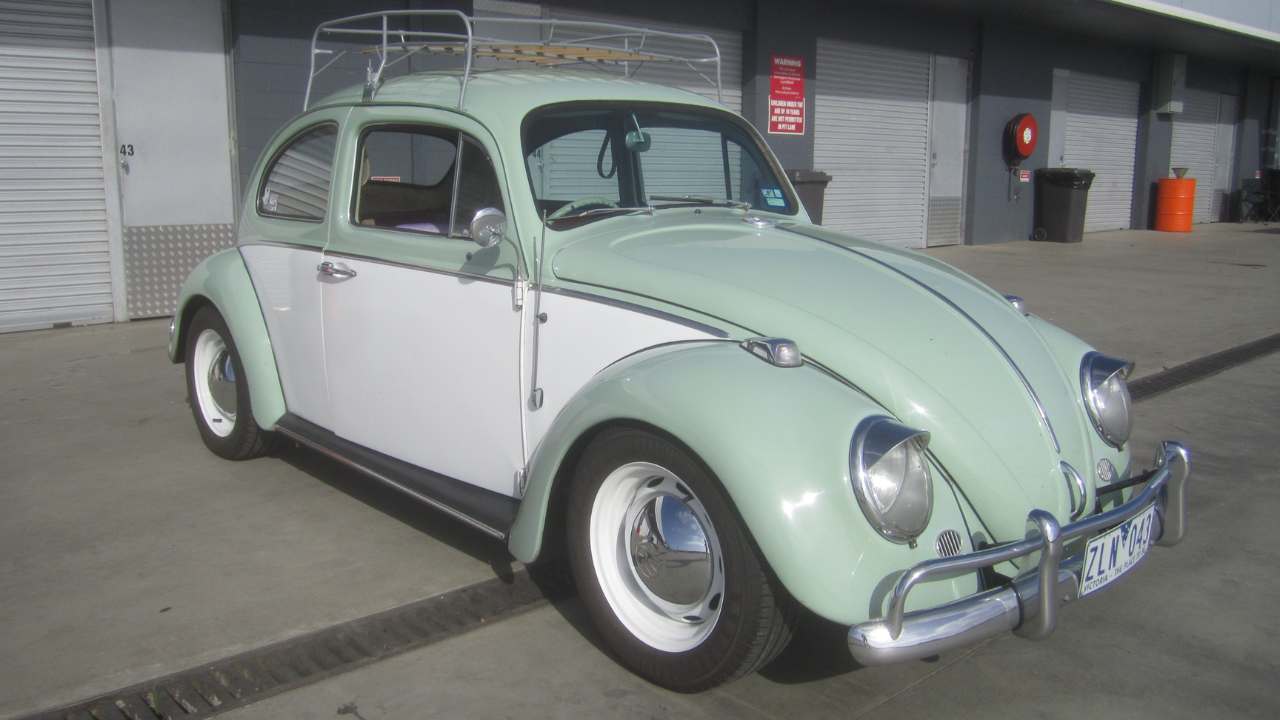
Styling also played a role. The Beetle’s rounded fenders and domed roof were not designed to be cute. They were the product of aerodynamics and packaging. Yet the shape aged gracefully and became instantly recognizable in silhouette. That visual continuity allowed Volkswagen to evolve the Beetle for decades without losing its identity, something few manufacturers have managed with a single model line.
How the Beetle rewired car culture worldwide
By the 1960s, the Beetle was more than a car. In the United States, it became a symbol of counterculture and an alternative to Detroit excess. Clever advertising leaned into its modest size and perceived shortcomings, presenting honesty and frugality as virtues. College students, artists, and young families embraced the Beetle as a rolling expression of different priorities.
Beyond the U.S., the car’s reach was even more significant. Production in Brazil and Mexico turned the Beetle into basic transport for millions, often as taxis or workhorses in harsh conditions. As volumes climbed, it joined the small group of models that defined mass motorization. Rankings of all-time best sellers consistently place the Beetle near the top, alongside the Toyota Corolla and Ford F-Series, a testament to how deeply it penetrated markets far beyond its European roots.
The car’s cultural footprint extended into film and television. Herbie, the anthropomorphic Beetle in Disney’s series, cemented the idea of the car as a lovable character rather than just a machine. That perception fed back into real-world enthusiasm, reinforcing the notion that a small economy car could carry emotional weight and fan devotion usually reserved for sports cars or luxury sedans.
Reinvention, nostalgia, and the end of the line
Volkswagen eventually replaced the original Beetle in its home market with the front-engined, water-cooled Golf, but production of the classic air-cooled model continued in Mexico until the early 2000s. By then, it had already inspired a wave of retro design. The 1998 New Beetle took the familiar silhouette and placed it on a modern Golf-based platform, trading air cooling and rear engines for contemporary safety and emissions performance.
Later retrospectives on the model’s evolution point out how the New Beetle leaned heavily on nostalgia, with a flower vase on the dashboard and rounded styling that echoed the original curves. Analysts have argued in Beetle retrospectives that this strategy helped Volkswagen reconnect with older fans while attracting new buyers who associated the shape with individuality rather than history’s darker chapters.
Yet nostalgia had limits. As consumer tastes shifted toward crossovers and SUVs, demand for compact hatchbacks and coupes faded. Volkswagen ultimately ended Beetle production, framing the decision as a response to changing market preferences and a strategic focus on electric vehicles and larger models. Reports on the final assembly in Mexico highlighted how workers and fans marked the end of a car that had defined generations of affordable motoring.
Why the Beetle’s legacy still matters in the EV era
Today, the original Beetle’s engineering looks quaint next to battery packs and advanced driver assistance systems. Its air-cooled engine would not meet modern emissions rules, and its crash performance falls far short of current expectations. Yet the ideas that made it influential remain highly relevant.
First, the Beetle showed that a global car could be simple, durable, and inexpensive without feeling disposable. That philosophy informs many of the small cars that followed, from the original Fiat 500 to the first-generation Toyota Corolla. Enthusiast histories of Beetle’s 80-year story often emphasize how its basic engineering allowed it to serve as a first car, a family hauler, and a platform for customization, sometimes within the same ownership.
Second, the Beetle proved that character sells. The car’s rounded profile and friendly face made it approachable, a quality that many modern designers seek to replicate in electric city cars and compact crossovers. The lesson is that efficiency and practicality can coexist with strong visual identity. This is visible in how brands craft distinctive light signatures and silhouettes for their EVs, hoping to capture a fraction of the instant recognition the Beetle enjoyed.
Third, the Beetle’s long production run shows the power of evolutionary change. Rather than reinventing the model every few years, Volkswagen refined it gradually, building trust in its reliability and parts availability. That approach influences how manufacturers now handle global platforms and modular architectures, where the underlying structure can support several generations of vehicles with incremental updates.
What could follow the Beetle’s template next
As automakers race to electrify lineups, some are looking back to the Beetle’s formula for guidance. A truly influential modern successor would likely share three traits with the 1938 original: affordability, simplicity, and emotional appeal.
On affordability, the Beetle was designed so that an average worker could aspire to ownership. Many current EVs remain expensive, which limits their impact. Engineers and policymakers who study historic people’s cars often point to the Beetle’s stripped-back approach to features and materials as a model for reducing costs without sacrificing core usability.
More from Fast Lane Only
- Unboxing the WWII Jeep in a Crate
- 15 rare Chevys collectors are quietly buying
- 10 underrated V8s still worth hunting down
- Police notice this before you even roll window down
*Research for this article included AI assistance, with all final content reviewed by human editors