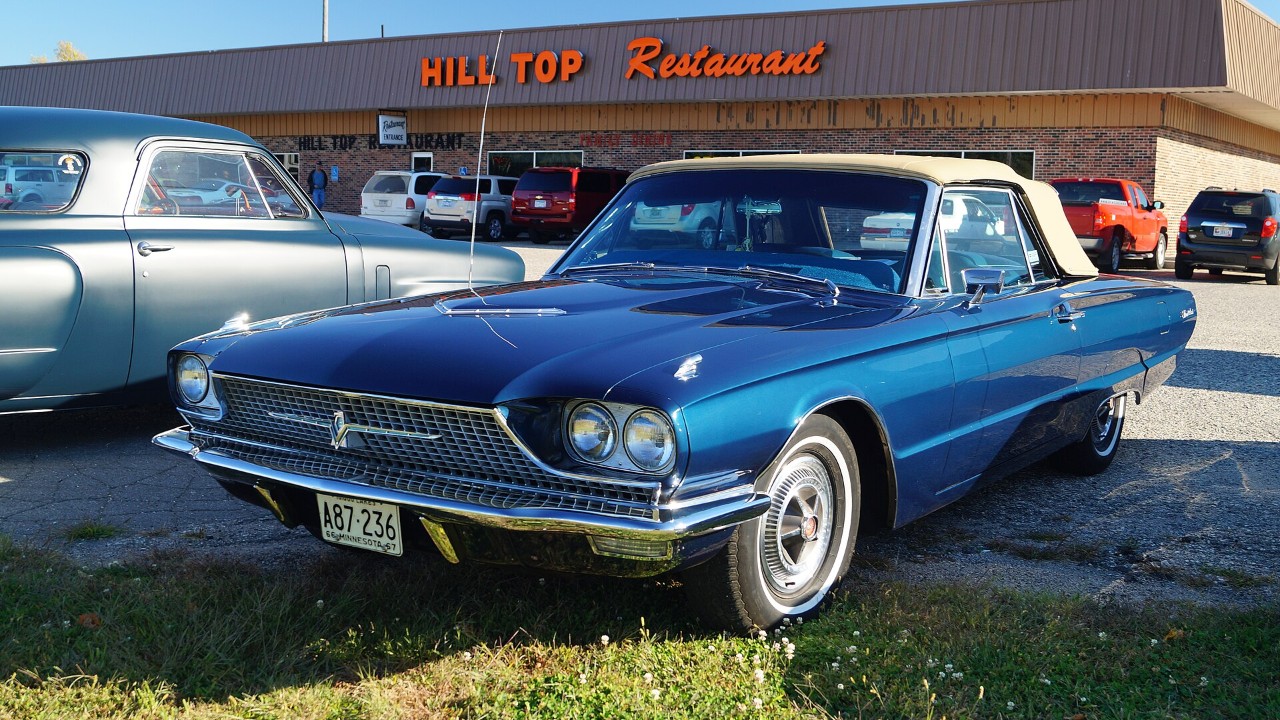
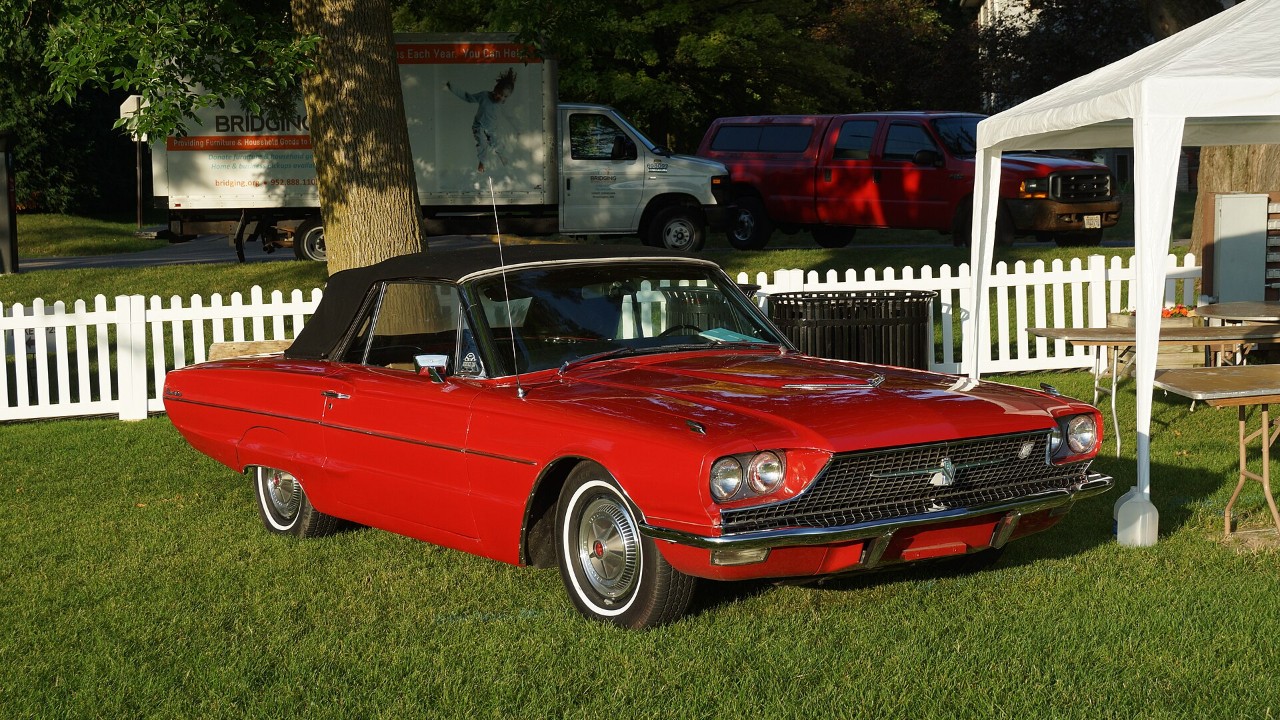
The Thelma & Louise Thunderbird was a 1966 Ford Thunderbird convertible, the last model year Ford ever sold the Thunderbird with a folding top. Louise drives it from the first reel to the last, and the car became the third star of the 1991 road movie. In fact, the production went through five of them.
Director Ridley Scott shot the film from a screenplay by Callie Khouri, with Geena Davis as Thelma and Susan Sarandon as Louise. So the choice of car mattered. A big, open Ford from the mid-1960s told audiences exactly who Louise was before she said a word.
That choice also left a paper trail. Studio records, an auction listing and a museum display all point back to the same model year, and they let us follow what happened to the cars once filming wrapped.
Five 1966 Thunderbirds, and none of them modified
The American Film Institute’s catalog entry for the film says the production used five 1966 Ford Thunderbirds. Each had a job: a principal car, a back-up, a camera car and two stunt vehicles. Filming ran from June 11 to August 31, 1990, and the crew moved to Moab, Utah, for the month of August. MGM distributed it, and the film then opened in Los Angeles and New York on May 24, 1991.
Five cars is a small fleet for a picture built around a chase. According to History.com’s roundup of Hollywood’s coolest cars, none of the five were modified for the role. Ford Authority adds that one car was picked for close-up work because of its back seat, since other characters ride along at points in the story.
Green or turquoise? What the sources say about the color
History.com’s This Day in History entry for the film’s release describes the car Louise drives as a green 1966 Thunderbird convertible. However, the same publisher’s movie-car feature calls it turquoise. The Barrett-Jackson listing for a screen-used car also gives a turquoise exterior with a white interior. Turquoise sits between blue and green, so viewers have long described the shade both ways.
Either way, the color did its work on screen. Against the red rock and desert light of the Southwest, a pale blue-green convertible with a white interior reads clearly in every wide shot. As a result, the Thunderbird stays easy to pick out even when the camera pulls far back from the road.
What made the 1966 Thunderbird convertible special
Ford introduced the Thunderbird in 1955 as a sporty car with a luxury streak. By 1966 it had grown into a four-seat personal-luxury car. That year was also the last of the fourth generation, and enthusiasts call those cars “Flair Birds.” Consumer Guide’s history of the 1966 model says Ford built 5,049 Thunderbird convertibles that year. It also notes that the all-new 1967 Thunderbird arrived without a convertible in the range.
The standard engine was a 390-cubic-inch V8, which Consumer Guide puts at 315 horsepower for 1966 after a compression increase. For the first time since 1963, buyers also had an engine choice: a 428-cubic-inch V8 rated at 345 horsepower. Meanwhile, the base convertible price dropped $74 from 1965, to $4,879. Sales still slid by nearly eight percent, and History.com says slow sales led Ford’s marketing team to decide the luxury image could survive without the drop-top.
Styling changed too. For 1966, Ford fitted a larger eggcrate grille and a simpler blade bumper, and it dropped the fake fender scoops of 1965. At the back, full-width taillights replaced the twin lamps, although the turn signals kept their sequential flash. RM Sotheby’s lists the car’s wheelbase at 113 inches, with disc brakes up front.
The screen car Barrett-Jackson sold in 2008
One of the film cars crossed the block at Barrett-Jackson’s 2008 Scottsdale auction as Lot 1285, offered with no reserve. The listing describes a restored convertible with a new white top, a 428-cubic-inch V8 and an automatic transmission. Its seller said the car came from MGM in 1991 and had never been offered to the public before.
The paperwork made the sale. Barrett-Jackson lists MGM letters of authenticity, plus photos of Brad Pitt signing the rear-seat armrest and Geena Davis signing the sun visor. Thelma & Louise was also Pitt’s first major film role, as the listing points out. History.com reports that a Thelma & Louise drop-top sold at auction in 2008 for $71,500. That is the figure we would hold up for any Thelma & Louise Thunderbird with this kind of documentation.
For context, an award-winning 1966 convertible with the standard 390 sold for $49,500 at RM Sotheby’s Arizona sale in 2012. That car had a concours restoration but no movie history. So, in our view, the film connection added real money on top of an already desirable car.
Where to see a Thelma & Louise Thunderbird now
You can also see one in person. Ford Authority reports that the Petersen Automotive Museum in Los Angeles displays a 1966 Thunderbird from the film, finished in turquoise with a white interior. It is the close-up car chosen for its back seat. In the same display, the Petersen shows the one-millionth Thunderbird to leave Ford’s assembly line.
That puts the film car next to a milestone of the model it represents. More than three decades after the premiere, the Petersen’s turquoise convertible remains one of the five 1966 Thunderbirds the AFI says the production used.
More from Fast Lane Only