The late 1970s are universally remembered as a dark age for American automotive performance. Tightening government emissions regulations and skyrocketing insurance premiums had completely choked out the legendary muscle cars of the previous decade. Yet, in 1978, an unexpected hero emerged from the commercial vehicle sector to claim the performance crown: a step-side pickup truck called the Dodge Li’l Red Express.
The Legal Loophole: The Origins of a Maverick
The origins of this legendary truck lie in a brilliant act of corporate malicious compliance orchestrated by Tom Hoover and the engineers at Dodge. In the mid-1970s, federal law dictated that all passenger vehicles and light trucks had to use restrictive unleaded fuel and catalytic converters. However, the engineering team discovered a massive loophole: vehicles with a Gross Vehicle Weight Rating (GVWR) of over 6,000 pounds were legally classified as “medium-duty” and were completely exempt from catalytic converter mandates.
Capitalizing on this oversight, Dodge introduced the Li’l Red Express in 1978 as part of their “Adult Toys” vehicle lineup. Because it didn’t require a choked-out exhaust system, engineers dropped a modified, high-output 360-cubic-inch (5.9L) police-spec V8 engine straight into the engine bay. It was a vehicle designed to cheat the system, and its market arrival shocked regulatory bodies and delighted the American public.
Unique Features That Set It Apart
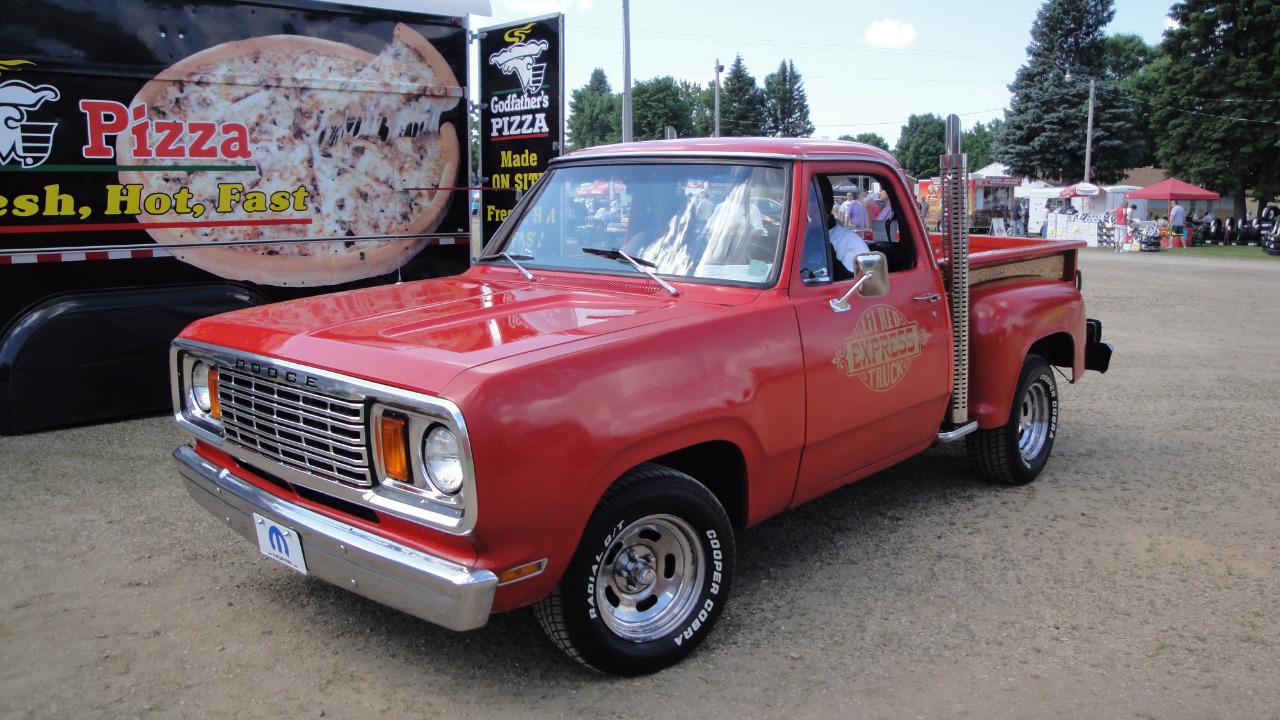
Visually and mechanically, the Li’l Red Express looked like absolutely nothing else on the road. The most striking, unforgettable features were the dual vertical chrome exhaust stacks mounted directly behind the cab, styled to look exactly like a miniature semi-truck. The body was finished exclusively in deep Medium Canyon Red paint, accented by real oak wood panels bolted to the step-side cargo bed and gold-tape pinstriping running along the doors.
Underneath the hot-rod aesthetics lay serious performance. The police-package engine utilized a heavy-duty four-barrel carburetor, a modified camshaft, and a high-flow intake path. It pumped out a factory-underrated 225 horsepower and a massive 295 lb-ft of torque. In an era where sports cars were utterly gutless, this boxy utility truck could comfortably outrun a contemporary Chevrolet Corvette or Pontiac Trans Am on a drag strip.
A Surprising Legacy of Speed
When Car and Driver magazine conducted their annual testing in 1978, the results completely upended the automotive world. The publication officially clocked the Dodge Li’l Red Express as the fastest accelerating American production vehicle from 0 to 100 MPH tested that year. A utilitarian work truck had officially humbled the finest sports cars of Detroit.
The government quickly closed the GVWR emissions loophole for the 1980 model year, permanently ending production after a brief two-year run of roughly 7,000 units. This artificial scarcity, combined with its bizarre history as a loophole-abusing muscle truck, has caused its collector value to skyrocket in recent years. Today, immaculate, well-documented models are highly prized icons at major classic truck shows. The legacy of the Li’l Red Express serves as a timeless reminder of what happens when rogue engineers refuse to let performance die, creating a legend where nobody expected to find one.
More from Fast Lane Only
- Unboxing the WWII Jeep in a Crate
- 15 rare Chevys collectors are quietly buying
- 10 underrated V8s still worth hunting down
- Police notice this before you even roll window down
*Research for this article included AI assistance, with all final content reviewed by human editors.