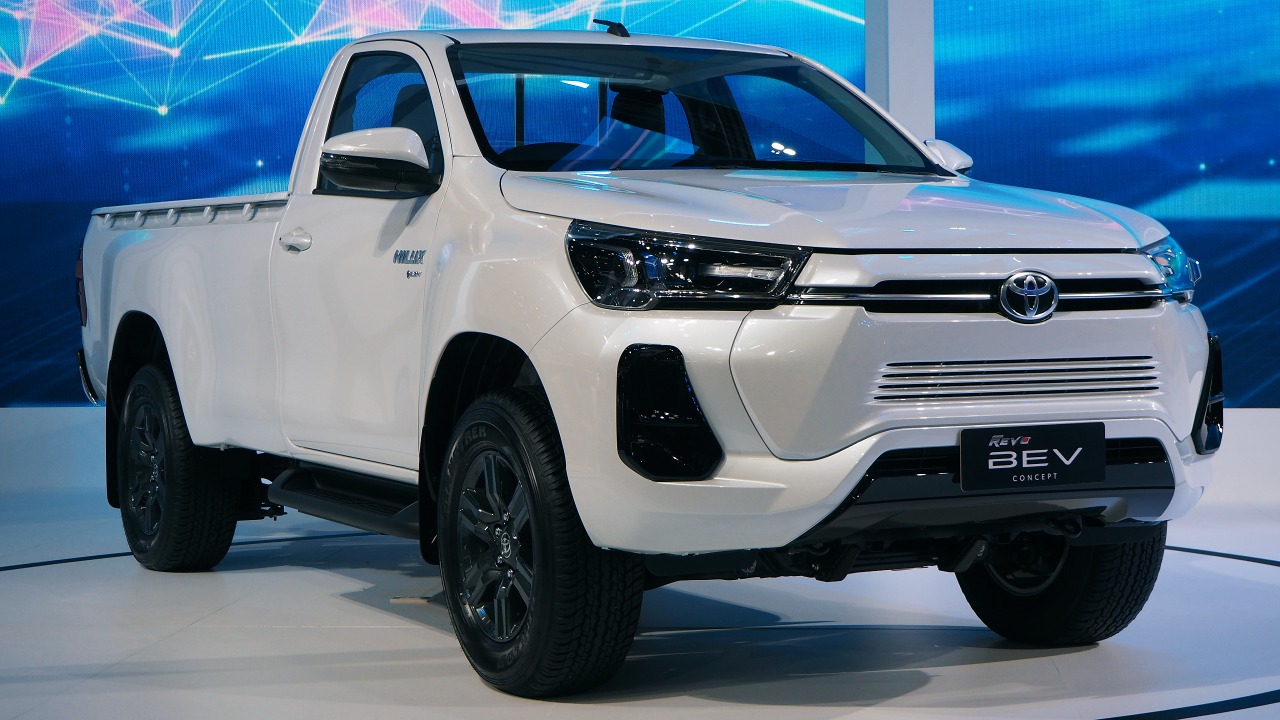
Toyota is finally putting an electric pickup into European showrooms, and it is doing so with one of its most recognisable workhorses. By bringing a battery powered Hilux to Europe, the company is not only expanding its regional line up, it is also signaling how it intends to handle electric trucks globally in the next few years.
The move positions Toyota directly in the emerging contest over zero emission pickups, a segment that has so far been dominated by American and Chinese brands. I see the European launch of the Hilux BEV as a test bed for a broader strategy that blends battery power, hybrid systems and even hydrogen into a multi pronged truck portfolio.
Hilux BEV arrives in Europe as a real work truck
The all new Hilux BEV is being introduced in Europe as a fully fledged member of the Hilux family rather than a niche experiment. Toyota has confirmed that the electric version will be rolled out from April 2026, following its public appearance at the Brussels Motor Show, and that it retains the ladder frame construction and basic proportions that have defined the Hilux for decades. By keeping the familiar body on frame layout and overall stance, the company is clearly trying to reassure traditional pickup buyers that the electric model is still a serious tool, not a lifestyle accessory.
Underneath that conservative silhouette, however, the Hilux BEV is configured to meet modern expectations for an electric work vehicle. The truck uses a battery electric powertrain that drives the rear axle, with the battery pack integrated into the frame to preserve ground clearance and off road geometry. Toyota has stated that the electric Hilux is engineered to deliver the same one tonne payload and 3.5 tonne towing capacity as its combustion siblings, which is a crucial benchmark for fleet operators and small businesses that rely on those figures for daily operations. By matching those core capabilities, the Hilux BEV positions itself as a direct substitute for diesel variants rather than a compromised eco option.
Hybrid Hilux and hydrogen plans show a multi track strategy
What strikes me most about Toyota’s truck roadmap is how deliberately it avoids a single technology bet. Alongside the Hilux BEV, the company is launching a Hilux with a Hybrid 48V powertrain in Europe from July 2026, effectively electrifying the diesel based model without abandoning internal combustion. This mild hybrid system is designed to improve efficiency and drivability while keeping the long range and refueling habits that many pickup owners still prefer. By offering both a battery electric and a hybrid Hilux in the same market, Toyota is hedging against uncertain charging infrastructure and varied customer readiness for full electrification.
The company is also preparing a hydrogen powered Hilux, which adds a third strand to its truck strategy. Reporting on the European debut of the electric pickup notes that Toyota is planning a hydrogen version of The Toyota Hilux, building on earlier prototype work that used fuel cell stacks and high pressure tanks in the familiar chassis. That future model would target users who need rapid refueling and long range but still want zero tailpipe emissions, particularly in regions where hydrogen infrastructure is being subsidised. Taken together, the Hilux BEV, the Hybrid 48V variant and the planned hydrogen Hilux illustrate a portfolio approach in which Toyota expects different technologies to coexist in the truck segment for years.
European launch builds on Thai and global rollout
The decision to start European sales of the Hilux BEV in 2026 does not come in isolation, it follows an earlier rollout in Asia that effectively served as a proving ground. Toyota has already committed to commence sales of the Hilux EV in Thailand in December 2025, with that market acting as the first large scale deployment of the electric pickup. Thailand is one of the strongest territories for the Hilux nameplate, and using it as the launchpad for the Hilux EV allows Toyota to test charging patterns, durability and customer acceptance in a truck heavy environment before expanding into Europe.
From my perspective, the European introduction at the Brussels show is therefore the second phase of a broader regional strategy. The company is using a staggered schedule, first Thailand, then Europe from April 2026, to gather data and refine production while still moving quickly enough to keep pace with rivals. The fact that the Hilux BEV is being shown and specified as a mainstream model, rather than a limited run curiosity, suggests that Toyota sees significant volume potential once it has validated the product in its initial markets. That approach also leaves the door open to further regional launches if the Thai and European experiences prove positive.
Skipping the U.S. highlights Toyota’s cautious EV truck calculus
One of the most telling aspects of Toyota’s electric pickup plan is where the Hilux BEV is not going. The company has made clear that its first battery electric pickup will not be sold in the United States, even as it invests in Europe and Thailand. In reporting on the global debut, analysts noted that Toyota Unveils Its First Electric Pickup, But It is Skipping the U.S., a decision that reflects both regulatory realities and product positioning. The Hilux is not currently sold in the American market, where the Tacoma and Tundra dominate Toyota’s truck lineup, and re homologating the Hilux BEV for U.S. crash and emissions rules would be a costly exercise.
I read that choice as a sign of Toyota’s caution about the American electric truck segment, which is already crowded with large, high powered models and where demand has been volatile. By contrast, Europe and Thailand offer established Hilux customer bases, tighter emissions rules and, in some cases, incentives for zero emission commercial vehicles. Focusing the Hilux BEV on those markets allows Toyota to build experience with electric trucks without immediately confronting the unique expectations of U.S. buyers, who often prioritise extreme towing figures and long highway range. It also buys time for the company to decide whether a future electric Tacoma or Tundra, rather than a Hilux, should be its first battery pickup for the United States.
What the Hilux BEV signals about Toyota’s wider EV truck ambitions
Looking across these moves, I see the European rollout of the Hilux BEV as a signal that Toyota is finally ready to treat electric pickups as a core part of its commercial vehicle strategy. The company has spent years refining hybrids and experimenting with fuel cells, and it is now applying that experience to a truck that must satisfy demanding professional users. By insisting that the Hilux BEV match the payload and towing of its diesel counterparts, and by integrating the battery into the existing body on frame architecture, Toyota is trying to prove that electrification does not have to dilute the Hilux identity. That message is aimed not only at European buyers but also at policymakers who are tightening emissions rules for light commercial vehicles.
At the same time, the staggered rollout and the decision to skip the U.S. underline how carefully Toyota is pacing its entry into electric trucks. The Hilux EV in Thailand, the Hilux BEV in Europe from April 2026, the Hybrid 48V Hilux from July and the planned hydrogen Hilux together form a layered strategy that can adapt to different regional conditions. If these models gain traction, I expect Toyota to extend the same multi technology approach to other pickups and body on frame vehicles, using the lessons from Hilux to shape future electric and hydrogen trucks. For now, the electric Hilux in Europe stands as the clearest indication yet that Toyota’s truck future will be electric, but not electric only.
More from Fast Lane Only