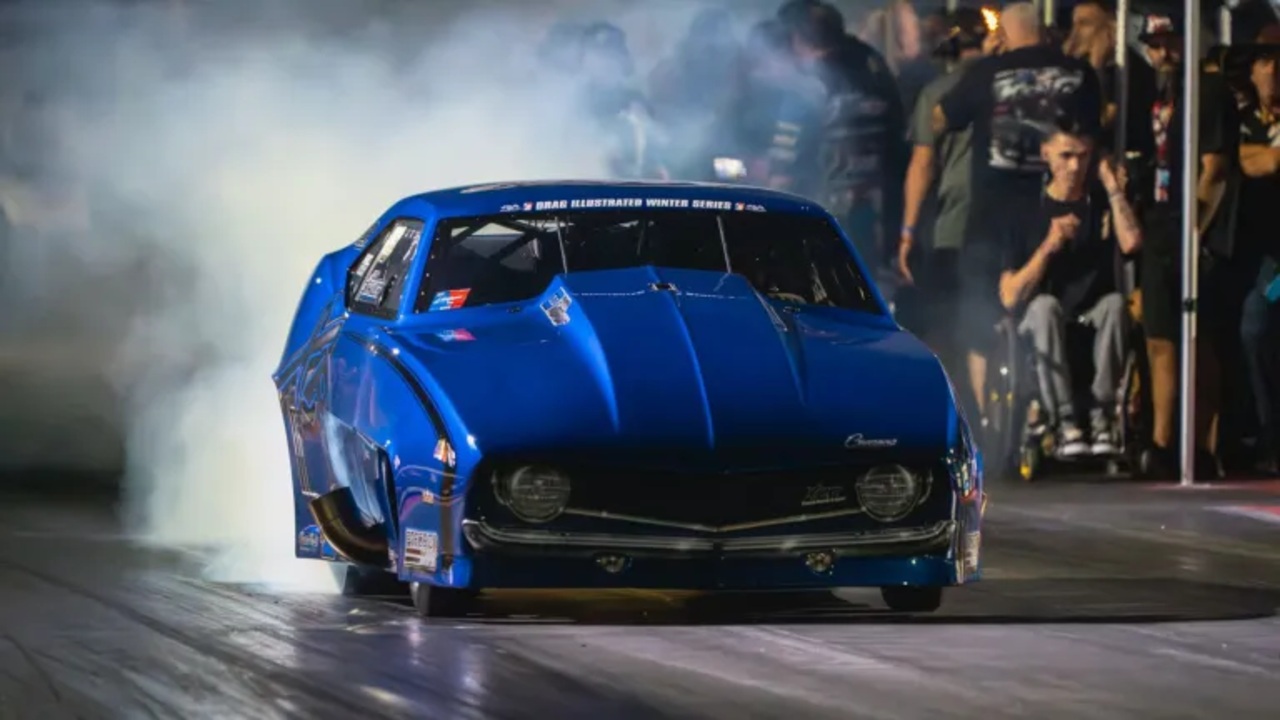
The U.S. Street Nationals delivered a watershed moment for Pro Mod racing when the 32-car field locked in with every entry running in the 3.50-second zone, a first for the class and for the event. What had long been a theoretical benchmark became reality as the bump spot settled in the mid 3.50s, confirming that the category’s performance ceiling has shifted in a single, stunning weekend. At the center of it all, Jimmy Taylor held firm as the standard bearer at the top of the qualifying sheets, underscoring just how deep and unforgiving the field had become.
A historic 3.50s bump spot reshapes expectations
The defining statistic of the weekend was the bump number itself. After the final qualifying sessions, the Pro Mod ladder at the Drag Illustrated US Street Nationals was finalized with a 3.596 bump spot, meaning the slowest car in the 32-car field had still run 3.596 seconds to the eighth mile. That figure, confirmed when officials announced the completed order for The Drag Illustrated US Street Nationals, marked the first time a full Pro Mod field had been compressed entirely into the 3.50-second range, transforming what had been an aspirational target into the new baseline for entry.
The brutality of that cutoff became even clearer when individual performances around the bubble emerged. One report noted that, after running a 3.595 in the final qualifying session, a six-time NHRA Pro Stock champion only just bumped into the field in the No. 31 spot, a reminder that even drivers with world titles on their résumés were fighting for survival at the edge of the ladder. That 3.595, paired with the 3.596 bump held by the last qualifier, illustrated how little daylight existed between making the show and loading up early, and it confirmed that the “insane” nature of the bump was not hyperbole but a hard number that every team now has to beat.
Jimmy Taylor’s No. 1 run anchors the quickest Pro Mod field
At the sharp end of the sheet, Jimmy Taylor provided the benchmark that everyone else chased. Reporting from the event made clear that Jimmy Taylor remained the provisional No. 1 qualifier on Friday at the Street Nationals in Pro Mod, and later updates confirmed that he ultimately secured the top spot once qualifying closed. His performance did more than earn bragging rights, it set the tone for a weekend in which the entire category would be measured against a new standard of precision and power.
The significance of Taylor’s effort was underscored when the quickest Pro Mod field in drag racing history was officially declared set and he was awarded a $7,500 No. 1 qualifier bonus from Jerr. That payout, tied directly to his position at the top of the 32-car ladder, reflected how valuable the pole had become in a field where the slowest car was still in the 3.50s. In practical terms, Taylor’s combination of driving and tuning not only delivered the headline number but also framed the narrative of the event, with every other team forced to calibrate its expectations against the pace he established.
Friday night at Bradenton: when the record field came together
The turning point for the event arrived on Friday night at Bradenton Motorsports Park, when Pro Mod racers at the U.S. Street Nationals presented by M&M Transmission collectively pushed the category into uncharted territory. Reports from Bradenton described how the Pro Mod field, already quick from Thursday’s opening session, used the cooler Friday conditions to stack one 3.50-second pass after another until the 32-car grid was saturated with sub-3.60 performances. By the end of the night, officials could confirm that every car in the show had dipped into the 3.50s, locking in the first all-3.50-second Pro Mod field.
The atmosphere at Bradenton Motorsports Park reflected the magnitude of that achievement. Coverage highlighted how Pro Mod teams warmed up for what was expected to be a historic final qualifying session, with the combination of the Street Nationals stage, the M&M Transmission backing, and the Florida facility’s reputation for traction creating a perfect storm for record-setting runs. When the dust settled, the Friday session had not only reshuffled the ladder but had also rewritten the performance record book, turning what might have been a strong early-season race into a defining moment for the class.
Side-by-side 3.50s and the brutality of eliminations
If qualifying established the numbers, eliminations proved how unforgiving a 3.50-second field can be. Saturday results emphasized that Side-By-Side 3.50-Second Races Highlight First Round of Pro Mod Eliminations at U.S. Street Nationals, a phrase that captured both the spectacle and the competitive cruelty of the opening round. With virtually no weak links on the ladder, early pairings featured cars separated by mere thousandths of a second, turning what might once have been routine first-round matchups into marquee-level showdowns.
The compressed performance window meant that even a minor misstep could be fatal. A driver who had clawed into the field with a 3.595, for example, still faced the prospect of drawing a rival capable of running deep into the 3.50s in the other lane, and any hesitation on the starting line or slight shake downtrack could erase the advantage of a strong qualifying number. The Saturday eliminations, streamed to fans and chronicled in detail, showed that the new performance baseline did not simply produce faster time slips, it fundamentally altered race-day strategy, with tuners forced to balance aggression against the razor-thin margin for error that side-by-side 3.50-second racing demands.
Depth of talent and machinery behind the numbers
The historic bump spot and record field were not the product of a single standout car but of a deep roster of elite drivers and cutting-edge machinery. One report highlighted Barnett, who is also competing in Pro Mod, running a 3.678 at 206.54 in Tommy Youmans’ Harts Charger boosted “Salvage Title” Mustang, a combination that blended modern power-adder technology with a fan-favorite body style. Performances like Barnett’s, sitting just outside the 3.50s yet still delivering 206.54 mph, illustrated how even exceptionally quick cars could find themselves on the wrong side of the qualifying bubble in this new era.
Across the pits, the presence of a six-time NHRA Pro Stock champion fighting to get into the show with that late 3.595 further underscored the depth of talent converging on the Street Nationals. The fact that such a decorated driver needed a near-perfect final session to secure the No. 31 spot spoke volumes about the level of competition. Combined with the precision tuning efforts that kept Jimmy Taylor at the top and the relentless pace of entries like the “Salvage Title” Mustang, the weekend’s results painted a clear picture: the Pro Mod landscape at the U.S. Street Nationals has evolved into a battleground where world champions, seasoned class veterans, and ambitious newcomers must all operate at the outer edge of performance simply to earn a lane on race day.
More from Fast Lane Only