A viral dashcam recording from Bhubaneswar has captured a fatal collision in which a city bus crushed an auto-rickshaw between two buses, turning an ordinary commute into a scene of sudden devastation. The footage, widely shared across social media, has shocked viewers not only for its brutality but for how quickly a routine traffic pause at a busy junction became lethal. The incident has renewed scrutiny of urban road safety, bus operations and the vulnerability of auto-rickshaw drivers in crowded Indian cities.
Circulated clips show the auto-rickshaw trapped with almost no room to escape as a state-run bus closes in from behind, a sequence that has prompted anguished questions about speed, spacing and basic defensive driving. For many who watched, the video is less an isolated horror than a grim illustration of how fragile the margin of safety can be when heavy vehicles, informal transport and dense traffic converge at peak hour.
The Bhubaneswar crash that stunned social media
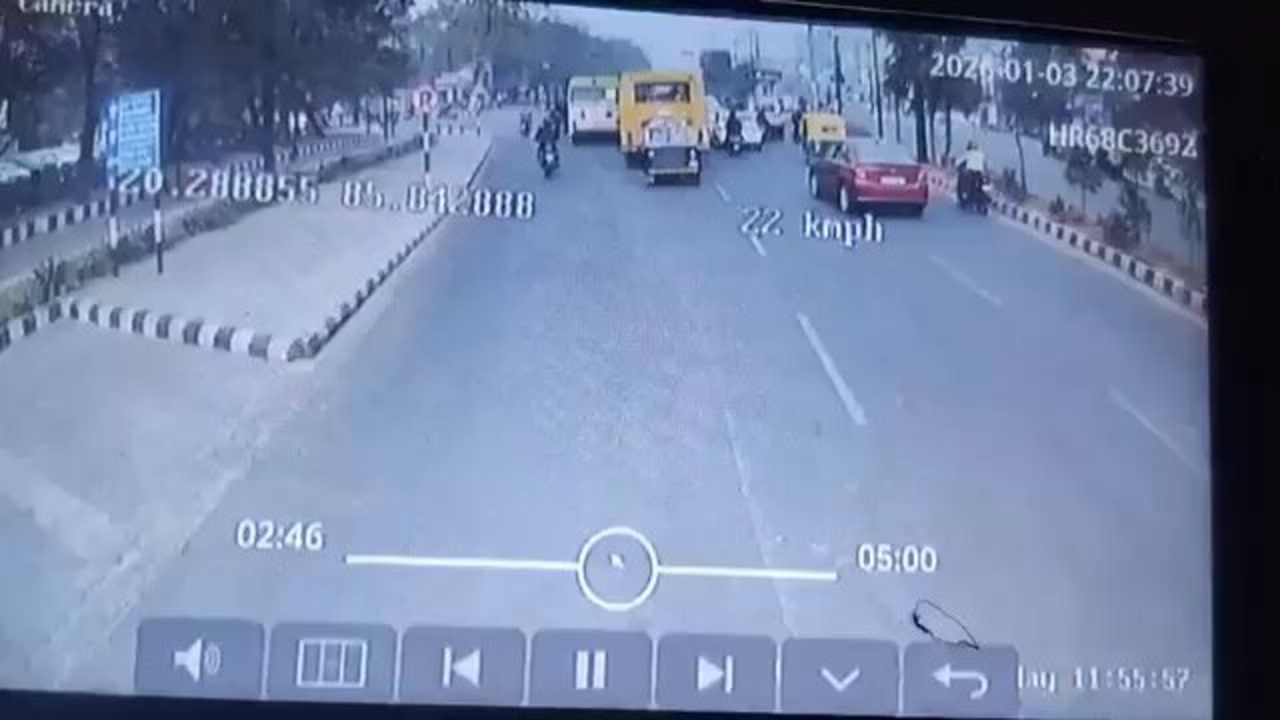
The fatal collision unfolded at Bhubaneswar’s busy Rupali Square, where a stationary auto-rickshaw was waiting in traffic when a speeding Ama Bus slammed into it from behind. According to descriptions of the dashcam recording, the impact drove the Auto forward into another bus ahead, effectively sandwiching the smaller vehicle between two much heavier ones and leaving the driver with no chance of survival. The clip, recorded from inside a bus in Bhubaneswar, shows the moment the larger vehicle closes the gap in a matter of seconds, underscoring how little time there was for anyone to react.
Witness accounts and online descriptions describe the scene as a Tragedy at one of the city’s most bustling intersections, where the Ama Bus appears to approach too fast for the conditions before striking the stationary auto-rickshaw. The viral dashcam footage from Bhubaneswar has been repeatedly shared with warnings about its disturbing content, and reports note that the autorickshaw driver was killed after being crushed between the two buses in Odisha. The stark visual record has intensified public anger over bus driving standards and the broader culture of impatience that often governs traffic at such junctions.
How the dashcam video captured the fatal seconds
The dashcam, mounted inside the bus, offers a driver’s-eye view of the final approach to Rupali Square, where traffic appears to be slowing or stopped. In the frame, the auto-rickshaw is visible ahead, positioned behind another bus and effectively boxed in by larger vehicles on a crowded stretch of road. As the Ama Bus closes in, the distance between the vehicles shrinks rapidly until the auto is no longer visible, swallowed between the two buses in a violent impact that plays out in a fraction of the clip’s runtime. The unbroken recording leaves little ambiguity about the sequence of events or the relative positions of the vehicles.
Descriptions of the footage emphasize that within seconds of the auto-rickshaw coming into view, the state-run bus behind it rams forward, crushing the smaller vehicle between the two buses. Observers have pointed out that the driver of the larger vehicle appears not to maintain a safe following distance, a basic defensive driving principle that is especially critical for heavy buses in congested corridors. The clarity of the Dashcam recording has made it a powerful piece of evidence in public debate, with many viewers arguing that the video shows a preventable collision rather than an unavoidable accident.
A pattern of autos crushed between buses
For many Indians, the Bhubaneswar footage feels disturbingly familiar because it echoes earlier incidents in other cities where auto-rickshaws were trapped between buses. In Bengaluru, a widely shared clip from Mar showed an auto-rickshaw moving slowly behind a BMTC bus when another BMTC bus slammed into it from behind, crushing the vehicle between the two larger buses. That video, like the one from Odisha, circulated heavily on social media and prompted questions about how two buses from the same public operator could close in on a vulnerable three-wheeler with such little margin for error.
The parallels between the Bengaluru and Bhubaneswar crashes are striking: in both cases, an auto-rickshaw is positioned behind a bus, another bus approaches from the rear, and the smaller vehicle is effectively trapped in a deadly squeeze. In the Karnataka case, the footage of the BMTC buses showed the auto moving slowly, not erratically, before being hit, which reinforced concerns that professional drivers of large vehicles were failing to anticipate the presence of lighter, slower traffic ahead. The Odisha collision involving the Auto at Rupali Square follows the same pattern, suggesting that the risk is systemic rather than isolated, particularly where buses operate in close convoy on crowded routes.
Public outrage, grief and calls for accountability
As the Bhubaneswar dashcam clip spread, viewers reacted with a mix of horror and anger, focusing on the apparent speed of the Ama Bus and the helplessness of the auto-rickshaw driver. Many social media users described feeling unable to watch the video more than once, while others shared it with explicit Trigger warnings because of the graphic nature of the impact and its aftermath. The knowledge that the autorickshaw driver in Odisha was killed after being crushed between the two buses has deepened the sense of grief, particularly among those who rely on similar three-wheelers for their daily livelihoods.
Online commentary has quickly moved from shock to demands for accountability, with users urging authorities in Odisha to scrutinize the conduct of the bus driver and the operating practices of the state-run service. The fact that the Dashcam recording itself appears to come from inside a bus has added to the pressure, since it provides a direct visual record that can be examined frame by frame. In the Bengaluru case involving BMTC buses, the resurfacing of the Mar footage prompted similar calls for disciplinary action and better training, and many commentators now argue that the Bhubaneswar tragedy shows how little has changed in the intervening period.
What the crash reveals about urban road safety
Beyond individual culpability, the Bhubaneswar collision has exposed deeper structural problems in how Indian cities manage mixed traffic at busy intersections. At Rupali Square, heavy buses, auto-rickshaws, two-wheelers and pedestrians all converge in a confined space, and the viral video suggests that there were no effective buffers or lane separations to protect smaller vehicles from being boxed in. The fact that a single high-speed approach by the Ama Bus could instantly turn a stationary queue into a fatal crush highlights the absence of robust speed calming measures, such as raised tables, rumble strips or enforced low-speed zones, around such high-risk junctions.
Experts and campaigners have long argued that auto-rickshaws are structurally vulnerable in collisions with buses, and the Odisha crash involving the Auto provides a stark case study of that imbalance. The pattern seen in the BMTC incident in Bengaluru, where an auto was similarly crushed between two buses, reinforces the argument that driver training, route supervision and strict adherence to following-distance rules are not optional extras but life-or-death necessities. The Bhubaneswar dashcam footage has now become a rallying point for those pushing for comprehensive reforms, from better enforcement and technology in buses to redesigned intersections that no longer leave the smallest vehicles with nowhere to go when a larger one bears down from behind.
More from Fast Lane Only