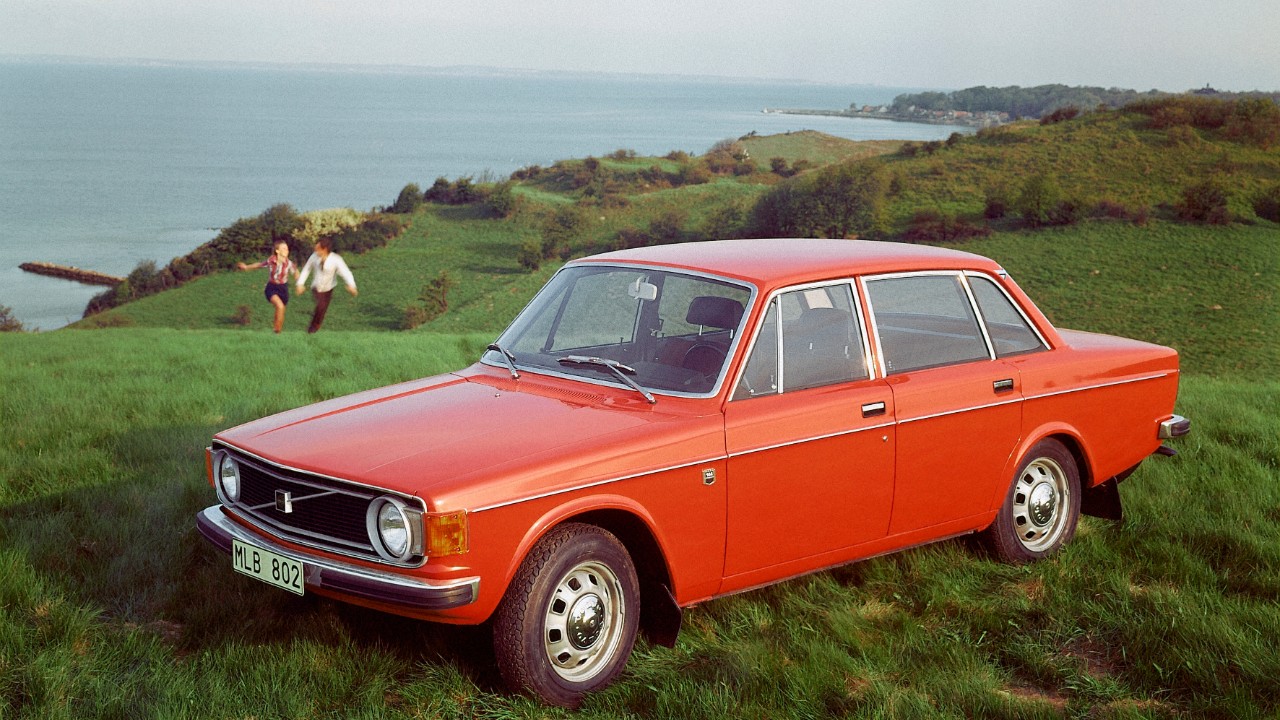
If one brake circuit failed on a Volvo 144, the car could still stop on both front wheels and one rear. That split, built in from the first day, set the tone for the whole Volvo 140 series. Between 1966 and 1974, Volvo built 1,205,111 of these sedans and wagons, and the design lived on in the 240 until 1993.
Plenty of people remember the 140 as a boxy, honest family car. That memory is accurate, but it leaves out how much engineering Volvo packed into the shape. Much of it sat where owners never looked, in the brake lines and the body structure.
The project also took a long time to reach showrooms. Volvo approved it in June 1960 and showed the finished car six years later.
From project 660 to the Volvo 140 series
The World of Volvo exhibit says the program was codenamed 660, after the month and year of that approval. By December 1961, two prototypes were ready, and the project became P1400. Test cars then covered more than 100,000 miles. One camouflaged prototype was photographed and labeled “Mazuo ZT92,” and some people took it for a Japanese car.
Jan Wilsgaard, Volvo’s design chief and the man behind the Amazon, drew the new body. Volvo then unveiled the 144 on August 17, 1966. In a 2006 anniversary release, Volvo quotes CEO Gunnar Engellau calling it “the biggest passenger car business venture so far in the history of Volvo.” Start-up costs came to SEK 150 million, not counting the factories.
Volvo’s release also says the 140 started its three-digit naming system. The first digit gave the series, the second the number of cylinders, and the third the number of doors.
Brakes that kept working on three wheels
Disc brakes sat at all four corners. According to World of Volvo, only the Renault 8 and Rover 2000 offered that in the same price range. However, the bigger idea was how Volvo plumbed them. It used two hydraulic circuits split in a triangle, so each circuit worked both front wheels and one rear.
As a result, losing one circuit left three wheels braking. Volvo’s anniversary release puts that at about 85 percent of braking force, while World of Volvo gives a range of 80 to 85 percent. Twin pressure-relief valves also helped stop the wheels from locking under hard braking.
The Swedish Automobile Association gave the system its gold medal. In its words, the setup was “from a traffic safety standpoint the most significant innovation on a standard car marketed in Sweden in 1966.”
Crumple zones and a cabin with nothing sharp in it
Around the brakes, Volvo built a body with energy-absorbing zones at the front and rear, according to its heritage model page. Between those zones sat a protective steel cage for the occupants. The steering column was split and collapsible, too, and the interior had no protruding parts.
Front occupants got seat belts from the start. Over its run, the series also introduced front head restraints, inertia-reel belts and a belt reminder, Volvo’s release says. Swedish reviewers noticed. One paper called it “the safest car ever built,” and Teknikens Värld named the 144 its Car of the Year for 1966.
Three bodies, two engines and 1,205,111 cars
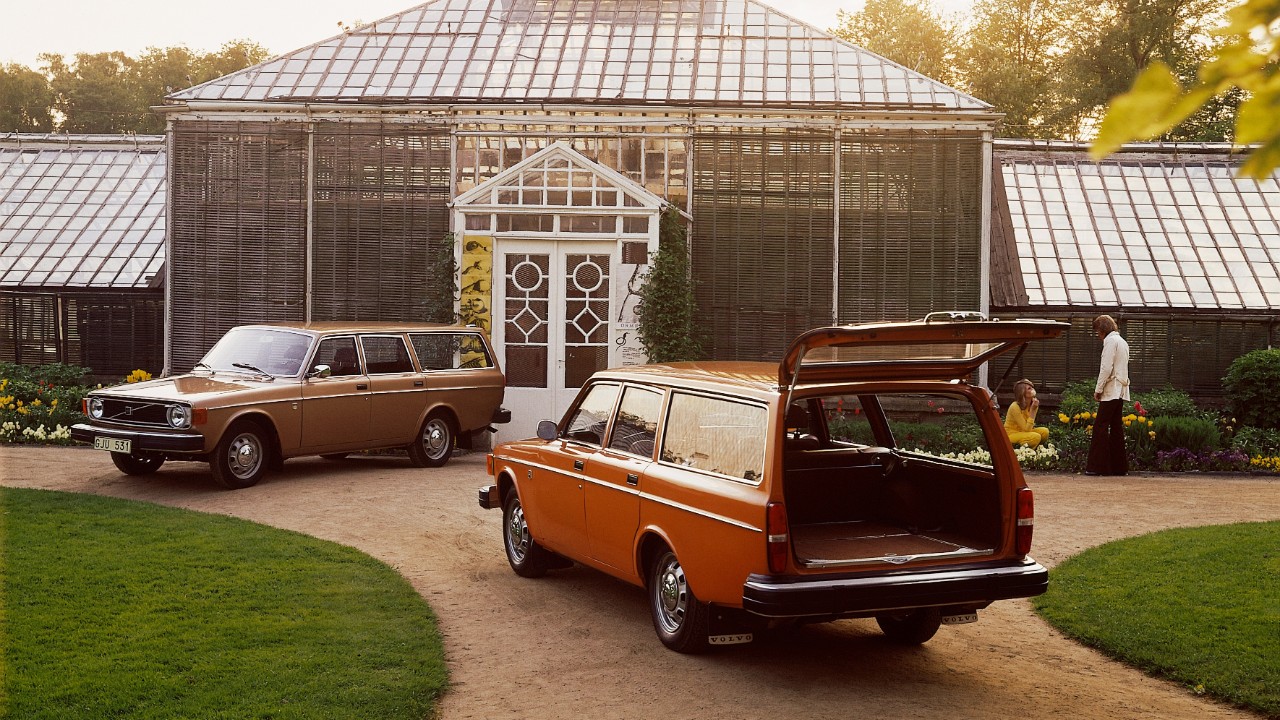
The four-door 144 came first. Then the two-door 142 followed in early summer 1967, and Volvo presented the 145 estate in late November 1967. The 145’s near-vertical tailgate opened onto a flat floor and more than two cubic meters of cargo space. Overall length was 464 cm on a 260 cm wheelbase.
Power came from overhead-valve four-cylinder engines. Volvo lists the 1.8-liter B18 at 75 or 96 bhp and the 2.0-liter B20 at 82 to 124 hp. Buyers could choose a four-speed manual, a four-speed with electric overdrive or a three-speed automatic. Classic Motorsports dates the B20 to 1969 and Bosch D-Jetronic fuel injection to 1971.
Volvo’s heritage table splits production into 412,986 of the 142, 523,808 of the 144 and 268,317 of the 145. Together those make 1,205,111. Note that Volvo’s 2006 release gives a larger total of 1,251,371 for the 142, 144 and 145, without a breakdown, so the per-model table is the figure used here.
How the 140 became the 240
For 1973, the 140 got a new tail and a blacked-out grille, Classic Motorsports notes. Production ended after the 1974 model year. Yet the shape kept going, because “the 240, its replacement, was basically an updated 140,” in that magazine’s words. The 240 added a new nose and front struts in place of the 140’s A-arms, and it stayed in production through 1993.
Volvo says the 240 carried over 140 body parts such as the doors, wheel arches and greenhouse. For shoppers today, IPD’s Bryan Cottrell warns about loose steering boxes, windshield leaks and rust in the spare-tire well and rear quarters. The car also has a racing footnote. IPD founder Richard Gordon won a professional road race for Volvo in North America in 1982, driving a 1974 142.
More from Fast Lane Only