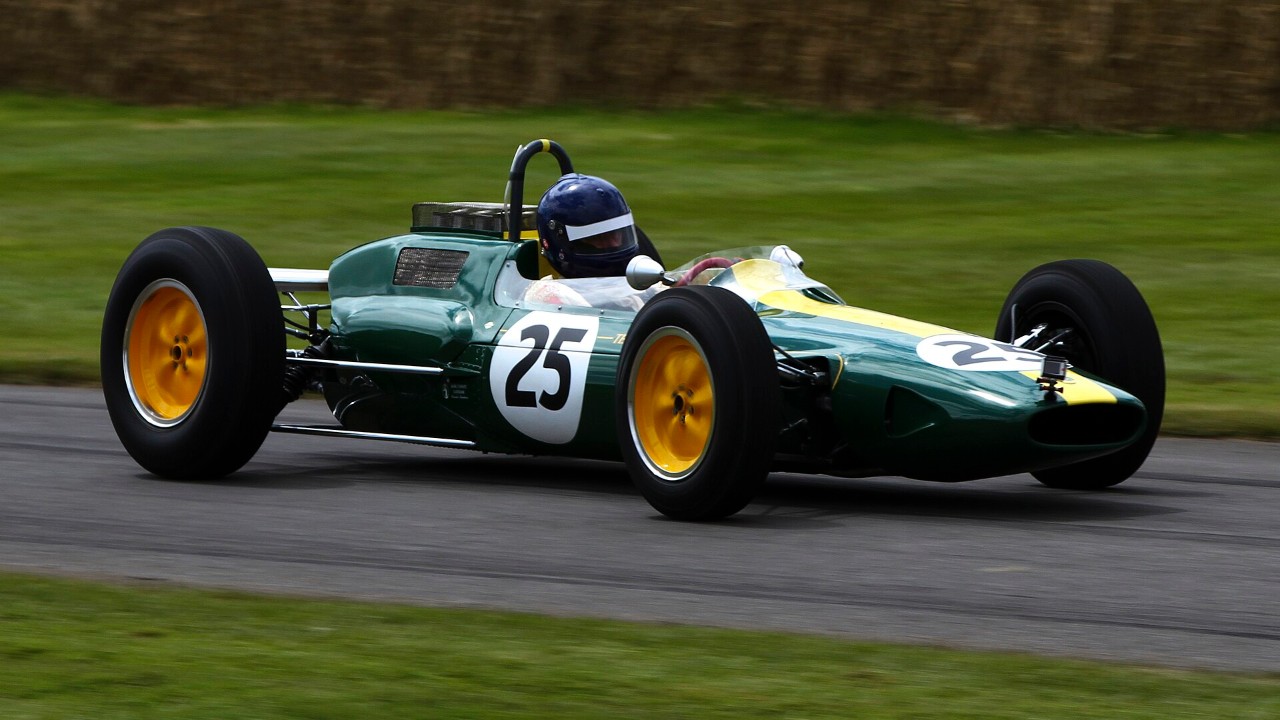
The Lotus 25 carried Jim Clark to seven World Championship Grand Prix wins in 1963, a record at the time. Colin Chapman’s car also won Clark the drivers’ title that year, and Lotus took the constructors’ crown. Its secret was the chassis, an aluminum monocoque instead of a frame of tubes.
Supercars.net goes further and says the design “revolutionised modern racing car design.” In 1962, it was new to Formula 1. The car earned a nickname from its shape, too: “the bathtub.”
Here is how Chapman built it, what it did in its two big seasons, and where the most successful chassis ended up.
How the Lotus 25 monocoque worked
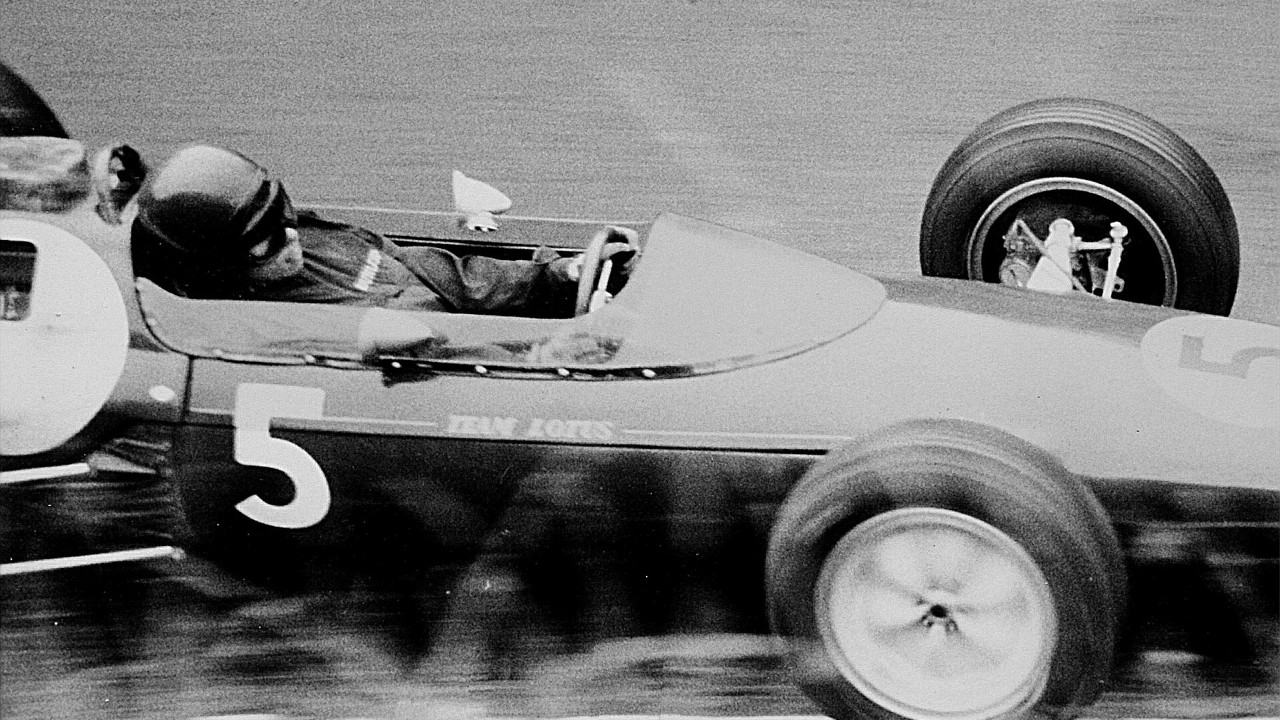
According to F1technical, the chassis is an aluminum structure made of box sections built around the driver’s seat. The fuel rode in rubber tanks inside those side boxes. In fact, the same profile calls the Lotus 25 the first monocoque in Formula 1.
The payoff was stiffness. Chapman’s design gave more torsional rigidity for less weight, as well as a smaller frontal area. As a result, the team could run softer suspension, which helped in slow, tight corners.
The car started small, and Chapman kept it that way. F1technical says he sketched the frame concept on a restaurant napkin. Later, he decided the cockpit was too wide and asked for an inch and a half to come out of it.
A 1.5-liter Coventry Climax V8
For power, the 25 used a Coventry Climax V8. F1technical lists it as a 90-degree unit of 1,498 cc, with a 63 by 60 mm bore and stroke. It made 195 bhp at 8,200 rpm.
Supercars.net describes the same engine simply as a 1.5-litre Coventry Climax V8. Team Lotus raced the design from 1962 through 1967, according to F1technical.
1962: close, but not yet
The 25’s first season came close to a title. F1technical says Clark nearly won the 1962 championship until a loose bolt forced him out of the final race.
There was a win that year all the same. Supercars.net reports that Clark won the 1962 United States Grand Prix at Watkins Glen in chassis R3. Meanwhile, Len Terry returned to Lotus in 1963 and worked on reliability, according to F1technical.
1963: seven wins and two titles
The next year, the car delivered. Clark and the Lotus 25 won a record seven World Championship Grands Prix, Supercars.net says. They also took six non-championship Formula 1 races in Europe. In addition, Clark, Chapman and the Lotus-Climax 25 took both the drivers’ and constructors’ championships.
Nearly all of it came in one chassis. Supercars.net credits R4 with the 1963 Belgian, Dutch, French and British Grands Prix. After a second place in Germany, R4 then won in Italy, Mexico and South Africa.
Hagerty’s record of the car puts it another way: Clark drove R4 to four consecutive Grand Prix wins that season. Its livery was the familiar Lotus green with a yellow stripe and yellow wheels, over a red interior.
Team Lotus built only seven Type 25s, numbered R1 through R7, in 1962 and 1963. Its successor, the Type 33, followed with new chassis numbers starting at R8.
Later races in other hands
The design kept winning after 1963. For instance, chassis R6 carried Clark to the 1964 Dutch, Belgian and British Grands Prix, plus the 1965 French Grand Prix, according to Supercars.net.
R4 had a longer, stranger career. Reg Parnell’s team bought it, fitted BRM power and renumbered it R13. Its last Formula 1 race was the 1967 Dutch Grand Prix. After that, it raced in the Tasman Series from 1967, Hagerty notes, and a later owner restored it in 1997.
Along the way, R4 kept scoring points. In 1964, Peter Arundell drove it to third place at Monaco and in the Dutch Grand Prix, Supercars.net says. Later, Mike Spence took it to fifth in the Dutch and Italian Grands Prix with BRM power.
Hagerty’s list of its drivers reads like a period entry list. Along with Arundell and Spence, it names Tony Maggs, Richard Attwood, Innes Ireland, Bob Bondurant, Chris Irwin and Piers Courage.
Back to Climax power
The 1997 restoration used Lotus drawings and material specifications, according to Hagerty. In addition, the car went back to a Coventry Climax FWMW V8, Supercars.net reports. Although the car was later called a Lotus 33, Hagerty describes the monocoque as a genuine 25.
The restored R4 then ran at the 1997 Goodwood Festival of Speed. It also raced in the 1998 Glover Trophy at the Goodwood Revival. Chassis R7 had a similar path: it ran a 2.7-liter Climax and a 3-liter BRM V12 for Parnell before it returned to Climax V8 form in the early 1970s.
What the Lotus 25 sells for today
R4 came up for sale in Sydney in 2008. According to Hagerty’s sales record, Bonhams sold the car as Lot 58 on November 16, 2008. The price was just under $1 million, and Sports Car Market reported it as a new world record for a Lotus.
More from Fast Lane Only