You do not need much imagination to understand why riders are sharing the clip of an SUV slamming into a motorcycle on the Pacific Highway. In a few chaotic seconds, a routine lane change turns into a violent shove that sends a vulnerable rider skidding across the road. The footage is confronting, but it also exposes how quickly your daily commute can become a crime scene when aggression replaces basic road sense.
Seen in the context of other recent crashes involving SUVs and bikes, the Helensvale video is not an isolated shock. It is part of a pattern that should change how you think about space, speed and responsibility whenever you are behind the wheel or on two wheels.
What the Pacific Hwy dash cam actually shows
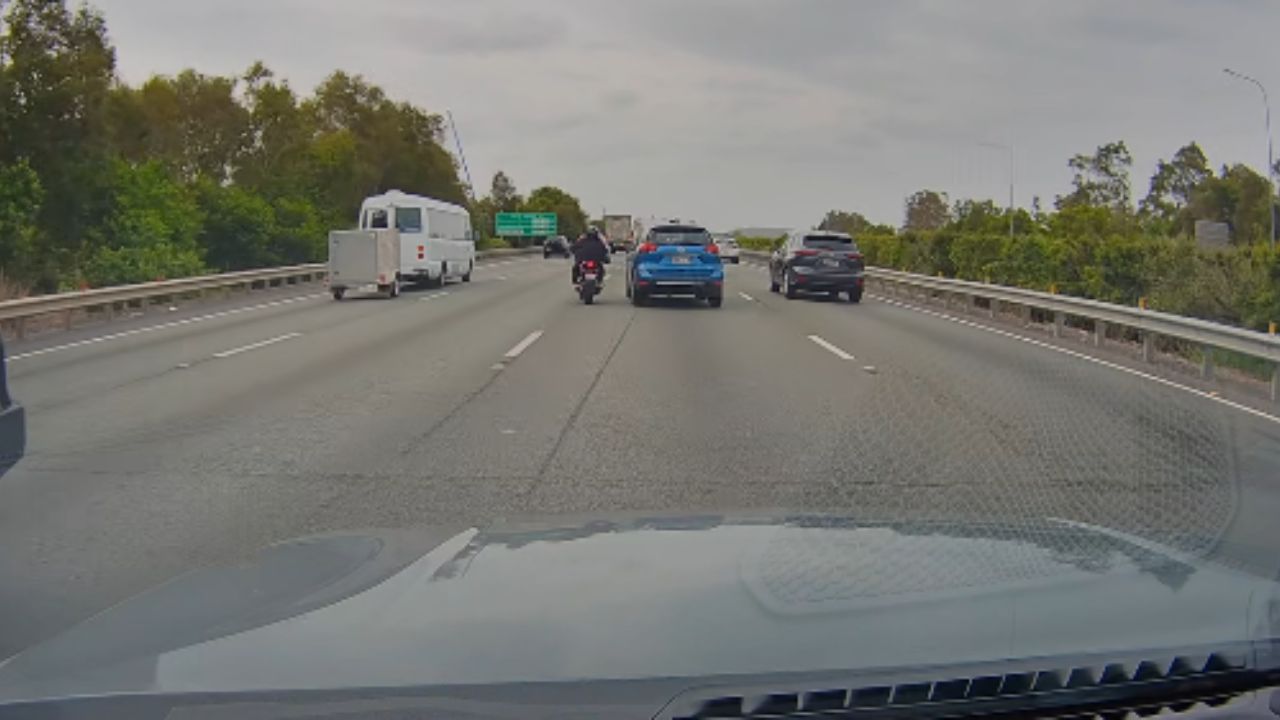
The clip that has ricocheted around social media was recorded on the Pacific Hwy at Helensvale, on Queensland’s busy Pacific Mwy corridor. In the video, a Nissan X‑Trail moves across lanes toward a Motorcycle that is already established in the traffic flow, then keeps coming until the two collide and the rider is knocked sideways. The dash cam angle makes it brutally clear that the larger vehicle barely adjusts course before contact.
The incident is described as an “X‑Trail driver collides with Motorcycle, Pacific Hwy, Helensvale,” and the short clip is enough to make you instinctively tense your shoulders. In the description, the location is set out as Pacific Mwy, Helensvale in QLD, with the focus squarely on how the Trail closes the gap on the rider. A second reference to the same “Description: X‑Trail driver collides with Motorcycle, Pacific Hwy, Helensvale” underlines that this is not a near miss but a direct impact, captured in unforgiving detail and shared via dash cam owners who routinely post incidents from Australian roads.
A further version of the same description, “Description: X‑Trail driver collides with Motorcycle, Pacific Hwy, Helensvale,” is linked to a site that aggregates these clips, reinforcing how this one crash has already been catalogued as part of a broader library of risky behaviour on the Pacific Mwy. That repetition, across multiple references to the same wording, is a reminder that what you are watching is not a stunt or a staged confrontation. It is a real rider, on a real highway, being struck by a Trail in live traffic and then preserved in a searchable archive of dash cam incidents.
From viral outrage to real‑world penalties
When you watch the Helensvale collision, your first reaction is probably emotional. The second should be legal. In a separate but closely related case on the same Pacific Motorway on the Gold Coast, An SUV driver has already discovered that a few seconds of aggression can follow you into court. In that incident, An SUV is seen repeatedly swerving at a motorcyclist before finally forcing her off the freeway, a sequence that ends with the rider tumbling into the roadside as traffic streams past. The driver was later fined after the clip circulated widely, a reminder that your behaviour on the road can be replayed frame by frame by police and insurers once a viral reel exposes it.
Coverage of the Gold Coast case makes clear that An SUV did not just drift once. The vehicle is described as repeatedly swerving at the rider before running her off the Pacific Motorway, south of Brisbane, and that pattern of movement is what pushed authorities to act. One report notes that An SUV driver has been fined after shocking dashcam footage shows them running a motorcyclist off the Pacific Motorway on the Gold Coast, underscoring that the law is catching up with behaviour that might once have been dismissed as a “near miss.” The same incident is referenced again in a segment explaining that An SUV driver has been fined after dashcam footage showed them repeatedly swerving at a motorcyclist before forcing them off the freeway, a sequence that turned a stretch of the M1 into a case study in how not to share the road, as you can see in the linked Gold Coast footage.
Road rage, hit‑and‑run and the limits of luck
If you are tempted to treat the Helensvale crash as a freak event, the pattern from overseas should give you pause. In Oregon, police released dash cam video of a driver swerving into a motorcyclist in what investigators described as a road rage hit‑and‑run. The clip shows a car veering sharply into the rider, who is then thrown across the asphalt while the offending vehicle keeps going. Authorities in Oregon stressed that the footage was graphic and distressing, and they used it to appeal for witnesses and to underline how a few seconds of anger can escalate into a serious crime, as detailed in the road rage case.
Another Oregon incident, captured from a different angle, shows an SUV sideswiping a motorcyclist in traffic. The video, shared widely, includes a warning about its confronting nature before playing the moment the larger vehicle drifts sideways into the rider. In that case, police in Oregon arrested a man after the crash was caught on camera, again using the recording as a central piece of evidence. For you as a driver or rider, the lesson is blunt. Once your actions are recorded, investigators can slow them down, zoom in and reconstruct intent in a way that was impossible before widespread dash cam adoption.
When the outcome is fatal, not viral
Not every collision involving a motorcycle and a larger vehicle is captured in a shareable clip, and not every rider gets to stand up afterwards. In Huntington Beach, a MOTORCYCLIST was killed in a crash on Pacific Coast Highway, a reminder that the stakes on coastal arterials are just as high as on the Pacific Hwy. Local reporting notes that the MOTORCYCLIST died in Huntington Beach on Pacific Coast Highway, with an investigation continuing into how the crash unfolded. The image of the scene, credited to Shutterstock, is a stark counterpoint to the Helensvale video: instead of a replay button, there is a police cordon and a family waiting for answers, as outlined in the Huntington Beach report.
On Sunday, Jan 18, 2026, at approximately 1:11 p.m., the Huntington Beach Police Department responded to a traffic collision on Pacific Coast Highway. According to the Huntington Beach Police Department, often referred to as HBPD, officers arrived at the scene where the two vehicles collided and began an investigation into the circumstances. For you, the key detail is not the exact timestamp but the fact that a single moment on a familiar stretch of road can trigger a full HBPD response, a forensic reconstruction and, in the worst cases, a death notification, as described in the HBPD summary.
What you should take from the Helensvale crash
When you watch the X‑Trail collide with the Motorcycle on the Pacific Hwy, it is tempting to focus only on the shock value. You should also see it as a checklist of what to avoid. The SUV appears to change lanes without leaving a safe buffer, treating the rider as if they were another car rather than a far more exposed human being. That same disregard is visible in the Gold Coast case, where An SUV repeatedly swerves at a motorcyclist before forcing them off the freeway, behaviour that later attracted a fine once the clip was reviewed. One segment that dissected the incident emphasised that An SUV driver has been fined after dashcam footage showed them repeatedly swerving at a motorcyclist, a line that should echo in your mind the next time impatience tempts you to “teach someone a lesson” in traffic, as highlighted in the TV breakdown.
More from Fast Lane Only