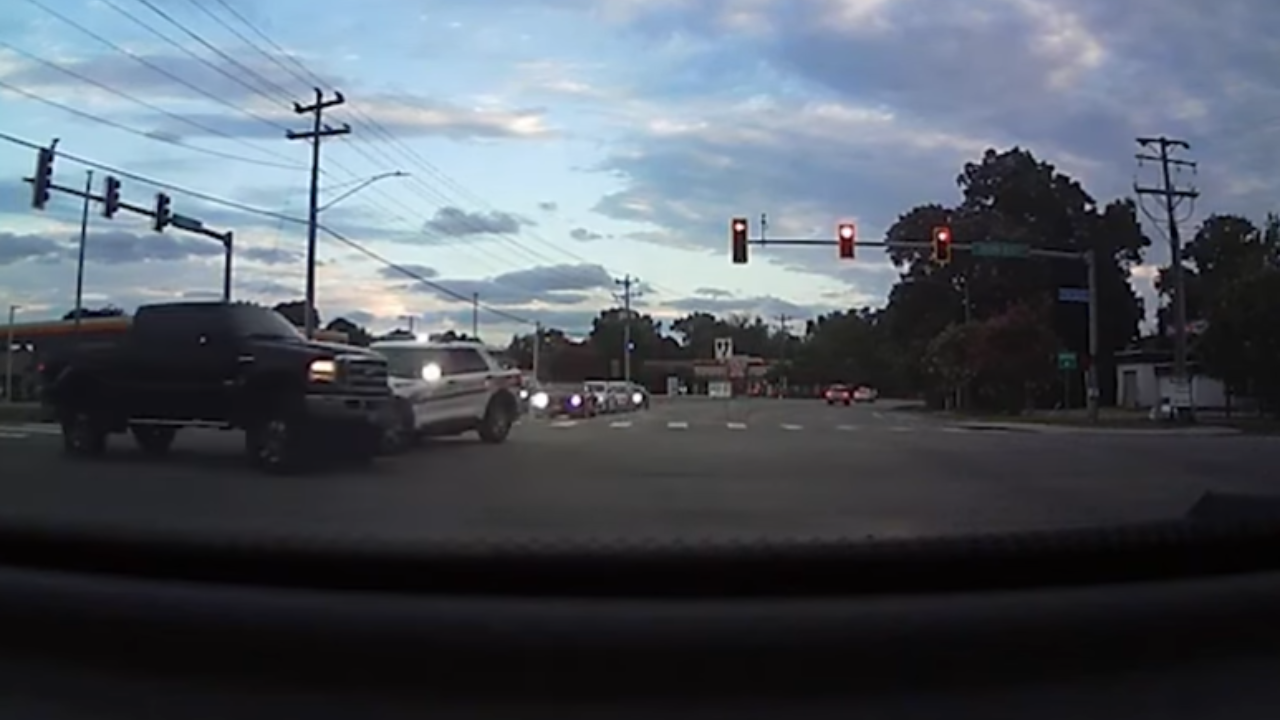
The dash cam clip is only a few seconds long, but it captures the kind of violent impact you rarely forget. A police cruiser enters an intersection, collides with a pickup truck, and the patrol car flips, rolling onto its roof as debris scatters across the roadway. You watch the cruiser’s undercarriage flash into view and realize how little separates a routine response from a life‑threatening crash.
For you as a driver, that footage is more than a viral curiosity. It is a blunt reminder that intersections are where your habits, an officer’s split‑second decisions, and the physics of two heavy vehicles can collide in the worst possible way. Understanding how these crashes unfold, and what the videos actually show, helps you navigate those same crossroads with a sharper sense of risk.
What the dash cam actually shows in the cruiser flip
In the clip that anchors this discussion, your vantage point is from a vehicle approaching a multi‑lane intersection as a marked police cruiser moves through on a call. The patrol car enters the crossing and meets a pickup truck that is already committed to the intersection. The impact is squarely into the cruiser’s side, and the force of the collision sends the police vehicle tipping up and over, flipping before it slams back to the pavement. The pickup remains upright, but the cruiser’s rollover dominates the frame, underscoring how a side impact at speed can turn a sedan‑style patrol unit into a tumbling shell in an instant, even when the other vehicle does not overturn.
That dynamic, where a police vehicle is struck and then rolls, is not unique to this one recording. In SANTA CLARITA, Calif., a separate video shows a deputy driving through an intersection when another car hits the cruiser and causes it to over. The pattern is similar: a patrol unit moving through a junction, a cross‑traffic vehicle that does not yield, and a sudden rollover that leaves the cruiser on its side or roof while investigators later work to reconstruct who had the right of way and whether lights or sirens were in use.
How a Florida intersection crash highlights the risks
If you want a sense of how quickly an intersection can turn dangerous for law enforcement, you can look to BRANDON, Fla., where a pickup truck slammed into a Hillsborough County Sheriff’s cruiser in the middle of a crossing. In that crash, the truck hit the deputy’s vehicle hard enough that the patrol car flipped over, leaving the deputy hospitalized with what were described as minor injuries. The collision unfolded in a busy area of Brandon, where multiple lanes and turning movements create the kind of complex traffic pattern you likely navigate every day.
According to reporting on that BRANDON, Fla. crash, the Hillsborough County Sheriff’s deputy was responding to another call with the cruiser’s emergency lights and sirens activated when the pickup struck the patrol car in the intersection and flipped it over. The Hillsborough County Sheriff’s office later confirmed that the deputy had been running code to a separate incident, a reminder that when you hear sirens and see flashing lights, the vehicle you are watching may be moving faster than surrounding traffic and may legally enter an intersection against a red signal. Even with those privileges, the law still expects both you and the responding deputy to exercise due care, because the physics of a pickup striking the side of a cruiser do not bend for anyone.
Columbus, Ohio, and the stakes of running a red light
The stakes become even clearer when you look at a fatal crash in Columbus, where dash camera video captured a police cruiser colliding with a pickup truck in an intersection. In that case, the officer was driving through a red light on the way to a call when the patrol car entered the crossing and hit the pickup, killing the truck’s driver. The video shows the moment of impact and the immediate aftermath, with the pickup pushed violently aside and the cruiser heavily damaged, underscoring how a split‑second decision to proceed against a signal can carry irreversible consequences for the person in the other vehicle.
Investigators later reviewed the footage and determined that the Columbus officer had the red light and did not appear to slow or pause before entering the intersection, a finding that has intensified scrutiny of how emergency responses are handled in Columbus, Ohio. Reporting identified the officer as Robinson and noted that the video shows Robinson running the red signal before the fatal collision with the pickup, while the pickup’s driver died and another person was treated and later released after the crash at the scene. A separate account of the same incident emphasizes that the video shows Robinson had the red light and does not seem to show any attempt to slow down or stop before entering the intersection, reinforcing how the dash cam has become central to understanding what happened in that crash.
Why dash cams are reshaping how you see police crashes
For you as a viewer, the power of these recordings lies in how they strip away guesswork. A clip labeled Video on social media can show the exact moment a police car collides with a pickup truck in an intersection, the angle of impact, and the way the cruiser flips or spins. In one widely shared post, Dashcam footage captures a police car striking a pickup in a junction and the truck flipping over, with the sequence replayed frame by frame so you can see how little time either driver had to react before the collision unfolds. Those images shape your perception of who was at fault long before an official report is released.
Dash cams are also changing how agencies document pursuits and intersection entries. In FRANKLIN COUNTY, Ohio, for example, The Franklin County Sheriff’s Office released dashcam and body camera video showing deputies chasing a stolen Honda and then crashing when the suspect vehicle lost control, giving you a detailed view of the pursuit route, the speeds involved, and the moment of impact once officials arrived at the scene in that case. When you combine that kind of pursuit footage with intersection crash clips, you start to see a fuller picture of how quickly a routine patrol can escalate into a rollover or fatal collision once a cruiser enters a busy crossing.
What you can do differently at the next intersection
These videos are unsettling, but they also give you a practical checklist for your own driving. When you approach a green light, the footage from Columbus and BRANDON, Fla. is a reminder to glance left and right before you commit, because a responding cruiser or a driver running a red may still be entering the intersection. If you hear sirens, the Hillsborough County Sheriff’s crash shows why you should slow down, look for the source, and be prepared to stop even if you technically have the right of way, since the deputy in that case was already in the intersection with lights and sirens on when the pickup hit the cruiser and flipped it. Treat every intersection as a negotiation, not a guarantee.
Location awareness matters as well. If you drive regularly in Columbus, Ohio or commute through Brandon, Florida, you know the specific intersections where traffic stacks up and sightlines are poor. Those are the places where a fast‑moving cruiser on a call and a pickup accelerating on a fresh green are most likely to meet. When you see a social clip that begins with the word According and then shows a police car hitting a pickup so hard that the truck flips, you are watching the worst‑case version of a scenario you face every day when you roll toward a green light own city. The more closely you study how quickly those crashes develop, the more deliberate you can be about pausing, scanning, and giving emergency vehicles the space they need to pass safely.
More from Fast Lane Only