When the Ford Taunus 17M arrived in 1957, it did more than give German families a new mid‑size saloon. It signaled that postwar West Germany was ready to trade austerity for confidence, chrome, and a distinctly modern idea of mobility. I see that car as a rolling manifesto, showing how a once‑shattered industrial base could reimagine itself for a new consumer age.
To understand how the 1957 Ford Taunus 17M modernized Germany, I need to look at what came before it, how its bold styling and engineering reset expectations, and how it helped push rivals and successors into a more ambitious era. The story runs from prewar roots in Cologne to a moment when Ford Germany could credibly claim to be shaping, not just following, European taste.
From prewar Taunus roots to a country ready for change
Long before the 17M P2, The Taunus name was already woven into German motoring. The Taunus story reaches back to 1939, when the 1172cc G93A became the first Cologne model to carry that badge, giving Ford a compact car that could survive war, scarcity, and reconstruction. By the time West Germany’s economy began to surge, that lineage meant the Taunus name carried familiarity, but it also risked feeling tied to an era of compromise rather than aspiration, especially as buyers who had grown up with rubble now wanted something that looked toward the future instead of back to the 1930s The Taunus.
That tension was visible in The Ford Taunus P1, a small family car that Ford Germany built from 1952 until 1962. Marketed simply as The Ford Taunus, the P1 was practical and compact, but at launch it still leaned on designs originating in the 1930s, a reminder that the company was stretching prewar thinking into a very different decade. As prosperity grew and Autobahns filled, that conservative look and feel left space for something bolder, and it set the stage for a mid‑size model that could break with the past more decisively than the P1 ever did The Ford Taunus.
The 1957 17M P2: “The Quality Car With The Sports Car Spirit”
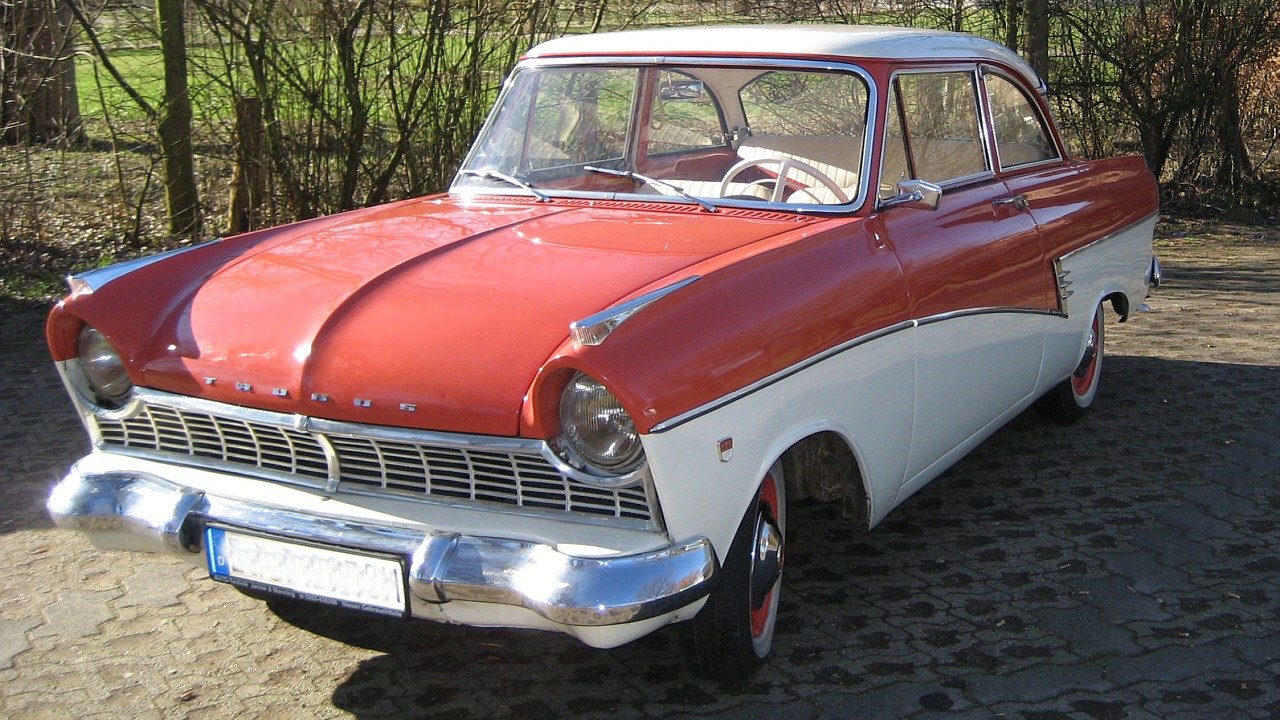
That break arrived when The Ford Taunus 17 M, also known as the Ford Taunus P2, went into production as a middle sized family saloon or sedan built by Ford Germany between August 1957 and August 1960. Compared with the modest P1, the 17M P2 was longer, wider, and visually far more extroverted, with sweeping lines and generous glass that made it feel like a scaled‑down American cruiser tailored to European streets. In museum displays today it still reads as a confident statement that Ford Germany was no longer content to be a cautious follower in its home market The Ford Taunus 17 M.
Marketing leaned into that new attitude. When the first of the German 17M series appeared in August 1957 it carried the slogan “The Quality Car With The Sports Car Spirit,” a line that captured how Ford wanted buyers to see the car: solid enough for family duty, but lively and stylish enough to feel aspirational. I read that tagline as a deliberate attempt to bridge the gap between sensible domestic saloons and the glamorous machines people admired from afar, and it helped position the 17M as a car that could satisfy both the head and the heart for a growing middle class The Quality Car With The Sports Car Spirit.
Symbol of Ford’s European revival and a new middle class
By the late 1950s, Ford’s German operations were no longer just rebuilding, they were competing aggressively for a share of a rapidly expanding market. It is striking to see that they once celebrated over half a million cars built per year and an 18.5 percent market share in Cologne, a figure that shows how deeply Ford had embedded itself in West German life. The 17M P2 sat right in the middle of that push, giving the company a car that could go head‑to‑head with domestic rivals in a segment that mattered for both volume and image 18.5 percent.
Contemporary observers now describe the real model as a symbol of Ford’s revival in Europe The Ford Taunus 17M was launched in 1957 as part of Ford Germany’s modernization, combining more generous proportions with dimensions still adapted to the European market. I see that balance as crucial: the car looked big enough to feel like a step up in life, yet it remained manageable in narrow streets and tight parking spaces, which made it an ideal companion for families moving into new suburbs and planning longer trips on weekends Europe The Ford Taunus.
Design, variants, and the everyday glamour of the Wirtschaftswunder
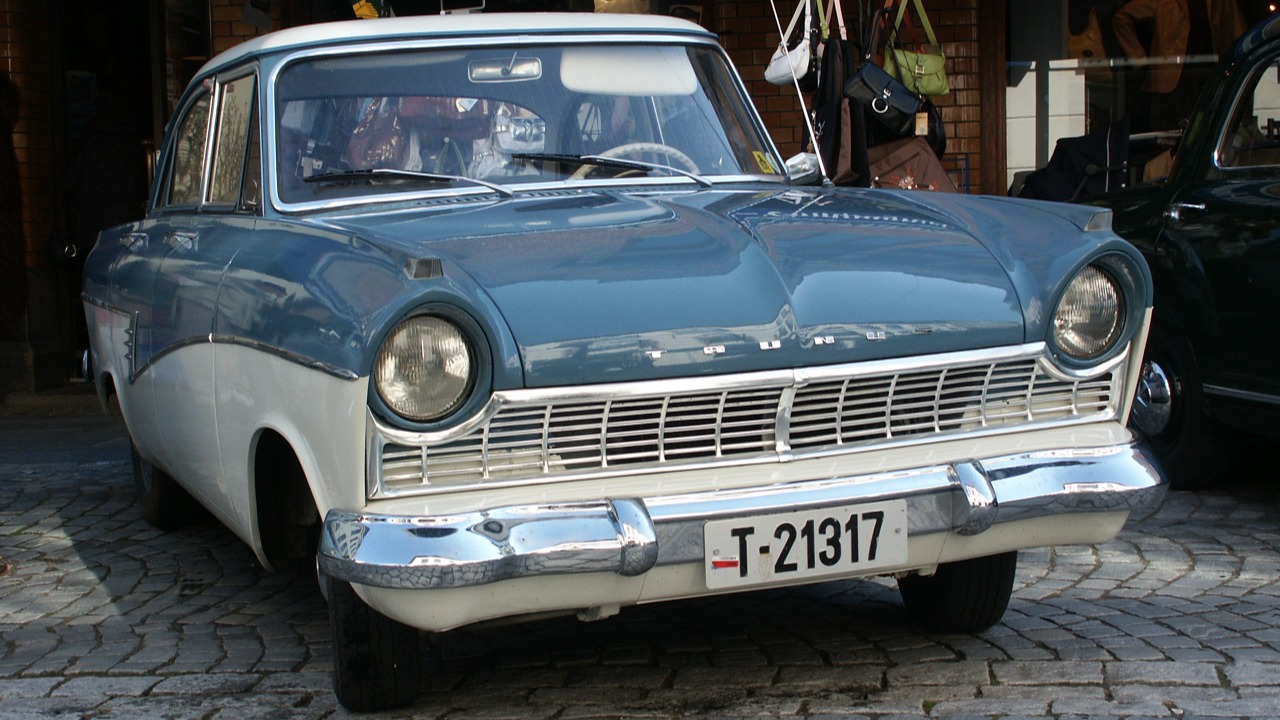
Seen up close, the 1957 Ford Taunus 17M in two‑door saloon form underlines how carefully Ford Germany tuned the car to everyday life. As a middle sized family saloon or sedan, it offered enough cabin space for parents and children without tipping into the bulk of American full‑size cars, and its two‑door layout kept costs down while still giving owners a sense of style. In period photos and surviving examples, the brightwork, two‑tone paint, and gently finned rear end all speak to a desire to bring a touch of glamour to the daily commute and the Sunday outing alike 1957 Ford Taunus P2 17M.
Even in miniature, that mix of practicality and flair still resonates. Collectors who study the German 17M series often point out how the proportions, trim, and stance capture a specific moment when West German prosperity, the Wirtschaftswunder, translated into cars that looked optimistic without being ostentatious. I find it telling that model makers keep returning to this shape, because it suggests the 17M P2 has become shorthand for a time when owning a car like this meant you had arrived, but you were still rooted in the everyday rhythms of work, school, and holiday drives When the.
How the 17M paved the way for later Taunus innovation
The impact of the 1957 17M becomes even clearer when I look at what followed. Launched in October 1960, the 17M P3 took the idea of a modern German family car further, with a pronounced oval theme in its styling and the first use of curved side glass in this line, a feature that improved both aerodynamics and interior space. Approximately 50% of the cars built were delivered with the smallest of the three engines, the 1498 cc unit, showing that even as design became more adventurous, buyers still valued efficiency and sensible running costs in their mid‑size saloons Launched.
Looking back across the P1, P2, and P3 generations, I see the 1957 Ford Taunus 17M as the hinge point that allowed Ford Germany to move from cautious postwar carryover designs to a confident, forward‑looking family of cars. The earlier P1, built by Ford Germany and sold as Ford Taun, kept the brand in the game, but it was the P2 that proved buyers were ready for more expressive styling and a richer driving experience, which in turn gave Ford the confidence to experiment further with the P3 and later front‑wheel‑drive Taunus models. In that sense, the 17M P2 did not just modernize Germany’s streets, it modernized Ford’s own idea of what a German family car could be Approximately.
More from Fast Lane Only: