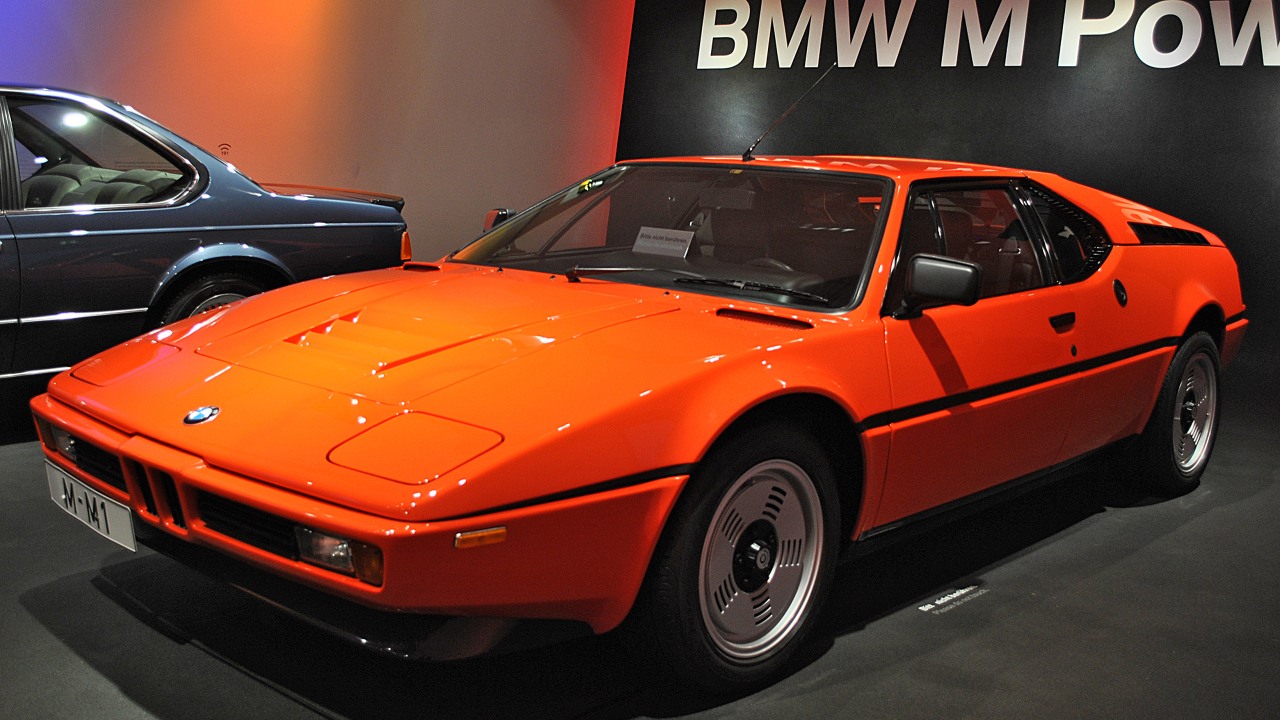
The BMW M1 arrived in 1978 as a shock to the system, a mid-engined wedge from a company better known for sedans than supercars. With its racing-bred straight six and radical layout, it signaled that BMW was ready to challenge the era’s most exotic machinery on both road and track. I see that moment as the start of a new performance chapter, one that reshaped how the brand thought about speed, engineering, and motorsport.
Today the M1 reads like a blueprint for the modern high-performance BMW, from its Motorsport roots to its limited production and track focus. Its short life and small build numbers only sharpen its impact, turning a once-controversial experiment into a landmark that still defines what “M” means nearly half a century later.
From racing rebellion to BMW’s first supercar
The M1 did not emerge from a marketing brainstorm, it grew out of a racing culture that wanted more freedom than BMW’s mainstream lineup allowed. Earlier in the 1970s, BMW engineers and drivers pushed for a dedicated competition arm, and BMW M was created as a response to that internal pressure for a purer performance focus. One account describes how “It All Started With” a “Rebellion” inside BMW, with the motorsport division born in garages rather than boardrooms, and that spirit set the stage for a road car that would be engineered like a race machine.
Plans for a mid-engined BMW date back to 1972, when the company began exploring a car that could compete in top-level sports car racing while also being sold to customers. A detailed “Brief History of the” M1 notes that the original idea was to build a mid-engine model specifically to meet racing homologation rules, a car that would be exotic enough for the track yet still carry BMW badges into a new arena. By the time the BMW M1 (model code E26) finally reached production, it had become the first car produced by BMW Motorsport, a clear signal that the racing department was ready to shape the brand’s road-going identity.
Lamborghini, delays, and a complicated birth
For a company that had never built a mid-engined road car, BMW needed outside help, and it turned to Lamborghini to get the M1 off the ground. Reports on the project describe how BMW partnered with the Italian firm to handle aspects of development and production, leveraging Lamborghini’s experience with low-volume supercars. That collaboration promised a shortcut to the exotic hardware BMW wanted, but it also introduced risk, and when Lamborghini ran into financial trouble, the M1’s schedule began to slip.
After a protracted development, the M1 finally debuted in 1978, but the delays had consequences. One analysis notes that “After” this drawn-out process, the Group 5 rules the car had been designed around were already shifting, which undercut the original competition plan. BMW had to reorganize production, with the M1 coupé ultimately hand built in small numbers, and the homologation timetable became harder to meet. The BMW Group Classic account of the M1 confirms that these complications led to delays in the start of series production, and the car ended up serving a more exclusive circle of enthusiastic customers than originally envisioned.
Design and engineering: a radical BMW

Even with its messy birth, the finished M1 looked and felt like nothing else in BMW showrooms. The car used a mid-engined layout, with the powertrain mounted behind the driver, a configuration that placed it firmly in super sports car territory. Official descriptions from BMW Group Classic emphasize that the BMW M1 is a mid-engined super sports car produced by BMW Motorsport GmbH, and that it was first presented to a public audience as a statement of intent from the performance division. The wedge-shaped body, created by Giorgetto Giugiaro, gave the car a low, sharp profile that matched its mechanical ambition.
Under the rear deck sat a 3.5-liter inline-six that produced 277 hp in road trim, a specification highlighted in a period overview that notes the M1 was “Built between 1978 and 1981” with this mid-mounted engine. The same source stresses that this configuration made it BMW’s first and only mid-engine supercar, a status it still holds. Contemporary performance summaries add that the M1’s chassis and suspension were tuned with racing in mind, and that the car’s engineering was closer to a competition prototype than a typical grand tourer. For a brand associated with front-engined sedans and coupes, this was a radical departure that redefined what a BMW could be.
Procar and the racing showcase that saved the project
By the time the M1 was ready, the Group 5 regulations it had targeted were no longer a viable path for a factory program, which left BMW with a homologation special and no clear series to race it in. One report on Niki Lauda’s M1 notes that, although the car was originally intended for Group 5 competition, shifting regulations diminished its viability as a factory-backed entry. Rather than abandon the project, BMW created its own stage, launching the M1 Procar series as a one-make championship that ran as a support race at major Formula 1 events.
The Procar concept turned a regulatory setback into a marketing and engineering showcase. BMW’s own retrospective describes the BMW M1 Procar as an ICON of PERFORMANCE, boasting a powerful six-cylinder in-line engine and a striking wedge shape that made it instantly recognizable on track. Top drivers, including Formula 1 stars, competed in identical M1 Procars, giving the model a global audience and proving its capability in front of the sport’s most demanding fans. Later coverage of Niki Lauda’s personal M1 heading to auction underscores how this chapter cemented the car’s reputation with a global audience, transforming a troubled homologation project into a legend of BMW Motorsport history.
Short production run, long legacy
In commercial terms, the M1 was always destined to be rare. Production ran only from 1978 until 1981, and a detailed ownership account notes that only 453 M1s were manufactured in total. The BMW M1 entry confirms that the M1 coupé was hand built, and that series production for the M1 was finished after this brief window. Another performance summary points out that the M1 was the first car produced by BMW Motorsport and that it was discontinued in 1981, which locked in its status as a limited-run experiment rather than a long-running model line.
Yet that scarcity is part of why the M1’s influence has grown. A video history of BMW milestones argues that when we talk about important steps in BMW history leading up to the newer Classer, we have to talk about the M1, placing it alongside the brand’s most significant innovations. A separate video reflection from a modern dealership employee, who admits that seeing an M1 “in the flesh” for the first time is a rare experience, underlines how the car still commands awe decades later. For me, the key point is that the M1 established a template: a Motorsport-developed halo car, rooted in racing, built in small numbers, and used to push engineering boundaries. Every subsequent M car, from the original M3 to today’s high-tech flagships, traces some part of its DNA back to the moment when the 1978 BMW M1 announced that BMW was ready to play in the supercar arena.
More from Fast Lane Only: