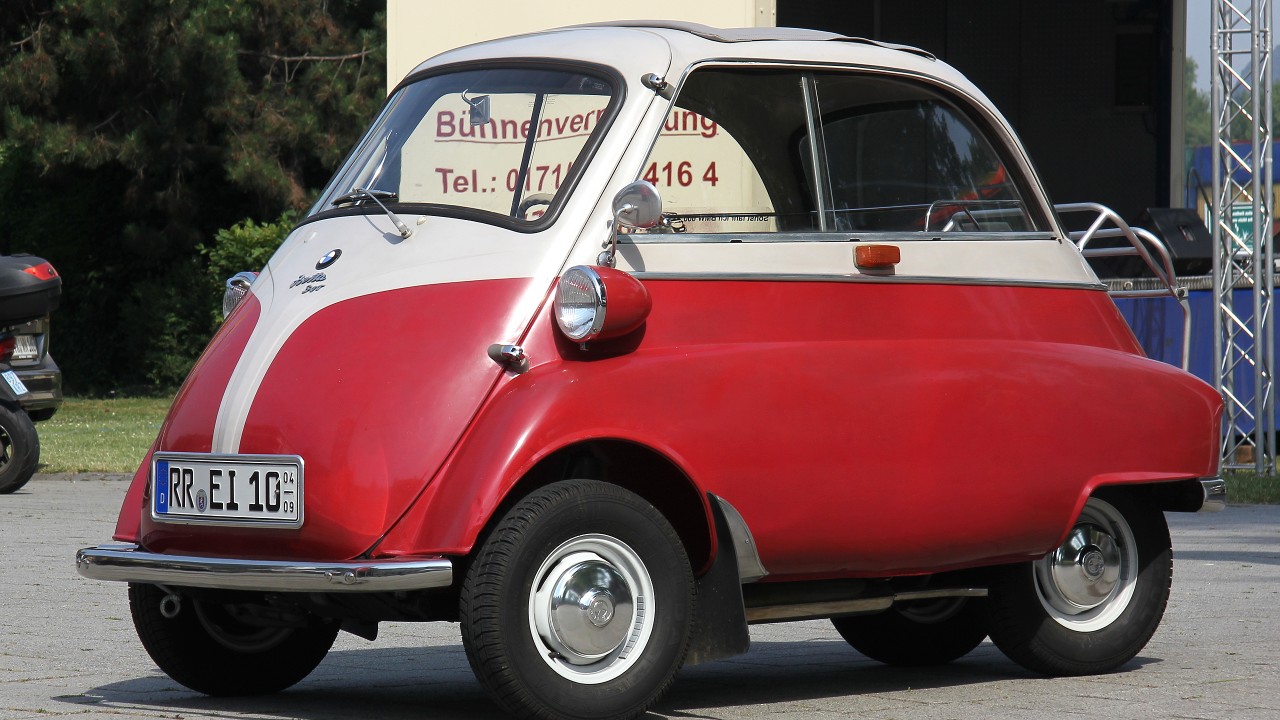
The 1956 BMW Isetta looked like a toy at a time when BMW was better known for elegant sedans and fast motorcycles, yet this tiny bubble car became the unlikely product that kept the company alive. By embracing a radically different idea of what a BMW could be, the firm bought itself time, cash flow, and a new customer base just as financial collapse loomed.
BMW on the brink: why a microcar suddenly mattered
By the mid 1950s, BMW was in serious trouble, caught between its fading Motorcycle business and large luxury cars that were too expensive for a Europe still recovering from war. The company was on the brink of bankruptcy, with traditional models failing to generate the volume or margins needed to sustain factories and engineering talent. In that context, a cheap, efficient city car was not a quirky side project, it was a last-ditch attempt to find something that ordinary workers could actually afford.
Microcars were gaining traction across Europe as a practical response to shortages of raw materials and fuel, and as a stepping stone for people moving up from scooters to enclosed transport. These tiny vehicles used minimal steel, sipped fuel, and could be built relatively cheaply, which made them attractive to both buyers and manufacturers facing tight budgets. The BMW Isetta 300 slotted directly into this trend, giving the company a way to compete in a booming segment of Microcars instead of relying only on big, slow-selling sedans.
From Italian fridge-maker to Bavarian lifeline
The Isetta did not start as a BMW idea at all, which is part of what makes its rescue role so striking. The original concept came from Renzo Rivolta, whose company Iso Autoveicoli S.p.A. in Italy built refrigerators and small vehicles, and who saw an opportunity for a compact, egg-shaped car with a single front door that opened like a fridge. That Italian design, known simply as The Isetta, was engineered to be simple, light, and cheap, a logical extension of a firm used to making household appliances rather than luxury cars.
BMW acquired the rights to build this Italian microcar and then reworked it to fit its own engineering standards and local regulations. Engineers such as Fiedler refined the original Italian layout, raising the headlights into pods and smoothing the body to improve both looks and practicality, while BMW replaced the Iso powerplant with its own small motorcycle-derived engine. The result was a German-built version of The Isetta that still carried the distinctive front-opening door but now reflected BMW’s mechanical know-how and could be produced at scale in its factories, as detailed in histories of The Isetta and the broader evolution of the model from its Italian roots.
Why the 1956 BMW Isetta 300 hit the sweet spot
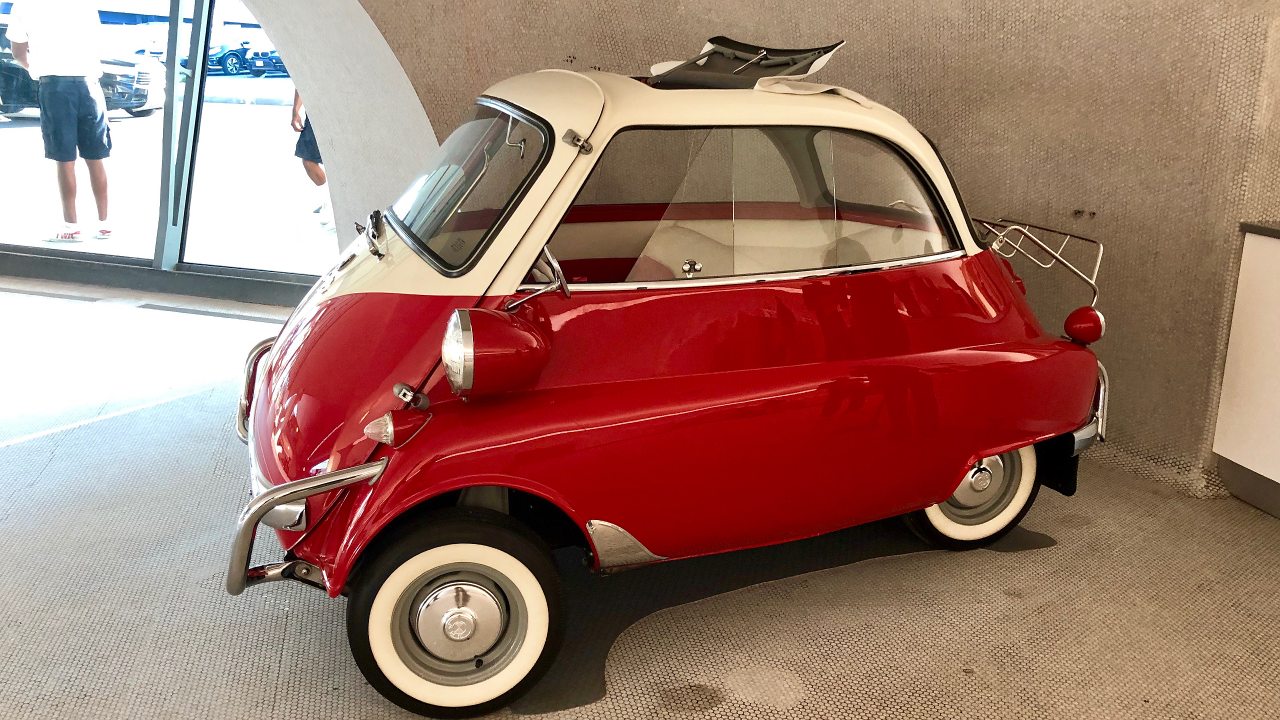
When I look at the 1956 BMW Isetta 300, I see the moment where this oddball concept matured into a product that could genuinely sustain a struggling carmaker. The 300 designation reflected a larger 298 cc engine that gave the car just enough extra power to keep up with urban traffic while still delivering the low running costs that buyers expected. Versions like the 1956 example highlighted by the Audrain Auto Museum, with its Z-bar trim and 298 cc engine, show how BMW was already iterating on the formula to make The Isetta more desirable and usable in everyday life.
That balance of minimalism and just-enough performance mattered because the Isetta was never about speed or the kind of handling that later fed BMW’s “Ultimate Driving Machine” image. Contemporary driving impressions describe it as almost comically far removed from that sporty ideal, yet still charming and surprisingly capable in city use. The 1956 BMW Isetta 300 could squeeze through narrow European streets, park in tiny spaces, and shield its occupants from the weather, all while costing less than a conventional car. Those qualities, documented in museum write-ups of the 1956 BMW Isetta 300 and in modern reflections on how far it sat from the Ultimate Driving Machine ethos, made it the right product at exactly the right time for cash-strapped urban buyers.
Volume, cash flow, and the microcar boom
What saved BMW was not just that the Isetta existed, but that it sold in meaningful numbers during a microcar boom that rewarded exactly this kind of vehicle. Across Europe, Microcars were popular because they used fewer raw materials and offered a cheap path into car ownership, and the BMW Isetta 300 rode that wave. Each unit was relatively inexpensive to build, used a small motorcycle-style engine, and could be assembled in facilities that might otherwise have sat underutilized, which meant every sale helped keep workers employed and money flowing into the company.
As the Isetta range evolved, BMW introduced variants such as the BMW Isetta 250, which used a 247 cc single-cylinder engine before the 300 series took over, showing how the company kept refining displacement and specification to match demand. Reports on BMW Isetta Specs note that after the launch of the BMW Isetta 250, the original bubble car was upgraded from a 247 cc single to larger engines, a progression that helped maintain relevance as expectations rose. Despite quirks like the front door and tiny footprint, these microcars made a big mark in automotive history because they generated the volume and steady income BMW needed while its more ambitious projects were not yet ready to carry the business.
From stopgap oddity to brand-defining icon
At first, The Isetta was treated inside BMW as a stopgap, a way to plug a financial hole while the company figured out its long-term direction. Corporate histories describe how BMW was on the edge of collapse in the mid 1950s, with Motorcycle production declining and luxury models failing to sell, and how The Isetta shifted from emergency measure to symbol of survival. By giving thousands of people their first taste of BMW ownership, the microcar broadened the brand’s audience and proved that the company could adapt quickly to post-war mobility challenges instead of clinging to pre-war assumptions about what a BMW should be.
Over time, that adaptability became part of BMW’s identity, and Today the Isetta 300 is often cited as an early example of the company’s willingness to rethink urban mobility. Modern retrospectives describe the BMW Isetta 300 as an iconic microcar that redefined how people moved through crowded cities and as a product that paved the way for later innovations in compact, efficient vehicles. When I connect those dots, the 1956 BMW Isetta is not just the quirky bubble car that kept the lights on, it is the car that proved BMW could survive by reinventing itself, a lesson that still shapes how the brand approaches new technologies and changing cities.
More from Fast Lane Only: