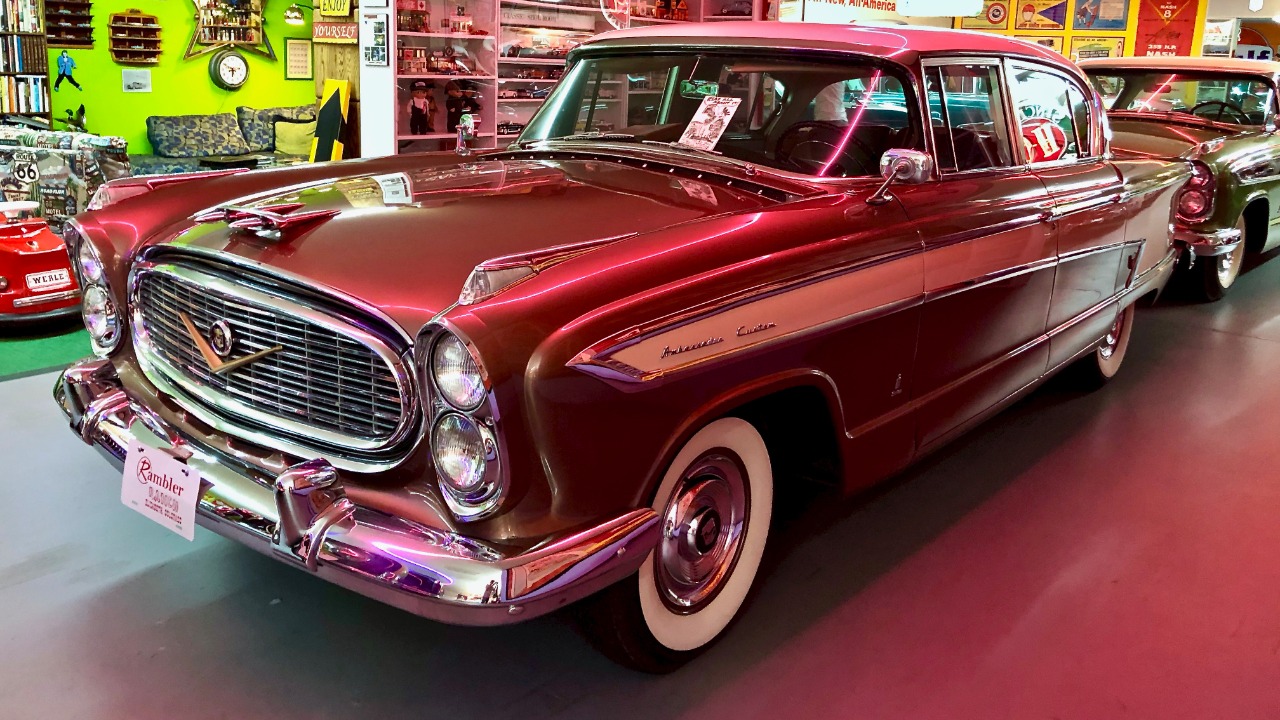
The 1957 Nash Ambassador arrived at a moment when American cars were growing longer, lower, and louder, yet it tried to win buyers with something quieter: the way it slipped through the air. Instead of relying only on chrome and tailfins, Nash leaned into a body that had been shaped for years around airflow, smooth surfaces, and enclosed wheels. The result was a sedan that looked unusual even in its own decade, but that also hinted at how seriously Detroit could treat aerodynamics when a company committed to it.
To understand why that 1957 model pushed so hard on streamlining, I have to look back at how Nash had already spent the decade experimenting with wind-cheating shapes, and how that strategy set it apart from the muscle-first thinking that would soon dominate American roads. The Ambassador’s story is not just about one model year, it is about a small brand trying to out-think bigger rivals by cutting drag instead of simply adding displacement.
From bathtub curves to Farina lines
Long before the 1957 Nash Ambassador appeared, the company had already staked its identity on aerodynamics with the earlier 1950 Nash Ambassador, a car that wrapped its passengers in rounded “bathtub” bodywork and skirted rear wheels in the name of smoother airflow. That earlier Ambassador was so focused on streamlining that it looked almost sealed to the road, a shape that some drivers loved and others mocked, but that clearly treated drag reduction as a design priority rather than an afterthought, as can be seen in period coverage of the 1950 Nash Ambassador. By the middle of the decade, Nash had learned that aerodynamics alone would not sell cars if the styling felt too heavy, yet the company did not abandon the idea that a cleaner shape could make a big sedan more efficient and more stable.
That is where the Italian influence came in. In 1952, the big Nash models were completely restyled around a design by Italian coachbuilder Pinin Farina, who was brought in to refine the body while keeping the brand’s commitment to airflow. The result was a cleaner, more tailored look that still used integrated fenders and relatively smooth sides, but now carried the crisp lines and proportions that buyers expected from European luxury cars. By the time the 1957 Nash Ambassador arrived, it was standing on that foundation, combining the earlier “bathtub” lessons with the sharper, more international profile that Pinin Farina had already given to the large Nash models.
Why Nash bet on airflow instead of brute force

In the second half of the 1950s, Detroit’s biggest names were starting to chase power and spectacle, a path that would soon lead to the Chevel SS454, Pontiac GTO and Dodge Charger RT that made Detroit proud in the muscle era. Those later icons, celebrated in retrospectives of cars like the Chevel, Pontiac GTO and Dodge Charger RT, leaned on big engines and aggressive styling to win over drivers who wanted straight-line speed more than subtle efficiency. Nash, by contrast, had already spent the early part of the decade proving with the 1950 Nash Ambassador that it was willing to sacrifice some conventional beauty for a body that cut through the air more cleanly, and that mindset carried into the 1957 car.
For a smaller player like Nash, that aerodynamic focus was a strategic choice as much as a design quirk. The company could not easily outgun the largest manufacturers on displacement or marketing budgets, but it could offer a sedan that promised quieter cruising, better fuel economy, and a more composed ride at highway speeds thanks to its streamlined profile. The 1957 Nash Ambassador, shaped by the earlier experiments and the Italian Pinin Farina restyle, represented a bet that drivers would eventually value the way a car moved through the air as much as the way it roared away from a stoplight, even if that meant living with a silhouette that looked different from the chrome-heavy competition.
The 1957 Ambassador’s aerodynamic signature
By the time the 1957 Nash Ambassador reached showrooms, its body carried a distinctive mix of curves and creases that made its aerodynamic intent visible from every angle. The front end sat relatively low and rounded, with integrated fenders that avoided the sharp, drag-inducing steps seen on some rivals, while the roofline flowed in a continuous arc toward the rear instead of breaking into a boxy trunk. Even the side glass and pillars were arranged to keep the profile as clean as possible, a continuation of the thinking that had shaped the 1950 Nash Ambassador and then been refined under Pinin Farina’s hand.
Those choices mattered on the road. A smoother nose and a gently tapering tail helped reduce turbulence at highway speeds, which in turn cut wind noise and made the car feel more settled in crosswinds, benefits that owners could feel even if they never used the word “aerodynamics.” The 1957 Ambassador’s design did not chase the wild tailfins and exaggerated chrome spears that were starting to dominate American boulevards, but instead tried to make the air’s path over the car as uninterrupted as possible, a philosophy that would later become standard practice in modern sedans and crossovers.
How the market reacted to Nash’s streamlined gamble
Even with its thoughtful bodywork, the 1957 Nash Ambassador faced a market that was increasingly dazzled by horsepower numbers and flamboyant styling cues. Buyers who would later flock to cars like the Chevel SS454 or Pontiac GTO were already being trained to equate performance with displacement and noise, not with a quiet cabin and a slippery shape. In that environment, the Ambassador’s aerodynamic virtues were harder to sell on a showroom floor than a towering fin or a booming exhaust, and Nash’s message about efficiency and stability struggled to cut through the marketing roar of larger competitors.
Yet the car’s influence outlasted its sales figures. The combination of the 1950 Nash Ambassador’s radical “bathtub” form and the Italian Pinin Farina restyle that shaped the big Nash models in 1952 created a lineage that treated airflow as a core design problem, not a late-stage tweak. The 1957 Ambassador stood at the intersection of those ideas, showing that a mainstream American sedan could be styled around the wind without giving up comfort or presence, and that lesson would echo decades later as automakers of every size learned to chase drag coefficients with the same intensity they once reserved for cubic inches.
Why the 1957 Ambassador still matters to modern eyes
Looking back from today, I see the 1957 Nash Ambassador as a kind of missing link between the rounded experiments of the early postwar years and the wind tunnel driven shapes that define current production cars. Its body is not as radical as the 1950 Nash Ambassador that first pushed the brand into aerodynamic territory, and it is not as clinically optimized as a contemporary electric sedan, but it carries the DNA of both approaches. The car’s smooth front, flowing roofline, and relatively uncluttered sides show a company trying to reconcile style, comfort, and airflow long before drag coefficients became a marketing bullet point.
That is why the Ambassador’s story still feels relevant when I watch enthusiasts celebrate the brute force of the Chevel SS454, Pontiac GTO and Dodge Charger RT or admire the clean Italian lines that Pinin Farina brought to the big Nash models. The 1957 car proves that even in an era obsessed with chrome and cubic inches, there was room for a different kind of innovation, one that treated the invisible currents of air around a car as seriously as the metal and glass you could see. In that sense, the Ambassador did more than just push aerodynamics for its own sake, it quietly previewed the priorities that would eventually reshape the entire industry.
More from Fast Lane Only: