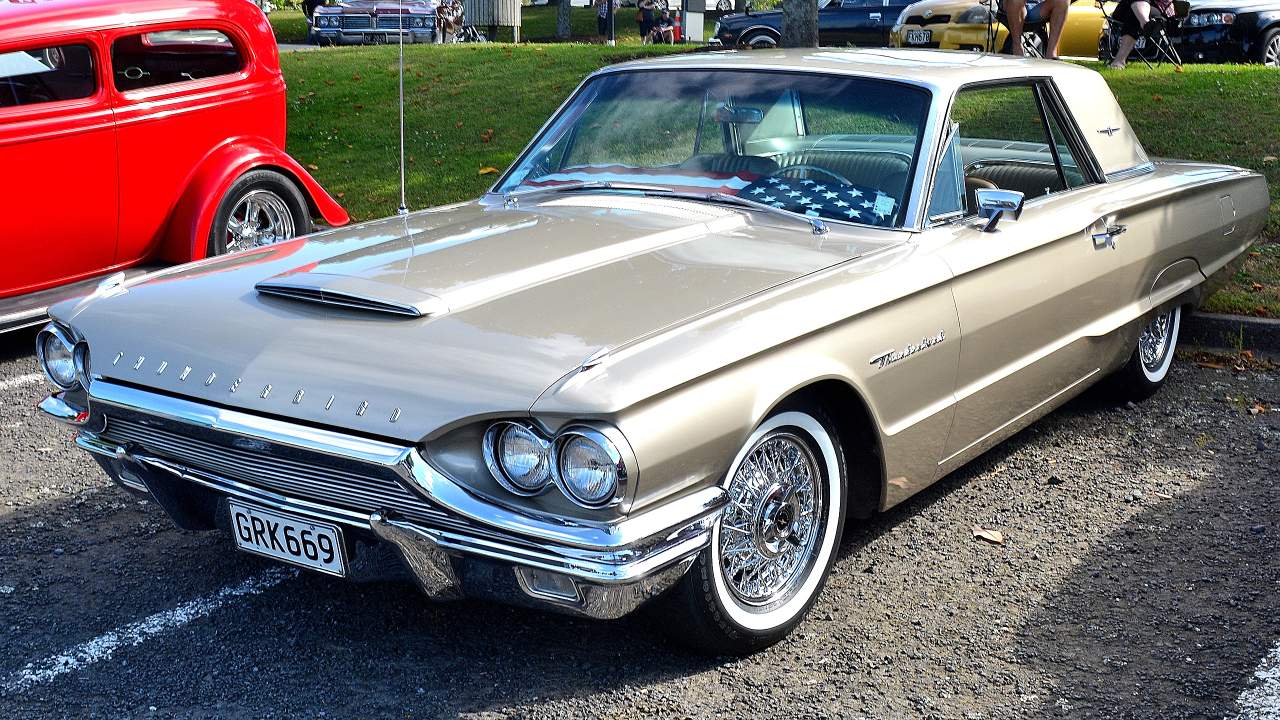
The 1964 Ford Thunderbird arrived at a moment when American drivers were starting to want something more personal than a family sedan but more comfortable than a sports car. With its crisp new body, aviation‑inspired cabin and unapologetically plush ride, it pointed Detroit toward a future where style and comfort mattered as much as raw speed. I see that car as a turning point, the moment when the idea of a “personal luxury car” stopped being an experiment and became a template everyone else would chase.
The moment the Thunderbird grew up
By 1964, Ford had already used the Thunderbird nameplate to test how far it could push the idea of a driver‑focused coupe, but the fourth generation was a clean break. The company reshaped the car into a large personal luxury machine, with the Ford Motor Company moving away from earlier curves in favor of a more squared‑off, formal look that signaled maturity. Instead of chasing sports‑car reflexes, the Thunderbird leaned into presence, turning into the kind of car you bought to make an entrance rather than to set a lap time.
That shift was not just about sheet metal, it was about carving out a new market segment. The fourth‑generation Ford Thunderbird is repeatedly described as a stylish personal luxury car that blended elegance with confident performance on city streets and highways, and that balance is exactly what set it apart. It was not a stripped‑out performance coupe and it was not a chauffeur’s limousine, it was a car for an owner who wanted to drive, be seen and feel indulged at the same time.
Formal styling with a personal edge
What strikes me most about the 1964 model is how deliberately it looks like nothing else in Ford showrooms. The body adopted squared‑off, almost architectural lines, with squared‑off formal styling replacing the softer shapes of the previous generation. The long hood, short deck proportions were still there, but the surfaces were cleaner and more tailored, like a well‑cut suit that had been pressed sharp. That visual discipline helped the car read as upscale without needing excessive chrome or fins.
Details finished the message. Enthusiasts still talk about signature bullet‑shaped taillights and wide, chrome accented grille, which gave The Thunderbird a refined but assertive face. Even in convertible form, the car kept that formal attitude, with the 1964 Ford Thunderbird Convertible presented as a personal luxury statement rather than a beach toy, something closer to a rolling lounge than a simple open‑air cruiser.
A cabin that treated the driver like a pilot
Open the door and the message of personal luxury becomes even clearer. Owners still rave that Inside was a “flight deck” instrument panel meant to evoke jet travel, wrapping around the driver and putting controls within easy reach. That aviation theme was not subtle, it was a promise that you were in command of something sophisticated, a machine that treated you more like a pilot than a passenger.
The seating and controls backed up that promise with real comfort. Reports on the convertible stress that The interior was very well appointed, with a wraparound dashboard, front bucket seats and a steering wheel that could swing aside to ease entry and exit, all aimed at making long road trips feel effortless. That focus on the driver’s experience is exactly what separates a personal luxury car from a standard coupe, and the 1964 Ford Thunderbird Convertible leaned into it so strongly that it still feels modern in concept.
Engineering comfort into the driving experience
Underneath the style, Ford quietly reworked the hardware to match the new mission. Contemporary descriptions note that Suspensions were revised and the power steering ratio reduced to require only three and a half turns lock to lock, while Brakes were power assisted and used a dual‑piston master cylinder feeding the steering linkage. None of that was aimed at track days, it was about making a big car feel manageable and reassuring in daily use, the kind of refinement that quietly wins over buyers who care more about ease than apex speed.
That same philosophy shows up in how the car is remembered. Enthusiasts describing the 1964 Ford Thunderbird talk about a more upscale driving experience, not quarter‑mile times. The car was tuned to glide, to isolate, to make the driver feel looked after, and that approach would become a blueprint for later personal luxury icons from multiple brands.
Flair Birds and the rise of personal luxury
Ford itself seemed to understand that it had created something distinct, which is why the 1964 to 1966 cars picked up the nickname Flair Birds. Those Thunderbirds were described as the most luxurious Thunderbirds to date, a picture of exclusivity and prestige that pushed the car firmly into aspirational territory. When I look at that run, I see a manufacturer using one model line to test how far it could go toward near‑luxury without stepping on its own full‑size sedans.
That experiment helped define a whole category. Accounts of the convertible are explicit that The Thunderbird defined a new market segment, the personal luxury car, and that They were not focused on pure speed but on comfort and style, with other manufacturers following the idea later on. When rivals from General Motors and Chrysler rolled out their own plush coupes, they were essentially responding to a template the 1964 Thunderbird had already drawn.
More from Fast Lane Only: