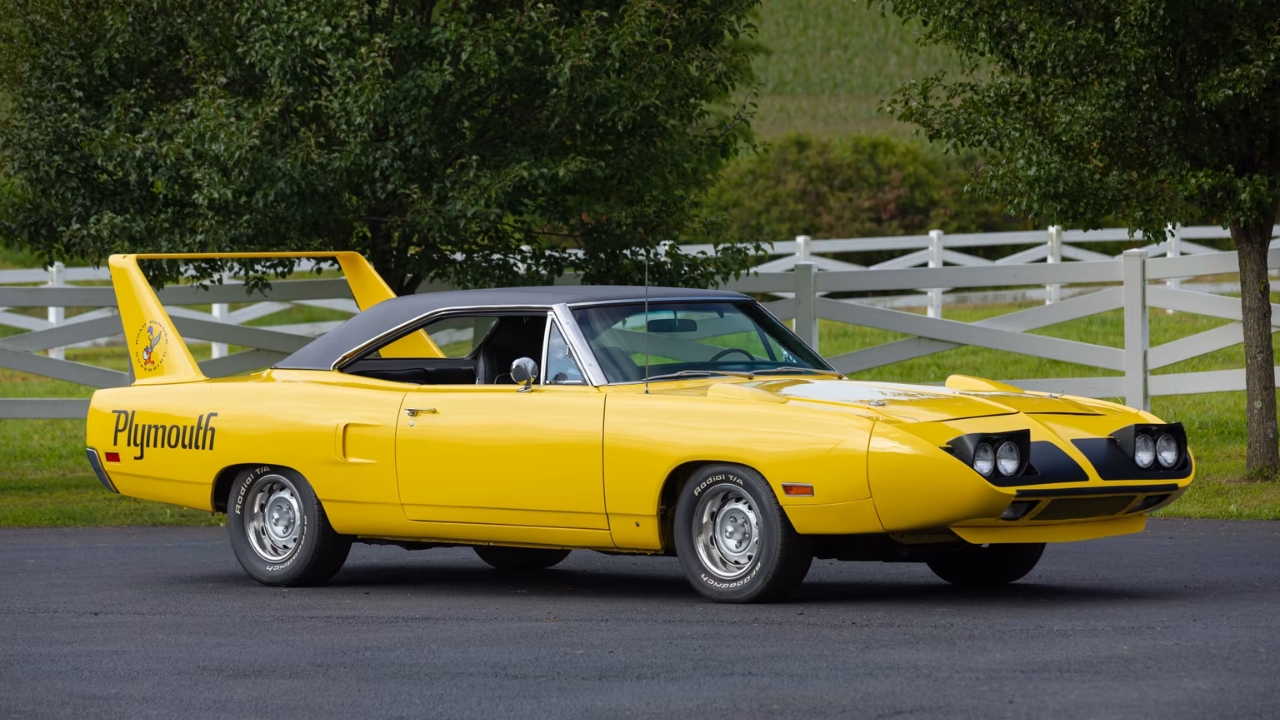
Few production cars have ever looked as outrageous as the 1970 Plymouth Superbird.
Even among the wild styling trends of the muscle car era, the Superbird stood apart. Its pointed aerodynamic nose stretched dramatically beyond the front bumper, while a towering rear wing rose high above the trunk lid. The car appeared less like a typical street machine and more like something that had escaped directly from a race track.
At the time, reactions were mixed.
Some people loved the car’s radical appearance. Others thought Plymouth had gone too far. Even by the standards of 1970, the Superbird looked unconventional, and many buyers struggled to understand why a manufacturer would build something so visually extreme.
The answer was simple.
The Superbird wasn’t styled that way for attention alone.
Every unusual feature served a purpose. The car was created to dominate NASCAR competition, and its dramatic appearance resulted from aerodynamic lessons learned on the race track. What looked excessive on the street actually represented one of the most sophisticated performance engineering programs of the muscle car era.
In other words, the Superbird looked outrageous because it was designed to solve a problem.
And remarkably, it worked exactly as intended.
NASCAR Was Driving Innovation
To understand the Superbird, it’s necessary to understand the racing environment of the late 1960s.
NASCAR competition had become incredibly important for American manufacturers. Success on the track translated directly into showroom credibility, and automakers invested heavily in racing programs. Engineers constantly searched for advantages that could improve speed and consistency on high-speed oval circuits.
Aerodynamics emerged as a critical factor.
As race cars became more powerful, teams discovered that airflow could dramatically influence performance. A vehicle capable of moving through the air more efficiently often enjoyed a significant advantage over competitors, particularly on NASCAR’s fastest tracks.
Chrysler recognized this opportunity earlier than many rivals.
The company began exploring aerodynamic solutions that would eventually lead to some of the most famous race-inspired production cars ever built.
The Superbird was the ultimate result.
It Was Based on the Road Runner
The Superbird did not begin life as an entirely separate model.
Instead, Plymouth used the popular Plymouth Road Runner as the foundation for its aerodynamic special. The Road Runner already possessed strong performance credentials and a well-established reputation among enthusiasts, making it a logical starting point.
Using the Road Runner also helped Plymouth satisfy NASCAR homologation requirements.
At the time, manufacturers generally needed to produce street versions of their specialized racing cars in order to compete. The Superbird therefore existed because Plymouth wanted a race car that could legally participate in NASCAR competition.
The road-going version was essential to that goal.
Without it, the racing program would not have been possible.
The Nose Cone Solved a Real Problem
The Superbird’s most obvious feature was its elongated front nose.
To casual observers, the design looked bizarre. Traditional muscle cars typically featured blunt front ends that emphasized aggression rather than aerodynamic efficiency. The Superbird moved in the opposite direction.
Engineers discovered that airflow around the standard body created drag that limited top-speed potential.
The pointed nose helped air move more smoothly around the vehicle, reducing resistance and improving high-speed stability. While the difference might not have seemed dramatic to street drivers, it mattered enormously during NASCAR competition.
At racing speeds, small aerodynamic improvements could produce meaningful gains.
The nose cone delivered exactly those gains.
Its appearance may have been unusual, but its effectiveness was undeniable.
The Massive Rear Wing Had a Purpose
If the nose cone attracted attention, the rear wing practically demanded it.
Mounted high above the trunk, the wing became one of the most recognizable design elements in automotive history. Its height caused many observers to assume it existed purely for visual drama.
In reality, the wing served a very specific function.
As speeds increased, aerodynamic forces affected vehicle stability. The wing generated downforce, helping keep the rear tires planted more firmly on the racing surface. This improved control and confidence during high-speed driving.
The height of the wing wasn’t arbitrary either.
Engineers positioned it where it could operate in relatively clean airflow above the body. This allowed the wing to function more effectively than it would have if mounted lower.
The design looked extreme because the engineering requirements were extreme.
Function dictated form.
Chrysler Had Already Tested the Formula
The Superbird did not appear out of nowhere.
It built upon lessons learned from the earlier Dodge Charger Daytona, another Chrysler aerodynamic special developed for NASCAR competition. The Daytona demonstrated that radical aerodynamic modifications could produce significant performance advantages.
The results were impossible to ignore.
Chrysler engineers gathered valuable data and refined their understanding of how airflow influenced racing performance. Those insights directly influenced the Superbird’s development.
Rather than starting from scratch, Plymouth benefited from existing experience.
The company already knew the basic formula worked.
The challenge involved refining and applying it effectively.
The Superbird became the next step in that evolution.
High-Speed Performance Improved Dramatically
The true measure of the Superbird’s success was not appearance.
It was performance.
Aerodynamic improvements allowed the car to achieve higher speeds than many conventional competitors. On NASCAR’s fastest tracks, these gains translated into a meaningful competitive advantage.
Drivers noticed the difference immediately.
The car felt more stable at speed, and its ability to maintain momentum on long straightaways made it particularly effective in racing conditions. The aerodynamic package delivered exactly the benefits Chrysler engineers had predicted.
This wasn’t theoretical engineering.
The results appeared on the track.
That success justified the unusual appearance.
The car looked different because it performed differently.
Richard Petty’s Return Added Importance
The Superbird’s development was closely tied to one of NASCAR’s biggest stars.
Richard Petty had left Plymouth after the company initially chose not to produce an aerodynamic race car comparable to the Charger Daytona. Petty believed such a vehicle was necessary to remain competitive.
Plymouth listened.
The Superbird was developed in part to entice Petty back to the brand. The strategy worked. His return gave the car enormous visibility and credibility within the racing world.
The association proved valuable.
When one of NASCAR’s most successful drivers embraced the Superbird, enthusiasts paid attention.
Petty’s involvement became an important part of the car’s legacy.
The Street Version Was a Tough Sell
Ironically, the qualities that made the Superbird effective on the track created challenges in the showroom.
Many buyers admired the car’s performance credentials but found its appearance difficult to embrace. The aerodynamic nose and towering wing were practical for racing purposes but looked unusual on public roads.
As a result, sales were slower than Plymouth hoped.
Some dealers struggled to move inventory, and a number of cars remained unsold for extended periods. Consumers often gravitated toward more conventional muscle cars that offered strong performance without such dramatic styling.
At the time, this seemed like a disadvantage.
Decades later, it would become part of the car’s appeal.
Collectors Eventually Understood
As the years passed, enthusiasts gained a deeper appreciation for the Superbird.
What once seemed excessive began to look visionary. Collectors recognized that the car represented a rare example of genuine racing technology influencing production-car design. The unusual styling was no longer viewed as a flaw.
Instead, it became a badge of authenticity.
Every strange-looking component existed for a reason. The car’s appearance reflected engineering priorities rather than marketing trends.
That distinction matters.
The Superbird wasn’t pretending to be a race car.
It essentially was one.
The Car That Made Aerodynamics Impossible to Ignore
The Superbird helped demonstrate the growing importance of aerodynamics in automotive design.
Although later vehicles would integrate aerodynamic principles more subtly, the basic lesson remained the same. Airflow matters. Stability matters. Efficiency matters.
The Superbird simply made those lessons impossible to miss.
Its dramatic appearance served as a visible reminder of the power of engineering.
The car looked unusual because it was solving real problems.
That honesty remains one of its most appealing qualities.
Outrageous by Design
Looking back, it’s easy to see why the Superbird continues attracting attention.
The nose cone, giant wing, and race-inspired details make it one of the most recognizable American performance cars ever built. Yet the visual drama tells only part of the story.
Every unusual feature existed because engineers believed it would improve performance.
More importantly, they were right.
The Muscle Car That Backed Up Its Looks
The 1970 Plymouth Superbird looked outrageous but worked because its radical styling was driven by function rather than fashion.
Created to improve NASCAR performance, the car used advanced aerodynamic solutions that reduced drag, increased stability, and helped Chrysler compete at the highest levels of stock-car racing. Its pointed nose and towering rear wing may have seemed excessive, but both delivered measurable results where it mattered most.
More than fifty years later, the Superbird remains one of the most fascinating cars of the muscle car era.
Not because it looked different.
Because it proved that looking different could make a real difference.
And few cars have ever demonstrated that more dramatically.
More from Fast Lane Only