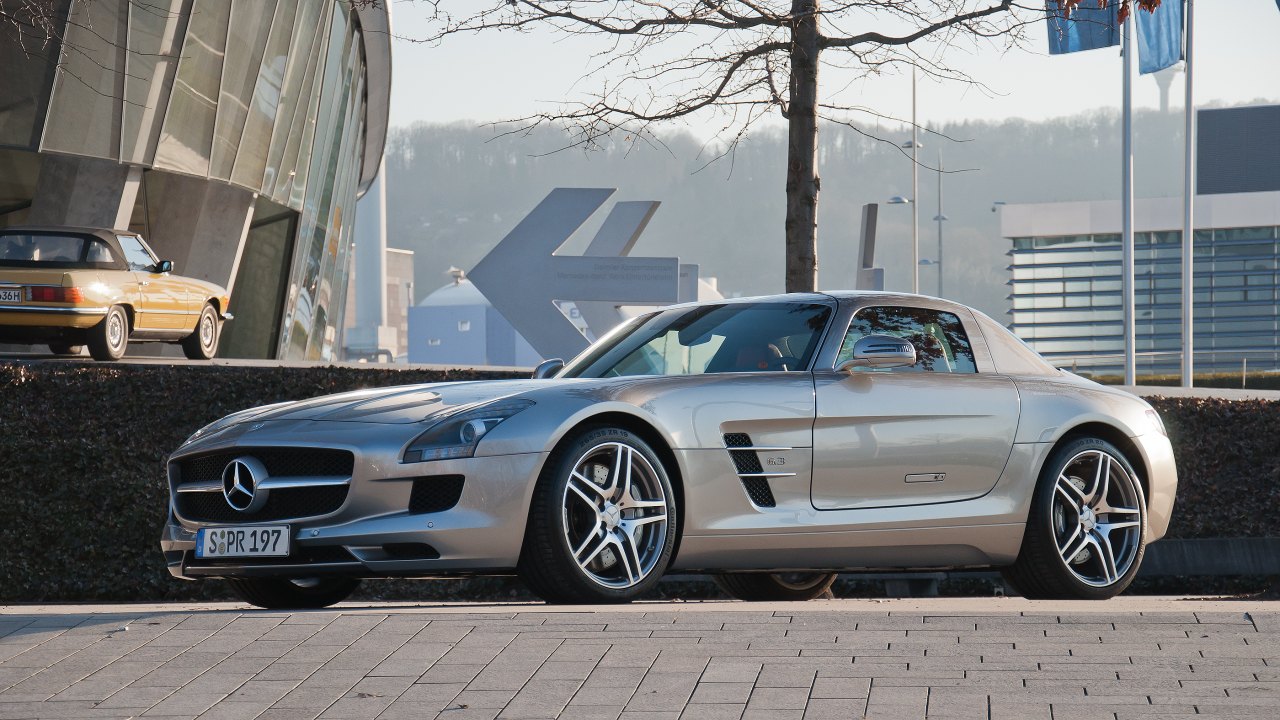
The 2012 Mercedes-Benz SLS AMG was conceived as more than a flagship supercar. It was engineered and styled as a modern salute to one of the most important sports cars in history, the Mercedes-Benz 300 SL, while proving that a heritage-inspired design could still feel cutting edge. By blending retro cues, serious motorsport credentials, and everyday usability, it managed to honor a legend without becoming a museum piece on wheels.
That balance is why the SLS AMG has already slipped into “modern classic” territory, with collectors and enthusiasts treating it as a spiritual successor to the 300 SL and a benchmark for how a brand can revisit its past. The 2012 model year, in particular, crystallized the formula with both coupe and roadster variants, high profile racing success, and even a world record stunt that underlined its status as a halo car.
Reviving the 300 SL story for a new era
From the start, the SLS AMG was framed as a direct link to the original 300 SL, the car that made gullwing doors a Mercedes-Benz signature. Contemporary coverage described it as a “spiritual successor” to the Mercedes-Benz 300 SL and a realistic successor to later icons from the brand, positioning it as “pure elegance” that would likely gain value over time. That connection was not accidental: the proportions, the long hood and short tail, and the dramatic doors on the coupe were all deliberate callbacks to the 300 SL, a car whose “iconic gullwing doors” trace back to racing engineering in the 1950s.
Design voices around the project reinforced that intent. According to an AMG spokesman, the SLS was presented as a modern-day interpretation of its forebear, a car that looked to the past but added an “ultra-modern twist” in its technology and execution. Later commentary in a Modern Classics Episode described The Mercedes Benz SLS AMG Is a Great Tribute To The Legendary 300, underlining how clearly enthusiasts saw the lineage. By the time social media retrospectives were calling the SLS a vision that “felt instantly timeless” from the moment Mercedes showed it, the car’s role as a bridge between eras was firmly established.
A bespoke AMG flagship built from the ground up
What made the SLS more than a styling exercise was the way AMG used it to showcase its engineering independence. Origins and Model Name The SLS Mercedes Benz are tied to the fact that it was the first car entirely designed and built in-house by AMG, rather than a tuned version of an existing Mercedes platform. That clean-sheet approach allowed the team to chase a “perfect union of sportiness and luxury,” with a front mid-engine layout, rear transaxle, and extensive use of lightweight materials to deliver both performance and refinement.
Under the hood, the 2012 SLS AMG Roadster shared its heart with the Coupe, using the same naturally aspirated 6.2-liter AMG-designed power unit that revs to 7,200 RPM, producing 563-horsepower and a thick band of torque. Automotive testers highlighted how the motor was placed up front in a North/South, mid-mount orientation, with power sent to the rear wheels through a rear-mounted transmission, which helped balance the car’s long nose and abbreviated tail. Financial and collector analyses later noted that Mercedes went on to build about 12,000 SLS AMG models for global markets over five years, with roughly one third of those as roadsters, a relatively low production run that supports its emerging status as a future classic.
From road to racetrack: proving its legend in competition

A tribute car only earns real credibility if it can perform, and the SLS AMG did that in both showroom and race trim. Road tests of the 2012 SLS AMG Roadster described it as the “evolution of a legend,” noting that when the SLS AMG coupe arrived it practically became an instant classic thanks to its combination of brutal acceleration and surprisingly usable manners. Reviewers pointed to its ability to feel like a “monster rocket” while still being well adapted for city driving, a balance that helped it stand apart from more compromised exotics.
On track, the SLS AMG GT3 program turned the car into a fixture in international GT racing. Reports on Mercedes Benz SLS AMG customer teams in 2012 detailed how the GT3 version took victories in highly competitive series such as the ADAC GT Masters, including a first win in the final race of that season. The same year, the SLS AMG also served as an official F1 safety car, sharing duties with an AMG estate medical car that used a 6.3-liter V8, which placed the gullwing in front of a global audience at every Grand Prix start. That combination of customer racing success and high profile safety car duty reinforced the idea that this was not just a nostalgic design, but a fully fledged performance flagship.
Engineering theater: stunts, records, and media moments
Mercedes and AMG understood that legends are built as much in the public imagination as on spec sheets, and the SLS AMG became the centerpiece of some carefully staged feats. In one widely reported stunt, Formula 1 legend and AMG brand ambassador David Coulthard used a 2012 Mercedes Benz SLS AMG to catch a golf ball in motion, setting a world record for catching a speeding golf ball with a car. The spectacle underlined both the car’s stability at high speed and its role as a technological showpiece for the brand.
The SLS also became a media favorite. Video reviews such as the one by Joe Ready of Rady’s Rides, filmed at Ferrari Tampa Bay, leaned into the car’s drama, from the sound of its big V8 to the way it delivered its power. Other enthusiast content, including a Friday Drive segment that described an SLS AMG Gwing as an “exquisite” experience, helped cement its image as a dream car even for fans of rival brands. One BMW-focused commentator went so far as to admit that a favorite car to drive was a Mercedes Benz SLS AMG, noting that there was “just something so special” about the way it felt when it first came out, a telling endorsement from outside the Mercedes faithful.
Why the 2012 model year stands out as a modern classic
By 2012, the SLS AMG range had matured into a complete statement of what a modern tribute car could be. The coupe had already established itself as a design icon, and the arrival of the roadster gave buyers a second way to experience the same core package. Contemporary road tests of the 2012 Mercedes Benz SLS AMG Roadster described it as a “sure classic,” pointing to its front mid-engine layout, rear transaxle, and luxurious yet focused cabin as ingredients that would age well. Pricing and specification guides from that year framed the SLS as a supercar that combined timeless style, exhilarating performance, and luxurious comfort, whether specified as a hardtop or convertible, which helped cement its place as a modern classic in the eyes of the market.
Collector-focused coverage has since reinforced that view. Commentators like Derek Shaky, speaking for the Collector Car Network while walking around an SLS at a Bar auction setting, have explicitly framed the 2012 SLS AMG as “honoring a legend,” while market analysts describe it as “pure elegance” that is expected to only gain value in the coming years. Model overviews that look back on the SLS era emphasize that Mercedes and AMG built about 12,000 units worldwide, a relatively modest figure for a global halo car, and that the mix of coupe and roadster, plus the GT3 and safety car stories, give the 2012 examples a particularly rich narrative. Taken together, the heritage design, bespoke engineering, competition pedigree, and carefully cultivated mythmaking explain why the 2012 Mercedes-Benz SLS AMG did more than nod to the 300 SL legend, it successfully carried that story into a new century.
More from Fast Lane Only: